
Your needs, this model
Does it fit your priorities?
Does RP-1200-4G meet an eight-bay, 10GbE and two-drive mirror screen?
The exact selector and TS-x77XU guide list eight SATA trays, two 10GbE SFP+ ports and a QTS RAID 1 option. The RP-1200-4G starts with a Ryzen 3 1200 and 4 GB; disks and a configured mirror are not included. Confirm exact drive compatibility and current support before use.
Explore this need in the finder →Is this configuration the same as RP-2600-8G?
No. The RP-1200-4G is a four-core/four-thread Ryzen 3 1200 with 4 GB installed; RP-2600-8G is a six-core/twelve-thread Ryzen 5 2600 with 8 GB. The bay and RP PSU profile are shared, but the compute and memory configurations differ.
Explore this need in the finder →Does the rack package include rails or disks?
QNAP’s family guide says no drives are included and lists RAIL-B02 separately. Confirm actual seller contents and current support for the exact unit.
Explore this need in the finder →Scope: RP-1200-4G, not the faster RP sibling
This review covers the QNAP TS-877XU-RP-1200-4G configuration linked from a U.S. Official Store card. The item path carries an “-US” suffix, but the descriptive card does not independently establish the full seller SKU; QNAP’s exact selector labels the hardware TS-877XU-RP-1200-4G. Its hardware selector identifies an AMD Ryzen 3 1200 and 4 GB of DDR4 UDIMM memory, paired with the RP chassis and redundant supplies. Do not merge it with RP-2600-8G: that package uses a different CPU and twice the installed memory. It also differs from non-RP TS-877XU-1200-4G in power hardware. QNAP labels this configuration Legacy. This is a source-based review, not hands-on testing or a claim that a seller currently has it available.
Eight SATA positions with a single-port 10GbE ceiling
The system provides eight 3.5-inch SATA trays and QNAP lists compatible 2.5-inch SATA hard drives and SSDs as tray media. QNAP’s family guide says disks are not included. The network layout is two 10GbE SFP+ SmartNIC ports and two 1GbE RJ45 ports. For the finder, the highest single built-in port is 10Gbps; the SFP+ ports do not combine into one 20Gbps link. A switch or direct connection, optics/DAC, client adapter, storage design and workload all need to suit that rate.
The 2U platform exposes four PCIe slots with lane widths that vary by slot. These can make network or storage expansion possible, but add-in fit is conditional and should be planned from the card specification and the actual chassis layout. QNAP’s guide also lists four USB 3.2 Gen 1 ports and two faster Gen 2 Type-A/Type-C ports. None of those interfaces makes an unsupported drive or card compatible.
Entry configuration and the limits of the available evidence
QNAP specifies a four-core/four-thread Ryzen 3 1200, 3.1 GHz base and 3.4 GHz turbo, plus 4 GB installed memory. The selector lists four DDR4 UDIMM slots and a 64 GB maximum. QNAP’s older family guide prints “LDIMM” for the slots, which conflicts with the exact selector’s “UDIMM” wording. Confirm the qualified memory type and firmware for the actual unit before buying an upgrade. Do not infer that the CPU or base memory is suitable for a particular virtualization or iSCSI workload from the processor name alone.
For storage compatibility, search each proposed disk’s full model code, capacity and firmware in QNAP’s current list. No exact drive row was independently verified for this profile, so this review makes no blanket approval. The complete tray count is eight; a mirror consumes two selected positions, leaving six for other drives.
Redundant power needs a separate deployment plan
QNAP lists two 300 W hot-swappable supplies for the RP configuration. They are the practical difference from the standard TS-877XU-1200-4G, which has one 350 W supply. Redundant supplies are useful only when the wiring and electrical design make them independent enough to matter; they are not a substitute for a separate backup or resilient storage plan. The chassis is 2U and roughly 22 inches deep. RAIL-B02 is the named rail kit, but QNAP says rails are sold separately. Check cabinet depth, post compatibility, rear clearance, service access, loaded weight and cooling.
Mirror setup, backup and legacy status
QTS documents RAID 1 for the family. A buyer can create a two-drive mirror with compatible media, but neither a pair of drives nor a configured pool is established by the Store label. RAID 1 can continue through one member-drive failure in a healthy pair; it does not preserve a second copy against accidental deletion, malware or the loss of the NAS. Keep an independent backup and test restoring important files.
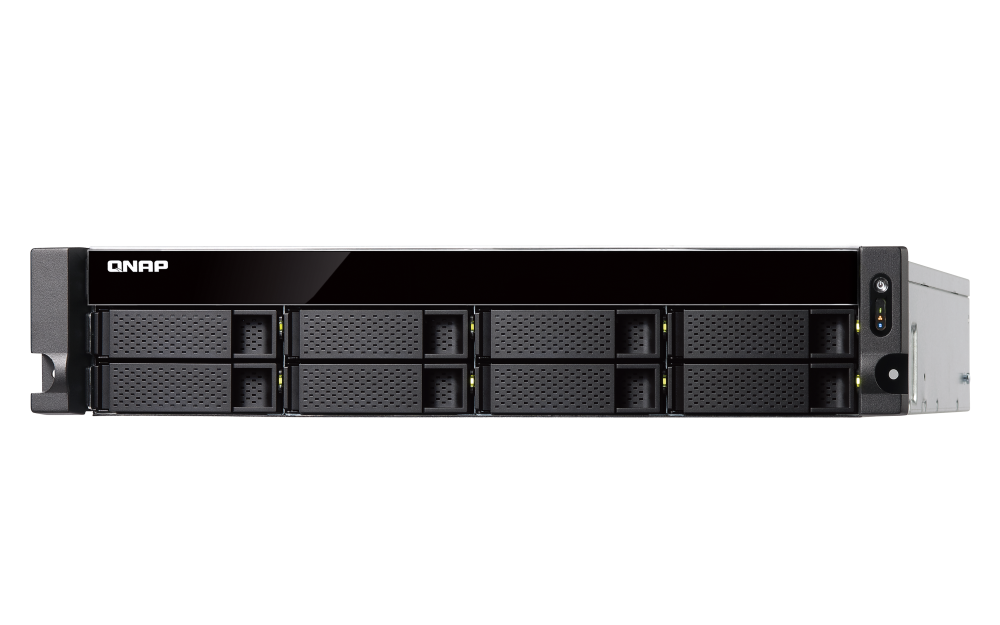
Use this model only if its exact 4 GB / Ryzen 3 / RP identity is acceptable and current software, support, parts and warranty are confirmed for the particular unit. For a new system, compare a current-reference 8-bay platform rather than treating an old rack NAS as a new production recommendation. The model photo shows the chassis only and does not reveal the installed processor, memory or redundant power modules.
Primary references
- QNAP TS-877XU-RP U.S. page and exact RP hardware selector
- QNAP software selector
- QNAP TS-x77XU User Guide, English-U.S.
- QNAP drive compatibility lookup
Key specifications
Key details at a glance
| Internal drive bays | 8 bays |
|---|---|
| Documented internal drive media | 3.5-inch SATA HDD / 2.5-inch SATA HDD (maximum 9.5 mm tray height) / 2.5-inch SATA SSD (maximum 9.5 mm tray height) |
| Built-in Ethernet ports | 2 x 10GbE SFP+ SmartNIC / 2 x 1GbE RJ45 |
| Fastest individual Ethernet port | 10 Gbps |
| Installed system memory | 4 GB |
| Maximum listed memory | 64 GB |
| Listed storage arrangements | RAID 1 |
| Dimensions (H × W × D) | {'height': 88.3, 'width': 482, 'depth': 562} |
| Weight | 12.17 kg |
| Data drives included in listed package | No |
| Processor | AMD Ryzen 3 1200 |
| CPU cores | 4 |
| CPU threads | 4 |
| Installed memory type | DDR4 UDIMM; current QNAP selector lists four UDIMM slots. |
Use the exact model’s instructions for operating limits, supplied equipment and version differences.
Sources for this review
Sources for this assessment

Check your setup before choosing a NAS
Use the finder to narrow documented desk/shelf or rack formats, internal-bay minimums, a single Ethernet-port rating and optional redundancy requirements.