
Your needs, this model
Does it fit your priorities?
Does the standard 1200-4G profile meet an eight-bay, 10GbE and mirror screen?
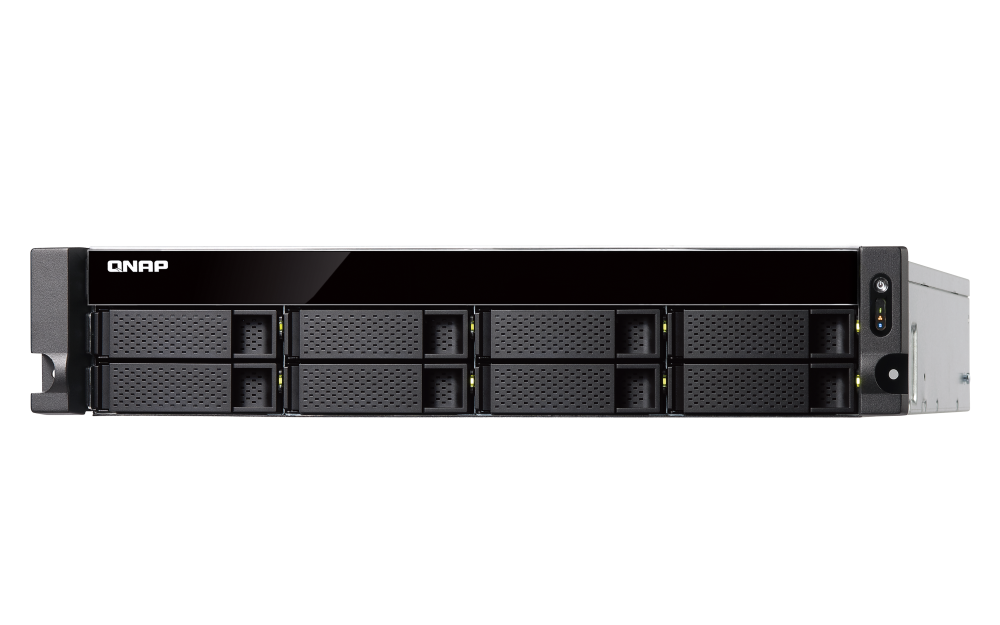
The exact standard selector and family guide list eight SATA trays, two 10GbE SFP+ ports and QTS RAID 1. This package uses a Ryzen 3 1200, 4 GB memory and one 350 W supply. Drives and a mirror are not included; the standard PSU is not redundant.
Explore this need in the finder →How is it different from TS-877XU-RP-1200-4G?
Both use a Ryzen 3 1200 and 4 GB, but the reviewed non-RP model has one 350 W supply; RP-1200-4G has two 300 W redundant/hot-swap supplies. Check the suffix and rear hardware before purchase.
Explore this need in the finder →Are disks or rails supplied?
QNAP’s guide says the unit ships without disks and lists RAIL-B02 as a separately purchased compatible rail kit. Confirm actual offer-specific contents and support.
Explore this need in the finder →Scope: the standard TS-877XU-1200-4G
This review covers the QNAP TS-877XU-1200-4G configuration linked from a U.S. Official Store card. The item path carries an “-US” suffix, but the descriptive card does not independently establish a full seller SKU; QNAP’s exact selector labels the hardware TS-877XU-1200-4G. It is an eight-bay 2U NAS with a Ryzen 3 1200, 4 GB memory and one standard power supply. It is not RP-1200-4G despite sharing CPU and base memory, nor either RP-2600/8G profile. QNAP labels this configuration Legacy. This is an evidence-based review of published documentation, not a hands-on setup or performance test and not a statement about current stock.
Eight SATA bays and built-in 10GbE
QNAP lists eight 3.5-inch SATA trays and support for compatible 2.5-inch SATA hard drives or SSDs. The guide says the unit ships without drives. Its two 10GbE SFP+ SmartNIC connections are individual ports; the two additional RJ45 jacks are 1GbE. A nominal 10Gbps network path depends on the switch or direct connection, cabling/optics, client adapter, storage layout and workload, so the port rating is not a promise of transfer speed.
The system is 2U, about 22 inches deep before allowances for ears and the protruding power supply. QNAP names RAIL-B02 but does not include rails in the stated package. Check actual rack post range, cabinet depth, service clearance, loaded weight and airflow before installing it. The platform offers four PCIe slots with different lane widths; expansion needs a card-by-card fit and compatibility check rather than relying on the raw number of slots.
The standard PSU is the key difference from RP
The non-RP configuration has one 350 W supply. The RP-1200-4G instead has two 300 W supplies with redundancy/hot-swap. This is not a CPU or bay-count upgrade: it changes power resilience and the rear hardware. A single-supply NAS cannot keep running through failure of its only PSU, and a second supply in the RP model only helps if the rack power arrangement is designed appropriately. Match the full suffix on the unit label and written order; a family-level TS-877XU name is not enough to verify redundant power.
Entry CPU and memory require realistic expectations
The Ryzen 3 1200 is a four-core/four-thread processor listed at 3.1 GHz base and up to 3.4 GHz turbo. The exact selector lists 4 GB of DDR4 UDIMM and four slots with a 64 GB maximum. An older guide spells the slot type “LDIMM,” conflicting with the selector’s UDIMM field; confirm QNAP-qualified memory for the exact unit before attempting an upgrade. The 4 GB base profile may be a constraint for memory-heavy applications. No CPU workload benchmark is inferred from a vendor clock rating.
QTS documents RAID 1 for the family. A two-drive mirror is an owner-created plan using two selected, compatible SATA drives; the chassis is not described as arriving with drives or a prepared pool. A mirror consumes two of eight trays and yields roughly one drive’s capacity before overhead. It may tolerate one member-drive failure while healthy, but it is not a backup. Keep independent copies and verify that restores work.
Drive, expansion and lifecycle checks
Before buying media, check the exact drive model, capacity and firmware in QNAP’s live compatibility list. This review did not establish a named supported disk. Verify PCIe cards, rack rails, firmware availability and system support with QNAP and the seller for the specific unit. QNAP’s Legacy designation means this is a historical comparison profile, not an endorsed current deployment. Ask for a written configuration and service/support terms; do not infer included disks, add-in cards or rails from a product image or descriptive Store card.
Who might still compare it?
This configuration can be useful as a reference point when comparing the same-generation RP model: the native bays, CPU and network profile are similar, while the single 350 W PSU is not redundant. For a new rack installation, a current-reference NAS with clearly documented support and a current drive list is easier to assess. The exact standard suffix, the sole power supply and the legacy lifecycle label should stay visible in any shortlist rather than being hidden under a generic eight-bay family entry.
Primary references
- QNAP TS-877XU U.S. page and exact standard hardware selector
- QNAP software selector
- QNAP TS-x77XU User Guide, English-U.S.
- QNAP drive compatibility lookup
Key specifications
Key details at a glance
| Internal drive bays | 8 bays |
|---|---|
| Documented internal drive media | 3.5-inch SATA HDD / 2.5-inch SATA HDD (maximum 9.5 mm tray height) / 2.5-inch SATA SSD (maximum 9.5 mm tray height) |
| Built-in Ethernet ports | 2 x 10GbE SFP+ SmartNIC / 2 x 1GbE RJ45 |
| Fastest individual Ethernet port | 10 Gbps |
| Installed system memory | 4 GB |
| Maximum listed memory | 64 GB |
| Listed storage arrangements | RAID 1 |
| Dimensions (H × W × D) | {'height': 88.3, 'width': 482, 'depth': 562} |
| Weight | 10.99 kg |
| Data drives included in listed package | No |
| Processor | AMD Ryzen 3 1200 |
| CPU cores | 4 |
| CPU threads | 4 |
| Installed memory type | DDR4 UDIMM; current QNAP selector lists four UDIMM slots. |
Use the exact model’s instructions for operating limits, supplied equipment and version differences.
Sources for this review
Sources for this assessment

Check your setup before choosing a NAS
Use the finder to narrow documented desk/shelf or rack formats, internal-bay minimums, a single Ethernet-port rating and optional redundancy requirements.