
Your needs, this model
Does it fit your priorities?
Do the two M.2 sockets make this a ten-bay SATA NAS?
No. QNAP's exact hardware selector identifies eight front 3.5-inch SATA positions and two separate M.2 2280 NVMe positions. The M.2 sockets may support cache or SSD-pool uses, but do not add native SATA bays and are not hot-swappable when built into this chassis. The current selector lists 2.5-inch SATA SSDs; the 2022 guide also lists 2.5-inch SATA hard drives, so check the exact drive and firmware in QNAP's compatibility data before ordering.
Explore this need in the finder →Can the TS-873AeU-4G-US make a two-drive mirror?
Yes, as a buyer-created setup under QTS: QNAP's current eight-bay QTS table lists RAID 1. Choose QTS, confirm two compatible drives, install them and create the array; the standard package does not include disks or a prepared pool. RAID 1 can help with one member-drive failure, but it does not protect against deletion, malware, theft or loss of the NAS, so plan a separate backup.
Explore this need in the finder →Do its two built-in 2.5GbE ports provide one 5-Gbps connection?
No. Each jack is an individual 2.5GbE interface. QNAP describes 5GbE Port Trunking across links, but that is not one 5-Gbps connection to a single client and does not guarantee file-transfer speed. For a faster single-link requirement, budget an exact compatible PCIe adapter and verify the switch, client, cabling, drives and workload as one path.
Explore this need in the finder →Does the non-RP TS-873AeU have the same power resilience as the RP model?
No. The exact TS-873AeU-4G profile has one 250 W supply and one listed power cord; the distinct TS-873AeU-RP-4G profile has two 300 W supplies. This non-RP version may be the better fit when a second chassis PSU is not required, but a single supply is not redundant. Also verify the correct rail: QNAP's current product text names RAIL-S01, its accessory list includes RAIL-B02 and other options, and its 2022 guide names RAIL-B02; no rail is listed in the package.
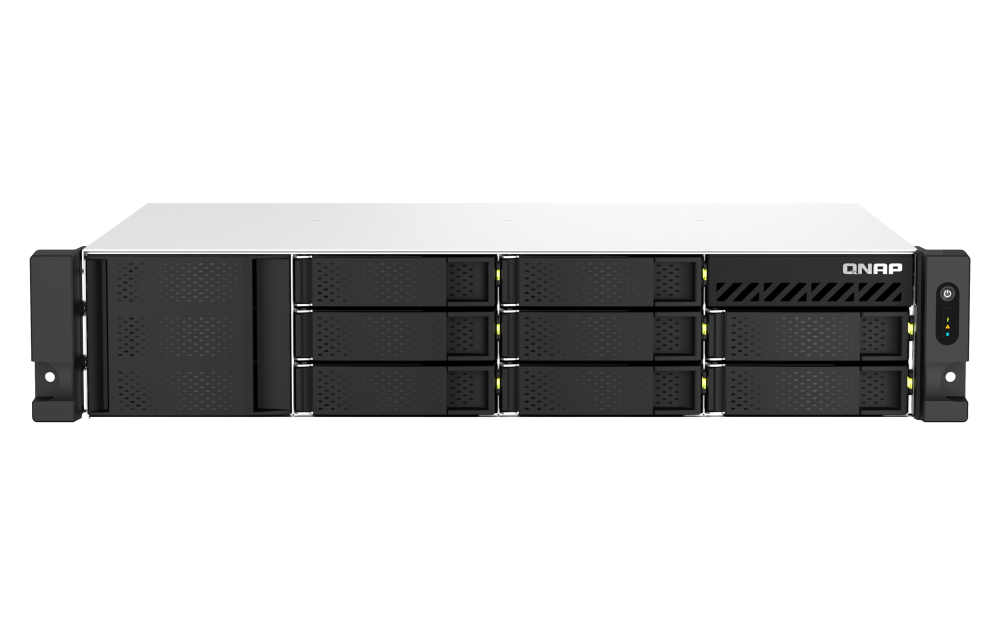
Explore this need in the finder →The TS-873AeU-4G-US is an eight-bay, short-depth rack NAS for a small office, studio or branch that needs real internal disk positions without filling a deeper rack. The suffix matters: this is the non-RP 4 GB configuration, with one 250 W power supply. It is not the separately reviewed TS-873AeU-RP-4G-US, whose redundant supply arrangement is a material hardware difference. QNAP's U.S. Official Store page identifies the exact “-4G-US” SKU; the active U.S. product page and hardware selector identify the underlying TS-873AeU-4G profile. Those sources support a current-reference assessment, not a promise that a particular seller has stock or will supply the manufacturer's standard contents unchanged.
Eight SATA bays, not ten
QNAP lists eight front 3.5-inch SATA bays, with 3.5-inch SATA hard drives and 2.5-inch SATA solid-state drives in its current U.S. compatibility summary. The two M.2 2280 PCIe Gen3 x1 positions are separate NVMe sockets for uses such as caching or an SSD pool. They do not turn the system into a ten-bay SATA chassis, and the built-in M.2 drives are not hot-swappable. The older TS-x73AeU family guide also lists 2.5-inch SATA hard drives, a difference from the current selector's listed drive-media types. QNAP's current family compatibility response names separate 3.5-inch HDD, SATA SSD and M.2 SSD entries with model, capacity, interface and firmware fields; some model labels use wildcards, so check the whole row and exact firmware rather than inferring support from a family name. There is no separate 2.5-inch-HDD category in that response, but that omission does not establish support or non-support. Confirm any planned 2.5-inch HDD with QNAP before buying a large set of disks or trays.
Eight bays are useful when capacity growth, a multi-disk array or a workload with separate storage roles matters more than minimizing the NAS itself. But a bay count is only a physical ceiling. The enclosure ships without HDDs, so actual raw and usable capacity depends on the drives chosen, their size and the storage layout. A two-drive RAID 1 mirror uses two of those positions and gives up one drive's nominal capacity to mirror the other; it does not protect against accidental deletion, malicious encryption, theft or the loss of the entire NAS. Budget a disconnected or otherwise separate backup and test restoration rather than treating the extra bays or snapshots as another copy.
Use the network rating as a link limit
The base system has two individual 2.5GbE RJ45 ports. Either one meets a 2.5-Gbps minimum for a single built-in link; neither is a built-in 5-Gbps port. QNAP describes 5GbE Port Trunking across the two interfaces, but aggregation does not make one faster connection between the NAS and one client, and it does not guarantee actual file-copy speed. The whole path still depends on the client interface, switch or router, cable, protocol, storage layout and concurrent workload.
There is one PCIe Gen3 x8 slot, and QNAP lists optional networking cards that can provide faster links. That is an expansion route, not an included feature: identify a card that QNAP supports for this precise NAS and operating system, check its physical length and bracket clearance, and confirm the receiving devices and cabling before planning around a 10- or 25-GbE link. The current selector lists four USB 3.2 Gen 2 ports (two Type-A and two Type-C), but USB expansion or M.2 cards should not be assumed to coexist freely in the one PCIe slot.
QTS is ready at 4 GB; QuTS hero changes the setup
The exact 4 GB selector profile lists an AMD Ryzen Embedded V1500B processor, 4 GB DDR4 SODIMM, two memory slots and a 64 GB maximum. It supports ECC memory, with QNAP advising an identical pair for dual-DIMM ECC use. The current software table identifies QTS 6.1.0 and lists RAID 1 for an eight-bay NAS, so a two-drive mirror is a documented option when the buyer chooses QTS and configures it after installing compatible disks.
QNAP's family page also says the TS-873AeU supports QuTS hero, its ZFS-based OS, but that choice is not equivalent to selecting a menu item on the stock 4 GB unit: QNAP says QuTS hero requires at least 8 GB RAM, recommends 16 GB or more for heavier use, and notes that switching from QTS requires removing the drives because the filesystems differ. A buyer interested in QuTS hero should confirm supported memory, the intended storage plan and migration implications first. This review's matcher assessment uses the exact QTS/EXT4 arrangement, not an assumed QuTS hero configuration. No storage pool, data drive, added RAM or prepared mirror is claimed to arrive in the box.
Short depth still needs rack planning
At 11.71 inches deep in QNAP's current listed body dimensions, this is a notably compact 2U chassis for a cabinet with limited front-to-back room. The same selector gives 3.49 inches high and 17.01 inches wide, explicitly excluding the rack ear hooks and the protruding portion of the power supply; the older family manual lists 3.5 × 18.98 × 11.71 inches and a lower net weight. Width can reflect whether ears are included, but the published net weights differ, so verify the actual mounting envelope and loaded rack weight rather than treating the figures as interchangeable. Include the rail, rack-post depth, airflow, cable bend room and enough access to service drives and fans in the installation plan.
Rail guidance also differs across QNAP material. The current product-page text names the optional RAIL-S01 short rail, the exact hardware accessory list includes RAIL-B02, marks RAIL-S01 as end-of-life and also lists RAIL-S02, while the 2022 guide identifies RAIL-B02. The current family compatibility response names all three models, but their description fields are blank; it does not resolve which rail is right for this exact U.S. configuration or rack. The family manual says the rail kit is purchased separately. That is a purchase check, not a detail to guess from the words “short depth”: confirm the current rail-to-rack fit for the post depth and delivered chassis before ordering.
One supply is the key non-RP tradeoff
The exact hardware profile lists a single 250 W supply and one power cord. This simpler power arrangement is the clearest reason to choose the non-RP chassis only when a second internal supply is not a requirement. A second PSU can support a different resilience design, but even the RP version would not itself provide a UPS, a protected circuit or proof of independent power feeds. If one supply fails, this non-RP model has no second chassis PSU to take over; plan site power and replacement procedures accordingly.
The standard package selector lists the NAS, an Ethernet cable, one power cord, drive screws and a quick installation guide. It does not list drives, rails or a PCIe network adapter. QNAP describes a three-year standard warranty, but the buyer should check the written U.S. coverage and seller's bill of materials for the exact SKU. Vendor-published throughput figures for the model family use stated lab components and include a TS-873AeU (-RP) label; they are not independent test results and do not establish real-world performance for this package.
Who should compare the RP version
This 4G-US profile is a practical candidate when eight native SATA slots, an 11.7-inch-deep 2U footprint, a documented QTS mirror and two individual 2.5GbE ports fit the plan—and the rack can be installed around a single PSU. Compare the RP sibling if a second internal supply is essential, but make the exact suffix the first check: do not select the non-RP model on the basis of the shared front view, bay count or family name. Neither configuration substitutes for tested backups, a validated drive list, compatible rails or a complete network path. The evidence supports those setup questions; it does not substitute for a hands-on performance review.
Key specifications
Key details at a glance
| Internal drive bays | 8 bays |
|---|---|
| Documented internal drive media | 3.5-inch SATA HDD / 2.5-inch SATA SSD |
| Built-in Ethernet ports | 2 x individual built-in 2.5GbE RJ45 |
| Fastest individual Ethernet port | 2.5 Gbps |
| Installed system memory | 4 GB |
| Maximum listed memory | 64 GB |
| Listed storage arrangements | QTS 6.1.0 / EXT4: current exact eight-bay software table lists RAID 1 / QTS 6.1.0 / EXT4 also lists RAID 5, RAID 6, RAID 10, RAID 50 and RAID 60 for eight bays |
| Internal file systems | EXT4 (QTS 6.1.0) / ZFS (QuTS hero, after required memory upgrade and OS reinitialization) |
| Hardware warranty | 3 years |
| Data drives included in listed package | No |
| M.2 NVMe slots | 2 |
| Processor | AMD Ryzen Embedded V1500B |
| CPU cores | 4 |
| CPU threads | 8 |
| Installed memory type | DDR4 SODIMM |
Use the exact model’s instructions for operating limits, supplied equipment and version differences.
Sources for this review
Sources for this assessment
- QNAP U.S. Tower / SMB product grid — TS-873AeU card
- TS-873AeU — QNAP U.S. product page
- TS-873AeU-4G — QNAP U.S. hardware selector
- TS-873AeU-4G — QNAP U.S. software selector
- TS-873AeU — QNAP U.S. package contents selector
- TS-x73AeU User Guide, Version 1 (2022-03-28)
- QNAP U.S. Official Store short-depth category — exact SKU row
- TS-873AeU-4G-US — QNAP U.S. Official Store item identity
- QNAP U.S. TS-873AeU versus TS-873AeU-RP comparison
- QNAP TS-873AeU official product-page front image
- QNAP Official Compatibility List — current TS-873AeU family response

Check your setup before choosing a NAS
Use the finder to narrow documented desk/shelf or rack formats, internal-bay minimums, a single Ethernet-port rating and optional redundancy requirements.