
Your needs, this model
Does it fit your priorities?
Does the RP label provide drive redundancy?
No. RP means the listed two 300W power supplies. QNAP documents a separate two-drive RAID 1 option that the owner must create; neither power redundancy nor a drive mirror is a backup.
Explore this need in the finder →What is the memory-profile distinction?
The comparison exposes 4GB in this selector. It also exposes a separate 8GB or 4GB sibling profile; do not treat the U.S. Store 8G-US SKU as a confirmed 4GB package. QuTS hero has an 8GB minimum, so the 4GB profile needs a supported upgrade first.
Explore this need in the finder →Can I rely on one rack-depth number?
No. QNAP’s current comparison and older English-U.S. guide report materially different chassis dimensions and weight. Verify the exact hardware revision, rail model, rack-post depth, loaded weight, cabling, airflow and service clearance in writing before installation.
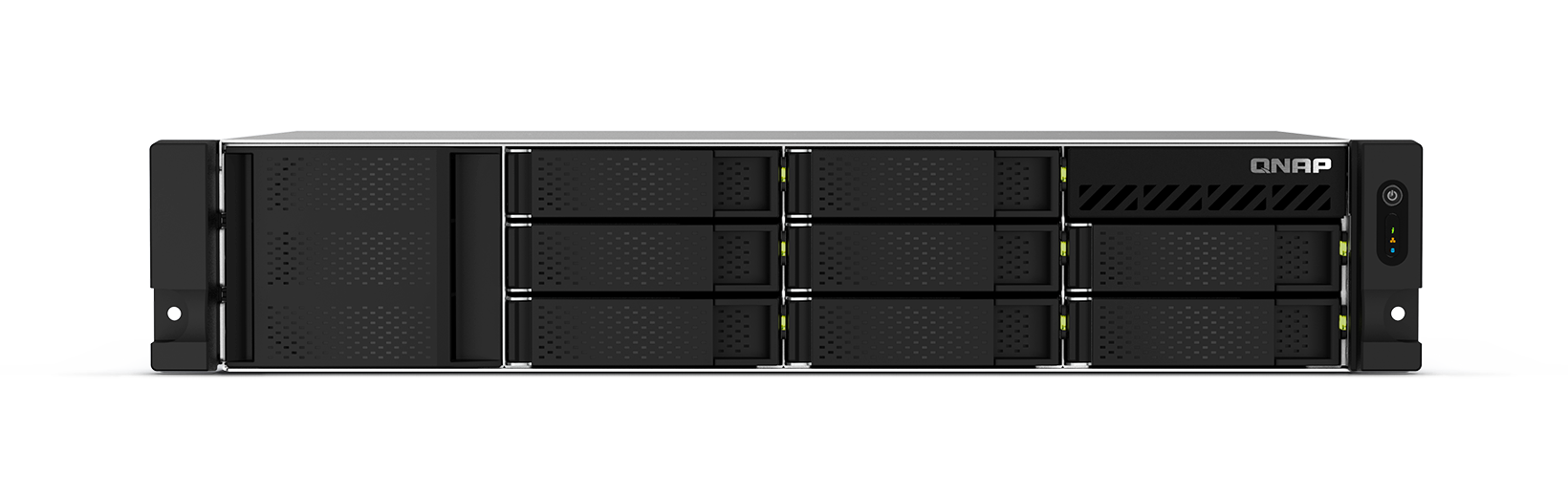
Explore this need in the finder →The TS-864eU-RP-4G is QNAP’s 4GB selector configuration of the eight-bay short-depth rack NAS with redundant power supplies. QNAP’s current U.S.-language hardware comparison exposes this 4GB selector and its 8GB counterpart; the English-U.S. family guide also lists TS-864eU-RP-4G as an ordering P/N. However, no exact current U.S. Store -4G-US package was established in this review. The exact Store listing captured for the RP chassis is the separate TS-864eU-RP-8G-US. Keep those identities distinct and do not treat a broad search result as an exact 4GB seller package.
Redundant PSU is not a redundant disk layout
The RP difference is two 300W power supplies in QNAP’s current comparison, versus a single 300W unit in the standard TS-864eU. The older guide also assigns two supplies and two power cords to the RP 4G P/N. This can matter where a rack has separate protected feeds and the administrator has a plan to monitor the second supply. The guide’s cord count is documentation for the 4G configuration, not a guarantee of the contents of a 4G seller’s box; no exact current Store package for it was confirmed.
Power redundancy does not create a drive mirror. QNAP marks RAID 1 as supported for the model family, and QTS documentation describes a two-disk mirror that the owner has to create. It may reduce risk from one failed member drive, but it is not protection from file deletion, malicious encryption or loss of the complete NAS. Arrange an independent backup and test a restore. If you only have one mains feed, the RP suffix may not deliver the operational benefit you expect.
Memory is the limiting difference for QuTS hero
The 4G selector lists 4GB installed and a 16GB maximum in QNAP’s hardware comparison. QNAP’s 2022 English-U.S. manual describes two DDR4 SODIMM slots for the family and advises using compatible QNAP memory modules; verify current part support before changing the installed memory. QNAP says QuTS hero requires at least 8GB RAM. The documented 4GB package is therefore below that floor as configured; QTS is the default plan. Reaching a minimum for an alternate OS requires a supported memory change and a migration that protects existing data. Inline data deduplication has a higher 16GB minimum, with QNAP recommending more for optimal use.
CPU identity also deserves a package check. The current QNAP U.S. product page names an N5095, while the older English-U.S. guide table groups N5105/N5095 family variants. The precise CPU for a selector-only 4GB seller item should not be inferred from the family name alone. Verify the complete unit label and current selector state before buying for a processor-specific workload. No performance testing or virtualization-capacity claim is made here.
Plan for eight SATA bays and one expansion slot
QNAP lists eight 3.5-inch SATA positions and supported 3.5-inch HDDs and 2.5-inch SATA SSDs. Drives should be checked by exact model and firmware. M.2 devices are not built-in slots; QNAP describes them as an optional PCIe-adapter addition. The chassis has one PCIe Gen 3 x2 slot, so a QM2/M.2 card competes with a 5GbE/10GbE network adapter or USB expansion card. Two 2.5GbE ports are built in, but they are separate links; link aggregation is not a promise of a single faster connection or an application benchmark.
Resolve the physical-data conflict before installation
QNAP’s current comparison gives the RP column 88.6 × 432 × 297.4mm and 20.3lb. The older English-U.S. guide gives 88.6 × 482.14 × 346.43mm and 7.9kg (17.42lb) for the RP 4G model. Those are materially different width, depth and weight values. The model page points to optional RAIL-S01 short-depth rails, while the earlier manual names RAIL-B02. Do not select a rail or calculate rack load from a single number. Confirm the exact chassis revision, mounting-depth range, front/rear service clearance and compatible rails with QNAP and the seller; no rail inclusion is asserted here.
Who should consider this reference profile?
It belongs on a comparison list if eight bays, a short-depth rack format and redundant PSU hardware are requirements, and the buyer is prepared to verify a matching 4GB package’s exact CPU, memory and seller suffix. It is not the right match if the installed 4GB configuration must run QuTS hero without an upgrade, if the rack dimensions need to be exact before procurement, or if “RP” is being mistaken for RAID. For a currently captured U.S. retail configuration, QNAP lists the 8G-US version separately; its memory and package claims must not be copied onto this 4G selector profile.
Key specifications
Key details at a glance
| Internal drive bays | 8 bays |
|---|---|
| Documented internal drive media | 3.5-inch SATA hard disk drives / 2.5-inch SATA solid-state drives |
| Built-in Ethernet ports | 2 x built-in 2.5GbE RJ45 |
| Fastest individual Ethernet port | 2.5 Gbps |
| Installed system memory | 4 GB |
| Maximum listed memory | 16 GB |
| Listed storage arrangements | QTS: RAID 1 (two drives) |
| Internal file systems | QTS: EXT4 / QuTS hero: ZFS |
| Hardware warranty | 3 years |
| M.2 NVMe slots | 0 |
| Processor | Intel Celeron N5095 |
| CPU cores | 4 |
| CPU threads | 4 |
| Installed memory type | 4GB DDR4 as specified for this selector profile |
Use the exact model’s instructions for operating limits, supplied equipment and version differences.
Sources for this review
Sources for this assessment

Check your setup before choosing a NAS
Use the finder to narrow documented desk/shelf or rack formats, internal-bay minimums, a single Ethernet-port rating and optional redundancy requirements.