
Your needs, this model
Does it fit your priorities?
Does the RP label provide drive redundancy?
This non-RP profile lists one 300W supply. A separate owner-created two-drive RAID 1 arrangement is documented, but that mirror is not backup.
Explore this need in the finder →What is the memory-profile distinction?
The comparison exposes 8GB in this selector. It also exposes a separate 8GB or 4GB sibling profile; do not treat the U.S. Store 8G-US SKU as a confirmed 4GB package. QuTS hero has an 8GB minimum, so the 4GB profile needs a supported upgrade first.
Explore this need in the finder →Can I rely on one rack-depth number?
No. QNAP’s current comparison and older English-U.S. guide report materially different chassis dimensions and weight. Verify the exact hardware revision, rail model, rack-post depth, loaded weight, cabling, airflow and service clearance in writing before installation.
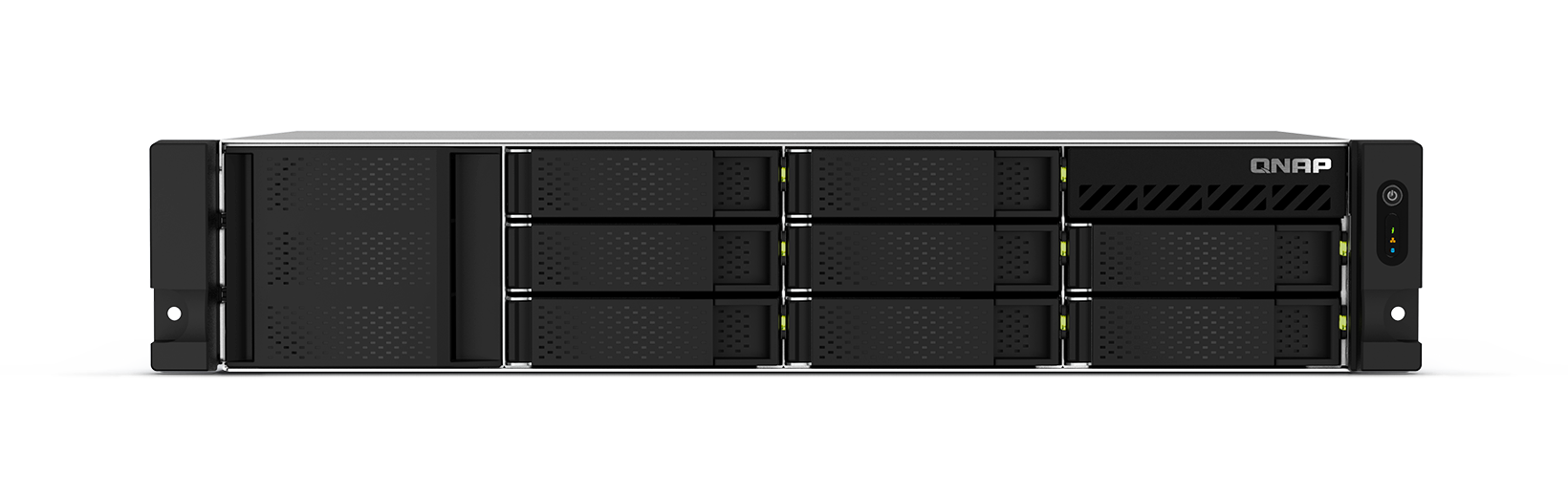
Explore this need in the finder →The TS-864eU-8G-US is the non-redundant-power version of QNAP’s compact eight-bay rack NAS. Its appeal is a fairly specific one: eight front SATA positions in a short-depth 2U chassis, two built-in 2.5GbE ports, and a single PCIe expansion slot. The US Store item page and QNAP’s selector identify the 8GB configuration. This is a research-based reading of QNAP’s current product material, not a hands-on test or a promise about performance in a particular rack or network.
Eight native SATA positions, not an eight-drive package guarantee
QNAP lists eight 3.5-inch SATA bays and compatibility with 3.5-inch SATA hard drives and 2.5-inch SATA solid-state drives. The trays are the internal bay count; optional M.2 storage is not built into the chassis. QNAP describes M.2 as an option through a PCIe adapter, so adding NVMe storage would use the same expansion slot that could otherwise serve a network or USB card. Check the exact drive model and firmware against QNAP’s compatibility list instead of treating a supported media class as proof that every capacity or disk is accepted.
The captured official item identifies TS-864eU-8G-US but does not settle every possible offer’s contents. Confirm whether the seller’s exact package is diskless or a separately identified drive bundle, and do not assume a storage pool is already created. If you install two compatible SATA drives, QTS documents RAID 1; that mirror uses roughly one drive’s capacity before formatting overhead and needs to be created by the owner. It helps with one member-drive failure, but it is not a second backup copy.
A 2.5GbE path with a single expansion decision
The chassis has two 2.5GbE RJ45 ports. A single port is the relevant ceiling for a one-port requirement: the two ports do not become one guaranteed 5Gbps connection merely because link aggregation or trunking is available. The switch, client, cabling, storage and workload all affect real transfer rates. QNAP lists one PCIe Gen 3 x2 slot for optional adapters, including faster Ethernet cards, a QM2 card, or a USB expansion card. Those are alternatives, not a set of capabilities supplied simultaneously. If you need a 10GbE card and NVMe cache, check whether the exact adapter and workload can coexist without a second slot; this chassis has only one.
The current QNAP page names an Intel Celeron N5095 four-core/four-thread processor with burst frequency up to 2.9GHz. That is a specification, not a benchmark. QTS is the default operating system. QNAP also describes switching to QuTS hero on this family starting with QTS 5.2.2. The 8GB selector profile meets QNAP’s stated 8GB minimum for QuTS hero, but inline data deduplication has a higher 16GB minimum and QNAP recommends more memory for that use. QTS and QuTS hero are alternatives, not simultaneous file systems; changing between them requires reinitialization, so protect data elsewhere first.
Measure the rack instead of trusting a single dimension
The product page describes a short-depth rack design and points to an optional RAIL-S01 kit. The current QNAP comparison gives 88.6 × 432 × 297.4mm and 17.15lb for the non-RP column. The older English-U.S. TS-x64eU guide lists 88.6 × 482.14 × 318.13mm and 6.68kg (14.73lb) for the 4G non-RP model. These figures conflict, and the older guide names RAIL-B02 rather than the product page’s RAIL-S01. Do not use one source’s depth, width, weight or rail name as a clearance guarantee for this 8G-US package. Confirm the exact revision, rack opening, front/rear clearance, rail compatibility and loaded rack weight with QNAP and the seller before installation. Rails are not established as included.
Who should shortlist it?
It is a plausible paper fit when eight internal positions and a 2.5GbE link matter more than native M.2 sockets, multiple PCIe slots or redundant power. The 8GB starting configuration offers more memory headroom than the earlier 4GB selector profile, but buyers should still verify the exact part and memory limits rather than planning around an assumed upgrade. A separate backup target, compatible drives, a supported rail solution and enough ventilation remain part of the setup. QNAP states a three-year standard warranty on the Store listing; confirm the written regional terms for the exact sale.
Before purchase, compare the full TS-864eU-8G-US suffix, not just “TS-864eU”; check whether any included drives are named by exact model; verify the physical revision and rack kit; and decide whether QTS or QuTS hero is appropriate before initializing drives. These checks matter more than an aggregate link-rate headline or a vendor performance figure that does not reproduce your own setup.
Key specifications
Key details at a glance
| Internal drive bays | 8 bays |
|---|---|
| Documented internal drive media | 3.5-inch SATA hard disk drives / 2.5-inch SATA solid-state drives |
| Built-in Ethernet ports | 2 x built-in 2.5GbE RJ45 |
| Fastest individual Ethernet port | 2.5 Gbps |
| Installed system memory | 8 GB |
| Maximum listed memory | 16 GB |
| Listed storage arrangements | QTS: RAID 1 (two drives) |
| Internal file systems | QTS: EXT4 / QuTS hero: ZFS |
| Hardware warranty | 3 years |
| M.2 NVMe slots | 0 |
| Processor | Intel Celeron N5095 |
| CPU cores | 4 |
| CPU threads | 4 |
| Installed memory type | 8GB DDR4 as specified for this selector profile |
Use the exact model’s instructions for operating limits, supplied equipment and version differences.
Sources for this review
Sources for this assessment

Check your setup before choosing a NAS
Use the finder to narrow documented desk/shelf or rack formats, internal-bay minimums, a single Ethernet-port rating and optional redundancy requirements.