
Your needs, this model
Does it fit your priorities?
How many native drive positions does the exact TS-855X-8G-US profile have?
QNAP's English-U.S. guide identifies eight native SATA positions: six larger 3.5-inch bays and two 2.5-inch SATA SSD-only bays. The two M.2 NVMe sockets are separate and do not add native SATA bays. Confirm each intended drive model and firmware against the current QNAP compatibility list; the package list does not include data drives.
Explore this need in the finder →Does the base profile meet a 10.5-Gbps minimum for one built-in Ethernet port?
No. QNAP lists one built-in 10GBASE-T port as its fastest individual Ethernet port, plus two 2.5GbE ports. A 10.5-Gbps floor exceeds the documented base port. Optional PCIe networking is a separate card and cannot be counted as built-in; the rest of the network path also limits realized transfers.
Explore this need in the finder →Can an owner configure a documented two-drive mirror on this NAS?
Yes, as a setup choice: QNAP lists RAID 1 for the eight-bay profile under QTS and QuTS hero. Choose compatible drives and one OS, then create the pool; QNAP's package list contains no data drives or prebuilt array. A mirror is not an independent backup.
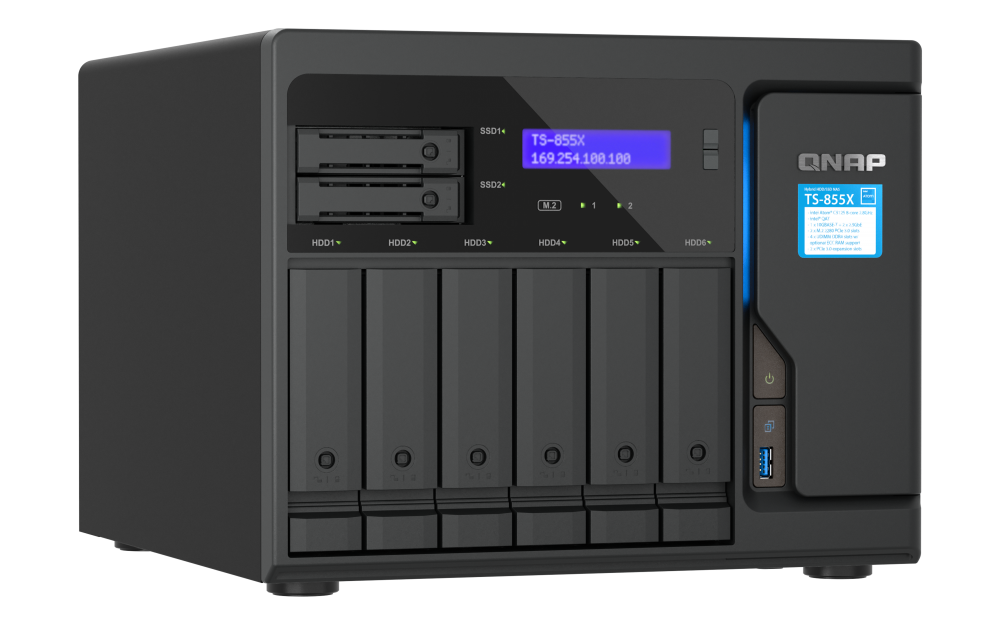
Explore this need in the finder →The QNAP TS-855X-8G-US is a tower NAS with eight native SATA positions and a built-in 10GBASE-T port. Its trays are not interchangeable: six take 3.5-inch SATA hard drives or 2.5-inch SATA SSDs; the two smaller bays are for 2.5-inch SATA SSDs only. This is a document-based assessment of QNAP's U.S. model, guide and exact Store identity—not a hands-on test or a claim about current seller stock.
Eight positions, but two bay types
The two M.2 2280 NVMe sockets are a separate layer for cache or a QuTS hero system drive, not extra front SATA bays. M.2 SSDs are not standard equipment; QNAP recommends cooling them with suitable heatsinks. If the goal is eight large HDDs, this six-plus-two media layout is a mismatch.
Media types are not an exact compatibility list. Verify each full drive model and firmware against QNAP's current compatibility list for this NAS before ordering. No specific HDD, SATA SSD or M.2 drive-and-firmware row was confirmed for this review. A published interface type alone is not approval for every capacity, firmware revision or operating mode.
The built-in 10GbE port is the key distinction
The network mix is two 2.5GbE RJ45 ports plus one 10GBASE-T port. One built-in port is rated at 10 Gbps, but not above 10 Gbps; a 10.5-Gbps minimum is outside the documented base profile. The switch, client NIC, cable, drives and workload must also support the intended path. QNAP discusses multichannel use of the two 2.5GbE ports, but that does not promise a combined rate for one ordinary client flow.
Two PCIe Gen 3 x4 slots allow optional expansion, including QNAP-listed network cards up to 25GbE. Those cards are additional purchases, occupy slots and need an exact model/card-fit check; they do not change the base system's built-in-port rating. For a buyer who requires native 10GbE, the onboard port is more direct than planning a card. For one who needs a built-in port above 10GbE, this model does not meet that condition.
Choose QTS or QuTS hero before creating storage
QNAP lists QTS with EXT4 as the standard profile and QuTS hero with ZFS as an alternative. The U.S. software selector lists RAID 1 under both. A two-drive mirror is an owner-created setup: choose compatible drives and one OS, then create the pool. The package is not a prebuilt array and contains no data drives. RAID 1 can help with one member-drive failure while healthy; it is not a separate backup.
The 8 GB base memory reaches QuTS hero's stated minimum, but not the threshold for every feature. QNAP says inline deduplication requires at least 16 GB and recommends 32 GB for optimal performance. The 8 GB non-ECC DDR4 UDIMM profile has four slots and a listed 128 GB maximum; ECC memory is supported, but QNAP warns against mixing ECC and non-ECC modules. Check supported memory before budgeting for virtual machines or heavier software use.
Package and physical checks
The English-U.S. guide lists the NAS, power cord, two 1GbE Cat 5e cables, tray keys, drive screws, two M.2 heatsinks and quick-start guide. It does not list data drives, an array, upgraded memory or a 10GbE cable. Treat this as the manufacturer's standard list, then confirm the exact TS-855X-8G-US seller bill of materials. The guide specifies a single 250 W power supply, tower form and three-year standard warranty; seller-added coverage is separate.
There is a material document discrepancy for close installations: the U.S. selector lists 22.13 lb and slightly different dimensions than the English-U.S. guide, which lists 18.74 lb and 224.8 × 292.7 × 319.8 mm. I have not selected one weight as correct. Confirm the exact revision, feet clearance and weight with QNAP if a shelf or lift limit is close. Leave room for airflow; the manufacturer lists a 0–40°C operating range.
Where it sits in QNAP's line
Compared with the TS-1655-8G-US, this model has half as many native positions—six 3.5-inch bays and two SSD-only bays versus twelve plus four—but adds one built-in 10GBASE-T port where the TS-1655 lists two 2.5GbE ports. The systems also differ in PCIe and M.2 specifications, so do not carry a drive or card assumption across them. Decide whether higher native-bay count or built-in 10GbE matters more for the actual installation.
QNAP says availability and support extend up to 2030; this does not prove current reseller stock or future parts supply. Its published lab transfer results use specified test configurations, not this reviewer's test or a forecast for a different drive and network setup. No independent noise, heat, power, reliability or throughput result is claimed here.
Who should investigate it further
Investigate this profile if eight positions are enough, the two smaller SSD bays are useful, and a built-in 10GbE port matters. It is a poor fit if you need nine native bays, eight large HDD trays, a built-in port above 10 Gbps or a ready-populated mirror. Exact drive-and-firmware support and seller contents still need checking. No unit was installed, owned, acoustically measured or performance-tested for this assessment.
Key specifications
Key details at a glance
| Internal drive bays | 8 bays |
|---|---|
| Documented internal drive media | 3.5-inch SATA hard disk drives in 3.5-inch bays / 2.5-inch SATA solid-state drives in 3.5-inch bays / 2.5-inch SATA solid-state drives in 2.5-inch bays |
| Built-in Ethernet ports | 2 x built-in 2.5GbE RJ45 ports / 1 x built-in 10GBASE-T RJ45 port |
| Fastest individual Ethernet port | 10 Gbps |
| Installed system memory | 8 GB |
| Maximum listed memory | 128 GB |
| Listed storage arrangements | QTS: RAID 1 listed for the eight-bay-and-larger class / QuTS hero: RAID 1 listed for the eight-bay-and-larger class |
| Internal file systems | EXT4 (QTS alternative) / ZFS (QuTS hero alternative) |
| Hardware warranty | 3 years |
| Data drives included in listed package | No |
| M.2 NVMe slots | 2 |
| M.2 SSD storage-pool support | Yes |
| Processor | Intel Atom C5125 |
| CPU cores | 8 |
| Installed memory type | 8 GB non-ECC DDR4 UDIMM (one 8 GB module in the TS-855X-8G profile) |
Use the exact model’s instructions for operating limits, supplied equipment and version differences.
Sources for this review
Sources for this assessment
- QNAP U.S. Tower/SMB grid — TS-855X family card
- TS-855X — QNAP U.S. product page
- TS-855X hardware selector — QNAP U.S.
- TS-855X software selector — QNAP U.S.
- TS-855X User Guide, English (U.S.)
- TS-855X-8G-US — QNAP U.S. Official Store identity
- QNAP U.S. Official Store SMB Desktop page 4 — TS-855X-8G-US card
- QNAP compatibility list — general drive selection policy
- TS-855X manufacturer product rendering — QNAP U.S.

Check your setup before choosing a NAS
Use the finder to narrow documented desk/shelf or rack formats, internal-bay minimums, a single Ethernet-port rating and optional redundancy requirements.