
Your needs, this model
Does it fit your priorities?
How many internal SATA drive positions does the TS-832PXU-RP-4G profile provide?
QNAP lists eight native 3.5-inch SATA bays and lists 3.5-inch SATA HDDs, 2.5-inch SATA HDDs and 2.5-inch SATA SSDs as supported media classes. The guide package does not include data drives. Verify each exact drive model and firmware in QNAP's compatibility information; the optional PCIe M.2 adapter does not add another native SATA bay.
Explore this need in the finder →Can one built-in network port meet a 10-Gbps minimum?
Yes, by nominal interface rating: QNAP lists two 10GbE SFP+ ports and two 2.5GbE RJ45 ports. The 10GbE connection is SFP+, not a 10GBASE-T jack. Check compatible transceiver/DAC, switch or peer, client NIC and cabling; the port rating does not predict file-copy throughput.
Explore this need in the finder →Can the owner choose a two-drive mirror?
QNAP's QTS table lists RAID 1 for eight-bay systems, and its RAID guide describes a two-member mirror. The owner supplies two compatible SATA drives, selects QTS RAID 1 and creates the pool; no drives or prepared array are established in the standard package. RAID 1 is not a second backup copy.
Explore this need in the finder →Are rails, data drives and full rack clearances covered by the model identity?
No. The English guide package list does not include data drives or rails and names RAIL-B02 as separately purchased. QNAP's current hardware dimensions exclude ear hooks and protruding PSU parts, while the guide reports a different full-chassis envelope and weight. Check exact delivered contents, rack/post depth, rail fit, rear cable bend, cooling and loaded rack capacity before relying on a listing.
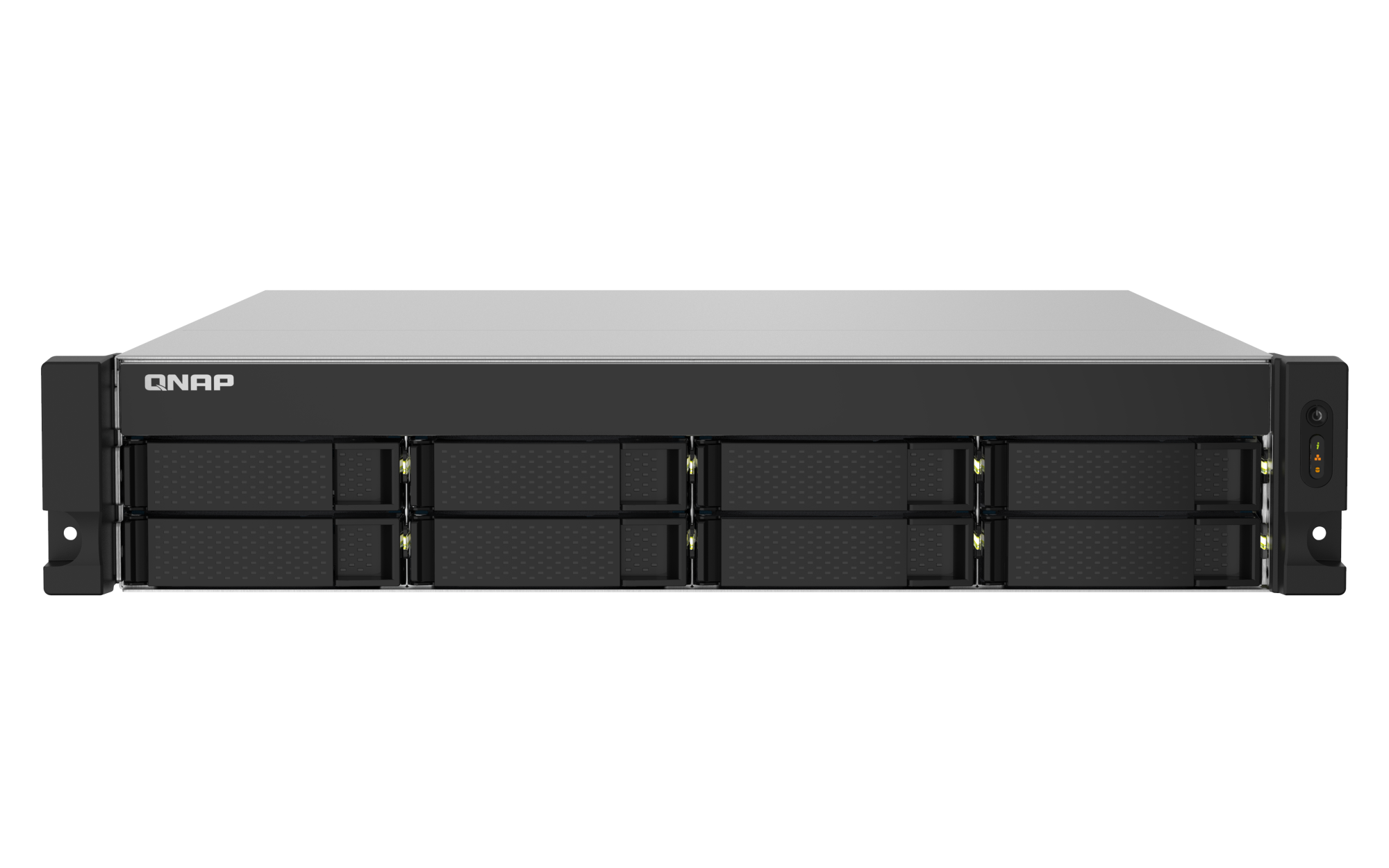
Explore this need in the finder →The QNAP TS-832PXU-RP-4G-US is a rack-first NAS for a team with a cabinet, network plan and someone to select and configure disks. It combines eight native SATA bays, two 10GbE SFP+ ports, two 2.5GbE RJ45 ports and twin 250-W supplies. It is not a ready storage pool: the guide package lists no data drives or rail kit, and the owner must create the RAID layout.
Eight internal positions, with the drive choice still yours
QNAP's exact U.S. TS-832PXU-RP-4G profile specifies eight hot-swappable 3.5-inch SATA trays and lists 3.5-inch SATA HDDs plus 2.5-inch SATA HDDs/SSDs as supported media classes. Check each disk model, capacity and firmware in QNAP's compatibility information; a matching connector alone is not approval. M.2 is optional through a PCIe adapter, not another native bay or a hot-swap position.
The current QTS table lists RAID 1 for the eight-bay group, and QNAP describes a two-member mirror. The owner supplies compatible drives and initializes the pool; the guide lists screws but no disks or prepared array. RAID 1 can survive one member-drive failure, but it is not a backup against deletion, malware or a site event. Plan a separately recoverable copy.
The port layout has a fast lane, but it is SFP+
One built-in 10GbE SFP+ connection meets a nominal 10-Gbps single-port floor; it is not a copper 10GBASE-T jack. Confirm a compatible transceiver or direct-attach cable, switch or peer, client NIC and cabling route. QNAP's link rate is not a transfer-speed promise: disks, RAID work, client, protocol and switch all matter. The two 2.5GbE ports also do not make one assured 5-Gbps client link.
The single expansion slot is PCIe Gen 2 x2. QNAP warns its bandwidth can restrict 10GbE performance for add-on cards. Check exact card compatibility and slot constraints before treating a PCIe M.2 adapter or network card as an upgrade; an unnecessary card spends the only slot on a potentially bottlenecked path.
One documented 4-GB RP configuration
The exact selector lists an AnnapurnaLabs Alpine AL324 four-core ARM Cortex-A57 at 1.7 GHz, one 4-GB DDR4 UDIMM and a 16-GB maximum. Use an approved module and confirm the delivered revision before planning an upgrade. The current software table shows QTS 5.2.11 and EXT4, the operating plan used here. I found no current QuTS hero profile for this family; a ZFS requirement needs model-specific confirmation.
The RP suffix matters: this profile has two 250-W supplies, unlike the separately observed non-RP TS-832PXU-4G-US with one. Dual supplies can help with one supply failure when correctly wired, but do not protect disk data. Verify the PSU revision before replacement. QNAP's comparison lists a three-year standard warranty; that does not settle seller terms or a particular unit's condition.
Rack fit is a procurement check, not a model-name shortcut
This 2U chassis is not a desktop NAS. QNAP's current page gives 3.49 × 17.01 × 20.12 inches and 27.49 pounds, excluding the ear hooks and protruding PSU portion from the dimensions. The English TS-x32PXU v03 guide instead reports 89 × 482 × 534 mm (3.50 × 18.97 × 21.02 inches) and 10.94 kg (24.11 pounds) for RP. The documents differ; measure the actual unit and allow for ears, rear plugs, cables, airflow and rail travel rather than guessing which number describes your installation.
The manual names the separately purchased RAIL-B02. Check post spacing, usable depth, fit, short-rack adjustment room, cable bend, airflow and loaded rack capacity. Its standard package list names the NAS, two RP cords, Cat5e cable and drive screws, not disks or rails. The Store item title uses the RP-4G-US SKU, but its picture label names non-RP; confirm the written bill of materials, not a thumbnail.
Who should compare it—and who should keep looking
The TS-832PXU-RP-4G-US suits an SMB team seeking eight SATA trays, native SFP+ and redundant power in a managed 2U rack. Look elsewhere if you need a quiet-room appliance, a turnkey disk-and-rail bundle, several high-bandwidth cards or copper 10GbE without SFP+ parts. A larger native-bay floor or desktop footprint points toward a different class.
This source-based assessment is not hands-on testing: I did not test speed, noise, power, temperatures, rack fit or failure behavior. Before purchase, confirm RP-4G-US identity, compatible disks and memory, SFP+ parts, PSU revision, written package contents and full rack clearance. Eight bays, 10GbE and RAID 1 describe capabilities—not installed drives, an initialized pool or guaranteed performance.
Key specifications
Key details at a glance
| Internal drive bays | 8 bays |
|---|---|
| Documented internal drive media | 3.5-inch SATA HDD / 2.5-inch SATA HDD / 2.5-inch SATA SSD |
| Built-in Ethernet ports | 2 x built-in 10GbE SFP+ / 2 x built-in 2.5GbE RJ45 |
| Fastest individual Ethernet port | 10 Gbps |
| Installed system memory | 4 GB |
| Maximum listed memory | 16 GB |
| Listed storage arrangements | JBOD / Single / RAID 0 / RAID 1 / RAID 5 / RAID 6 / RAID 10 / RAID 50 / RAID 60 |
| Internal file systems | EXT4 |
| Hardware warranty | 3 years |
| Data drives included in listed package | No |
| Processor | AnnapurnaLabs Alpine AL324 64-bit ARM Cortex-A57 |
| CPU cores | 4 |
| Installed memory type | 4 GB DDR4 UDIMM (1 x 4 GB) |
Use the exact model’s instructions for operating limits, supplied equipment and version differences.
Sources for this review
Sources for this assessment
- QNAP U.S. Tower/SMB product grid
- TS-832PXU-RP — QNAP U.S. product page
- TS-832PXU-RP-4G exact U.S. hardware profile — QNAP
- TS-832PXU-RP current QTS software specifications — QNAP U.S.
- QNAP U.S. comparison: TS-832PXU-RP and TS-832PXU
- TS-x32PXU User Guide v03, English (U.S.) — QNAP
- QTS 5.2.x RAID types — QNAP documentation
- TS-832PXU-RP-4G-US — QNAP Official Store item identity
- QNAP Official Store U.S. SMB 2U (8 Bay) category
- TS-832PXU-RP — QNAP U.S. product gallery image
Check your setup before choosing a NAS
Use the finder to narrow documented desk/shelf or rack formats, internal-bay minimums, a single Ethernet-port rating and optional redundancy requirements.