
Your needs, this model
Does it fit your priorities?
How many internal bays does the TS-832PXU-4G-US provide?
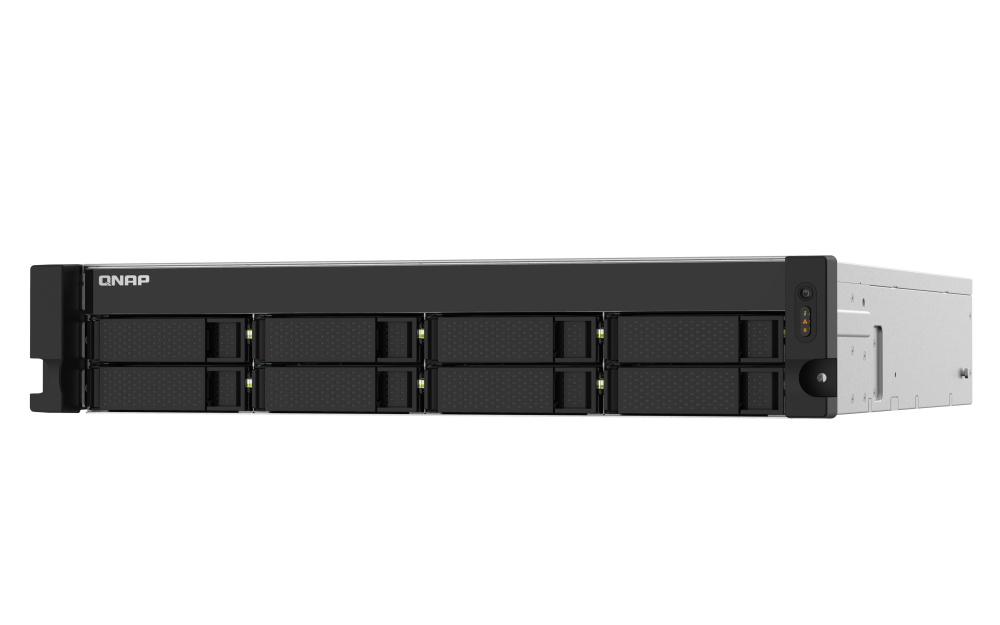
QNAP lists eight native 3.5-inch SATA positions and support for 3.5-inch SATA HDDs, 2.5-inch SATA HDDs and 2.5-inch SATA SSDs. The standard guide package does not list data drives. Verify the exact drive model and firmware; optional M.2 storage uses a PCIe adapter and does not add another native SATA bay.
Explore this need in the finder →Can one built-in port meet a 10-Gbps requirement?
QNAP lists two individual 10GbE SFP+ ports plus two 2.5GbE RJ45 ports. The 10-Gbps interfaces are SFP+, not copper 10GBASE-T. Check the switch or peer, client interface and compatible DAC/transceiver; nominal link rate does not predict file-copy throughput.
Explore this need in the finder →Does the model offer a two-drive redundant arrangement?
QNAP lists RAID 1 for the eight-bay QTS configuration. The owner must choose two compatible drives and create the mirror; no prepared array or data-drive pair is established in the standard package. RAID 1 protects against one member-drive failure under its documented conditions, not against deletion, malware, site loss or loss of the entire NAS.
Explore this need in the finder →How does its power supply differ from the RP version?
The exact TS-832PXU-4G profile and English v02 guide list one 250-W supply and one cord. QNAP’s comparison lists two 250-W supplies for the separate TS-832PXU-RP-4G configuration. Check this model suffix and power arrangement carefully; disk mirroring and a separate backup are different decisions.
Explore this need in the finder →Document-based model assessment · U.S. TS-832PXU-4G-US profile
The TS-832PXU-4G-US is QNAP’s eight-bay 2U rack NAS in its non-RP power configuration. QNAP’s U.S. comparison treats it as a separate 4G profile from the TS-832PXU-RP-4G-US and lists one 250-watt supply here versus two for the RP sibling. This assessment draws on QNAP’s U.S. product and hardware pages, comparison and English TS-x32PXU guide. It is not a hands-on test, performance benchmark or seller-package claim.
Eight native bays, not eight supplied drives
QNAP lists eight 3.5-inch SATA positions and support for 3.5-inch SATA HDDs, 2.5-inch SATA HDDs and 2.5-inch SATA SSDs. Bay count is not usable capacity: drive models, capacity, layout and formatting matter. Check QNAP’s compatibility list for each disk and firmware revision. The standard guide package does not list data drives or a created pool.
Optional M.2 SSDs are not built-in bays; QNAP describes them through a PCIe adapter, which occupies the single expansion slot. Do not add adapter-mounted storage to the native bay count. The slot is PCIe Gen 2 x2, and QNAP warns its bandwidth can restrict 10GbE performance for add-in cards. Check the exact card and workload before assuming an upgrade will meet a target.
QTS RAID 1 is available, but you build it
The current QNAP QTS table lists RAID 1 among the supported choices for an eight-bay configuration. RAID 1 is a two-member mirror: choose compatible drives, install them, create the storage pool and confirm its state yourself. The manual and standard package list do not describe an installed disk pair or a preconfigured mirror. A two-drive mirror also consumes two of the eight positions while providing roughly one member’s raw capacity before filesystem and system overhead. It helps with one member-drive failure under the documented assumptions; it is not a second copy against accidental deletion, malware, theft, fire or failure of the whole NAS. Keep a separate, tested recovery path.
QNAP’s product page describes file sharing, Hybrid Backup Sync, snapshots and cloud-account backup functions. Those documented features can inform a team’s design, but the page does not establish that a particular backup job is configured or that it meets a recovery-time goal. The selector currently identifies QTS 5.2.11 and EXT4 for the assessed operating plan. The sources reviewed here did not establish a separate QuTS hero configuration for this exact profile, so this assessment does not recommend or claim one.
10GbE uses SFP+, and the rest of the path must match
The NAS has two built-in 10GbE SFP+ ports and two 2.5GbE RJ45 ports. One SFP+ interface meets a nominal 10-Gbps single-port threshold, but it is not copper 10GBASE-T: verify a compatible DAC or transceiver, switch or peer, client NIC and cabling. The 2.5GbE ports remain separate; they do not create one 5-Gbps path for a client. Link rating is not transfer speed, which also depends on storage, network, client and workload.
The Alpine AL324 is a four-core 1.7-GHz ARM processor with 4 GB of DDR4 memory in one UDIMM slot; QNAP lists 16 GB as the maximum. That is a concrete starting configuration, not an independent workload rating. Buyers who need more memory should confirm the exact QNAP-approved module and the memory requirements of the applications they intend to run. This unit also has four USB 3.2 Gen 1 ports, while the four network interfaces are not substitutes for a compatible faster switch path.
Rack planning and package checks are essential
This is a 2U rack device, not a compact desktop box. The current hardware table gives 88.6 × 432 × 511 mm and 10.76 kg, excluding ear hooks and the protruding PSU part. The English v02 guide reports 89 × 482 × 534 mm and 9.45 kg for the non-RP TS-832PXU. These manufacturer values conflict on width, depth and net weight. Neither was measured here; verify the actual unit, rails, rear plugs, ventilation and service clearance before committing a rack position.
The guide’s standard list names the NAS, one power cord, an Ethernet cable, drive screws and a quick-installation guide, but not data drives or rails. QNAP lists RAIL-B02 as an optional accessory. A retailer or used-market package can differ, so ask for a written contents list and confirm the exact suffix. The single PSU is a material tradeoff against the RP sibling if power-feed redundancy is part of the deployment plan. A three-year standard manufacturer warranty is listed, but that does not establish a particular seller’s coverage, transferability or the condition of a used unit.
Who should keep it on the shortlist?
This profile merits consideration when the plan calls for eight internal SATA positions, 10GbE SFP+ and a rack-based QTS file or backup workflow. It is a weaker fit when redundant power is essential, the network needs copper 10GBASE-T without an adapter, or rack fit and rails cannot be confirmed. Verify the exact SKU, drive compatibility, SFP+ components, rack measurements, power plan and written package contents. The RP sibling has separate dual-supply facts that do not apply here.
QNAP’s throughput figures are manufacturer demonstrations, not independent results or predictions for another drive array or network. No price, live stock, ratings, customer experience or seller-added bundle is assessed. The central buying page summarizes these checks; it is not a compatibility guarantee.
Key specifications
Key details at a glance
| Internal drive bays | 8 bays |
|---|---|
| Documented internal drive media | 3.5-inch SATA HDD / 2.5-inch SATA HDD / 2.5-inch SATA SSD |
| Built-in Ethernet ports | 2 x built-in 10GbE SFP+ / 2 x built-in 2.5GbE RJ45 |
| Fastest individual Ethernet port | 10 Gbps |
| Installed system memory | 4 GB |
| Maximum listed memory | 16 GB |
| Listed storage arrangements | JBOD / Single / RAID 0 / RAID 1 / RAID 5 / RAID 6 / RAID 10 / RAID 50 / RAID 60 |
| Internal file systems | EXT4 |
| USB 3.2 Gen 1 ports | 4 |
| Dimensions (H × W × D) | 88.6 x 432 x 511 mm (H x W x D; current hardware selector excludes ear hooks and the protruding PSU part) |
| Weight | 10.76 kg |
| Hardware warranty | 3 years |
| Data drives included in listed package | No |
| System drives included (not data-bay drives) | |
| M.2 NVMe slots | 0 |
| Processor | AnnapurnaLabs Alpine AL324 64-bit ARM Cortex-A57 |
| CPU cores | 4 |
| Installed memory type | 4 GB DDR4 UDIMM (1 x 4 GB) |
Use the exact model’s instructions for operating limits, supplied equipment and version differences.
Sources for this review
Sources for this assessment
- QNAP U.S. Tower/SMB product grid
- TS-832PXU — QNAP U.S. product page
- TS-832PXU-4G rendered hardware selector — QNAP U.S.
- TS-832PXU QTS software selector — QNAP U.S.
- TS-832PXU package contents — QNAP U.S.
- QNAP U.S. TS-832PXU / TS-832PXU-RP comparison
- TS-x32PXU User Guide v02 — QNAP
- RAID types — QTS 5.2 documentation
- QNAP U.S. Official Store 2U (8 Bay) results
- TS-832PXU-4G-US — QNAP U.S. Official Store item identity
- TS-832PXU product image — QNAP U.S. page gallery
Check your setup before choosing a NAS
Use the finder to narrow documented desk/shelf or rack formats, internal-bay minimums, a single Ethernet-port rating and optional redundancy requirements.