
Your needs, this model
Does it fit your priorities?
Is an eight-bay label enough to confirm eight large HDD slots?
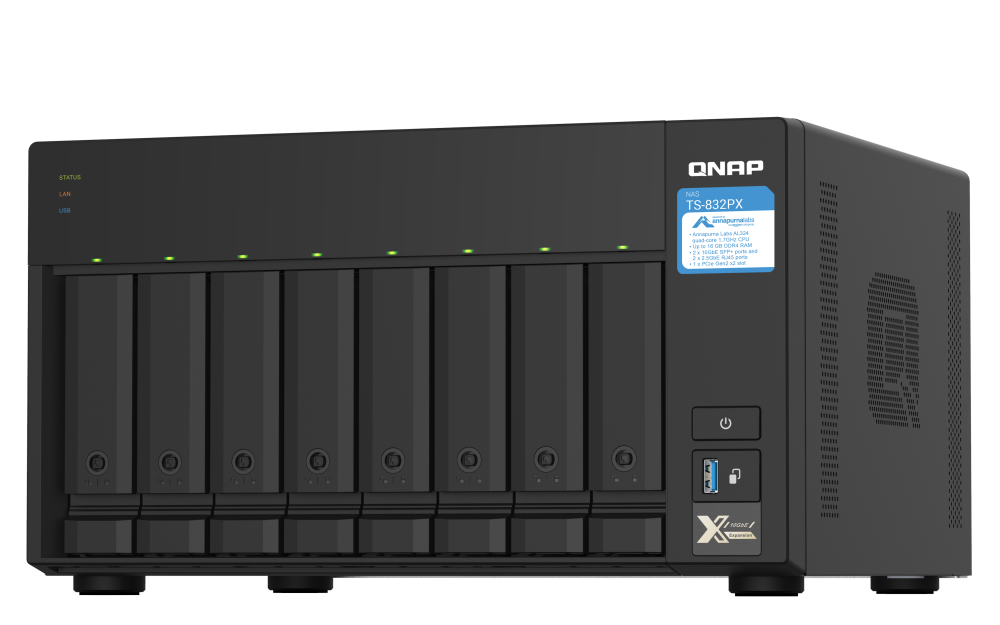
For this model, QNAP documents eight native 3.5-inch SATA positions, so it differs from hybrid models that combine SATA and E1.S/NVMe slots. The manufacturer still does not supply data drives; check each intended drive model and capacity in the QNAP compatibility list.
Explore this need in the finder →Can the TS-832PX-4G-US host a two-drive mirror and still use 10GbE?
Yes, QNAP's guide lists RAID 1 for two drives and the model page lists built-in 10GbE SFP+ ports. The owner must select compatible SATA drives and set up the RAID group, then provide a compatible SFP+ peer/cable; neither drive setup nor end-to-end throughput is supplied by the NAS alone.
Explore this need in the finder →Can it accept an M.2 card and a 10GbE network card at the same time?
Only one PCIe Gen 2 x2 slot is listed. Adding an M.2-capable QM2 or a network expansion card competes for that slot, so do not plan both internal expansion functions there simultaneously; built-in SFP+ ports are already present.
Explore this need in the finder →Assessment basis: this is a documentation-based assessment of the U.S. TS-832PX page, the TS-832PX user guide and the matching QNAP U.S. Store configuration. It is not an independent performance test. The reviewed item is the TS-832PX-4G-US profile, not the similarly named TS-832PXU rack model or another package with a different memory suffix.
Eight standard SATA bays are the main attraction
QNAP's guide identifies eight 3.5-inch SATA drive bays and permits compatible 2.5-inch SATA hard drives or SSDs in those bays. This gives the TS-832PX a more straightforward bulk-disk story than hybrid chassis where some positions are reserved for SSDs. QNAP's standard package list includes the NAS, AC adapter, cord, one Cat5e cable, tray keys and screws, but no data drives. The purchaser therefore has to select drives, verify exact model and firmware compatibility, and decide how many positions to fill at the start.
The 4G configuration has an AnnapurnaLabs AL324 ARM Cortex-A57 processor and 4 GB of DDR4 memory in one SODIMM slot, with the guide listing 16 GB maximum. That is a manufacturer specification, not a promise that every application will run comfortably. QNAP's software table makes some features RAM-dependent, and adding a memory module requires a QNAP-supported part. Buyers should consider how many backup jobs, indexes, containers or surveillance workloads they really expect to run instead of treating the maximum as a recommended starting size.
Built-in 10GbE has a specific SFP+ workflow
The chassis has two 10GbE SFP+ ports and two 2.5GbE RJ45 ports. That mix can suit a workstation or server on a high-speed wired network while leaving the RJ45 ports for ordinary clients or management roles. SFP+ is not the same connector and cable plan as 10GBASE-T: buyers need a compatible switch/NIC and a supported DAC or transceiver/fiber combination. The port's rated link speed is not a measured file-copy rate and two 10GbE ports do not promise one client a combined 20Gbps path.
QNAP lists one PCIe Gen 2 x2 expansion slot. A compatible QM2 card can add M.2 SSD caching, while other supported cards can add functions; however, that optional card uses the same slot. QNAP warns that the slot's bandwidth can constrain some 10GbE card performance. Since the system already has two built-in 10GbE SFP+ ports, the slot is better treated as a deliberate expansion choice, not a spare promise of unlimited bandwidth.
QTS and the owner-created storage plan
The TS-832PX is a QTS model. QNAP's guide documents RAID 1 as a two-drive mirror, and its eight-bay software options include broader multi-drive arrangements as well. One practical plan is two compatible disks in RAID 1, leaving six bays unused for later growth; another may prioritize capacity with a different layout, but usable space and failure tolerance depend on the chosen drives and RAID level. A mirror is not a backup. It will not reverse an accidental deletion, protect against malware or survive loss of the entire device, so decide where another recoverable copy will live and test a restore.
QNAP describes snapshots, file sharing and backup-to-NAS or cloud workflows. Those can be useful tools, but they require configuration, storage space and a destination. An external USB device or a QNAP expansion enclosure is a separate purchase and adds a different failure domain only if the backup routine is designed appropriately. The product's advertised throughput examples are manufacturer tests under specified laboratory settings; this assessment does not repeat them as expected household results.
Where it fits, and the detail that changes the choice
The TS-832PX-4G-US is a credible match for an owner needing eight conventional SATA positions, built-in SFP+ and a QNAP-managed storage system in a desktop tower. It is less attractive if the priority is a quiet one-disk appliance, low administrator involvement, native M.2 bays, large memory out of the box or a rackmount installation. The “PXU” name belongs to separate rack chassis and does not describe this model. Similarly, the model's PCIe slot is not the same thing as built-in NVMe storage.
Before ordering, verify the exact U.S. Store suffix and what is in the seller's box, choose compatible disks by model and firmware, identify an SFP+ transceiver/DAC that matches the far-end port, and check whether the 4 GB memory profile fits the workload. No installed array or hard drives are represented here. This review does not claim hands-on access, measured noise, power use, transfer rates or user-reported reliability; those questions remain for independent testing or the buyer's own evaluation.
Primary references: QNAP TS-832PX product page, the TS-832PX User Guide and the QNAP U.S. Store TS-832PX-4G-US page.
Key specifications
Key details at a glance
| Internal drive bays | 8 bays |
|---|---|
| Documented internal drive media | 3.5-inch SATA hard disk drives / 2.5-inch SATA hard disk drives / 2.5-inch SATA solid-state drives |
| Built-in Ethernet ports | 2 x 10GbE SFP+ / 2 x 2.5GbE RJ45 |
| Fastest individual Ethernet port | 10 Gbps |
| Installed system memory | 4 GB |
| Maximum listed memory | 16 GB |
| Listed storage arrangements | RAID 1 / RAID 5 / RAID 6 / RAID 10 / RAID 50 / RAID 60 |
| Internal file systems | EXT4 (QTS) |
| USB 3.2 Gen 1 ports | 3 |
| Hardware warranty | 2 years |
| Data drives included in listed package | No |
| M.2 NVMe slots | 0 |
| M.2 SSD storage-pool support | No |
| Listed expansion unit | QNAP TR RAID expansion enclosure or TL JBOD (exact model compatibility must be verified) |
| Processor | AnnapurnaLabs Alpine AL324 ARM Cortex-A57 |
| CPU cores | 4 |
| CPU threads | 4 |
| Installed memory type | DDR4 SODIMM |
Use the exact model’s instructions for operating limits, supplied equipment and version differences.
Sources for this review
Sources for this assessment

Check your setup before choosing a NAS
Use the finder to narrow documented desk/shelf or rack formats, internal-bay minimums, a single Ethernet-port rating and optional redundancy requirements.