
Your needs, this model
Does it fit your priorities?
Does TS-664-4G mean four bays?
No. QNAP's U.S. comparison lists six 3.5-inch SATA bays for the TS-664-4G, with two separate M.2 slots that are not included in the native SATA-bay count. The 4G suffix identifies the documented memory configuration, not the number of drive positions.
Explore this need in the finder →Can the 4 GB model run QuTS hero as listed?
Not at its documented starting memory. QNAP lists 4 GB DDR4 SODIMM for TS-664-4G, while its TS-664 product page requires at least 8 GB for QuTS hero. The U.S. comparison lists two memory slots and a 16 GB maximum, but confirm the exact SKU and supported upgrade module before relying on that route.
Explore this need in the finder →Does a two-drive RAID 1 setup replace a backup?
No. QNAP documents a QTS RAID 1 plan using two drives, with one-drive failure tolerance described in its RAID guidance. Deletion, malware, theft or failure affecting the entire NAS can still affect the mirror, so keep a separate copy and test restoring it.
Explore this need in the finder →Assessment basis: documentation research into QNAP's U.S.-listed TS-664-4G configuration and the shared TS-664 platform. This is not a hands-on test. QNAP's U.S. comparison lists a 4 GB TS-664-4G beside the 8 GB TS-664-8G, but the official store page checked for the family showed the 8 GB package only. This assessment therefore describes a documented hardware configuration, not a promise that a current U.S. retail offer exists under that exact suffix.
The suffix changes memory, not the six-bay layout
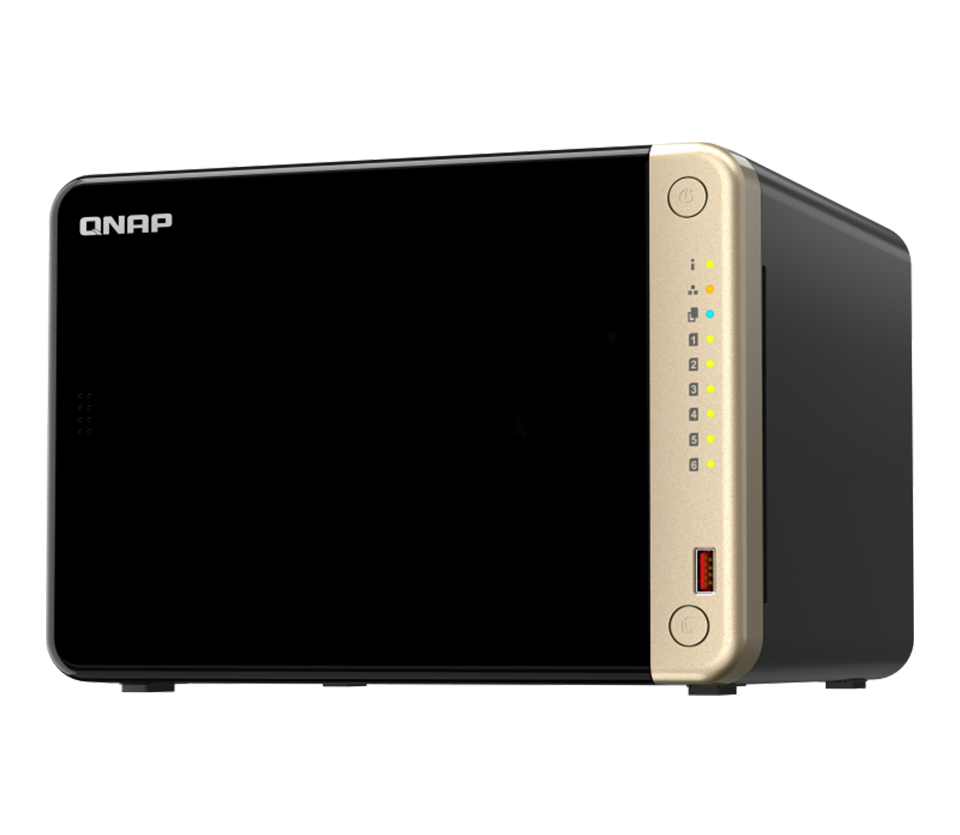
QNAP's U.S. comparison names TS-664-4G as a distinct configuration. It gives the 4G and 8G variants the same Celeron N5095 processor, six 3.5-inch SATA bays, compatibility with 2.5-inch SATA SSDs, two M.2 2280 PCIe Gen 3 x1 positions and two built-in 2.5GbE ports. The 4G suffix is not a four-bay count. Nor should either M.2 slot be counted as another front SATA bay: the system offers six conventional internal tray positions, with M.2 as a separate storage/cache path. The base NAS is listed without HDDs, so drive choice, cost and compatibility remain part of the build.
Memory gives the 4G variant an upgrade path—and a limitation
QNAP's U.S. configuration table and TS-x62/TS-x64 guide identify TS-664-4G as starting with one 4 GB DDR4 SODIMM. The U.S. comparison lists two SODIMM slots and a 16 GB maximum, whereas the TS-664-8G sibling begins with 8 GB. On paper, the 4G version can be a route for a buyer prepared to verify and perform a supported upgrade. That is not a claim that the 4G package is less expensive: no current price comparison or active offer was established.
There is a practical threshold to keep in view. QNAP's TS-664 product documentation calls for at least 8 GB RAM to run QuTS hero. The documented 4 GB base configuration does not meet that minimum as shipped; a compatible upgrade would be needed first. Inline deduplication has a still higher requirement, so do not treat the TS-664's maximum as a recommendation for every feature. Before relying on an upgrade, confirm that the offer is truly TS-664-4G, identify the installed module and revision, and check QNAP's current supported memory guidance. The older guide also warns against unsupported modules; a theoretical slot count is not a compatibility list.
The 8 GB sibling is the more straightforward comparison when the operating system choice requires 8 GB immediately, but its own memory-revision caveat remains: QNAP's current hardware reference describes a later SODIMM revision, while the older guide calls TS-664-8G non-expandable. Verify the specific unit either way. This variant distinction is about memory configuration, not the chassis, bay count or built-in network link.
Two built-in 2.5GbE links, not native 10GbE
QNAP's U.S. comparison lists two 2.5GbE RJ45 ports for the TS-664-4G. The maximum individual built-in link is therefore 2.5 Gbps; the pair is not a single 5-Gbps port and does not guarantee a corresponding file-copy rate to one computer. The switch or router, client adapter, cabling, drive arrangement and workload all affect the path. QNAP's TS-664 family page lists higher-speed expansion options, but those require an add-in card and are not part of this base configuration. If 10GbE is essential, verify the compatible card and the rest of the network before counting the feature as available to your setup.
RAID 1 is a setup choice, not a second backup
The TS-x62/TS-x64 guide documents RAID 1 for TS-664 configurations as a two-drive arrangement. QNAP's QTS RAID documentation explains that a mirror stores the same data on two drives and can tolerate one member-drive failure, while sacrificing capacity and leaving a single NAS as the place where both copies live. The TS-664-4G can therefore match a buyer's requirement for a supported two-drive redundant plan, but the mirror is not preconfigured and no data drives are included. It does not protect a shared folder from deletion or malware, and it cannot recover files if the entire enclosure is stolen or damaged. Plan another independent copy and test a restore.
QTS with EXT4 is the default operating system. QuTS hero with ZFS is an alternative rather than a second simultaneous mode; QNAP says changing the operating system requires an external backup and removal of the installed drives. For the 4G configuration, the memory minimum makes this choice especially relevant before setup. Choose the system and a compatible memory plan before loading data, rather than assuming a later software switch is effortless.
What an exact offer still needs to prove
The U.S. comparison page is useful evidence that QNAP lists a distinct TS-664-4G configuration, and the English family guide separately names it. In the U.S. Official Store page examined for this work, however, the configurable package was TS-664-8G-US; I did not confirm a TS-664-4G U.S. store SKU, current stock or an exact seller package. Treat any listing as a specific offer to verify, not as interchangeable with the 8G version because the photographs look alike. Check the printed model suffix, installed RAM, included drive count, warranty, return terms and whether the installed memory matches the intended operating system. No price or availability claim is made here.
The TS-664-4G is a sensible configuration to compare if six native SATA bays, two built-in 2.5GbE ports and a documented SODIMM upgrade path fit the plan. It is a weaker fit if QuTS hero is required without modifying the base memory, if the seller cannot confirm the 4G suffix, or if an included-drive package is essential. Confirm the exact compatible disks and array instructions, and keep a separate backup. A shortlist match only compares published fit fields; it does not validate an offer, drive, memory module, seller or complete network.
Key specifications
Key details at a glance
| Internal drive bays | 6 bays |
|---|---|
| Documented internal drive media | 3.5-inch SATA HDD / 2.5-inch SATA SSD |
| Built-in Ethernet ports | 2 × built-in 2.5GbE RJ45 (10M/100M/1G/2.5G) |
| Fastest individual Ethernet port | 2.5 Gbps |
| Installed system memory | 4 GB |
| Maximum listed memory | 16 GB |
| Listed storage arrangements | Single / RAID 0 / RAID 1 / RAID 5 / RAID 6 / RAID 10 |
| Internal file systems | EXT4 (QTS, default) / ZFS (QuTS hero, optional alternative OS) |
| Hardware warranty | 3 years |
| Data drives included in listed package | No |
| M.2 NVMe slots | 2 |
| Processor | Intel Celeron N5095 |
| CPU cores | 4 |
| CPU threads | 4 |
| Installed memory type | 4 GB DDR4 SODIMM as one 4 GB module. QNAP's U.S. comparison lists two SODIMM slots and a 16 GB (2 × 8 GB) maximum for the TS-664-4G configuration; the exact seller package and compatible upgrade modules still require verification. |
Use the exact model’s instructions for operating limits, supplied equipment and version differences.
Sources for this review
Sources for this assessment
- QNAP U.S. TS-664 configuration comparison
- QNAP TS-x62 / TS-x64 User Guide, English, document version 7
- QNAP U.S. TS-664 product page
- QNAP U.S. TS-664 family hardware specification (empty captured response; live page inspected)
- QNAP U.S. Official Store TS-664-8G-US page checked for the sibling package
- QNAP QTS 5.2.x RAID types documentation
- QNAP U.S. TS-664 chassis image shown in the official comparison

Check your setup before choosing a NAS
Use the finder to narrow documented desk/shelf or rack formats, internal-bay minimums, a single Ethernet-port rating and optional redundancy requirements.