
Your needs, this model
Does it fit your priorities?
How many native SATA positions does the TS-464eU-8G-US have?
QNAP lists four native 3.5-inch SATA positions. The two M.2 NVMe sockets are separate and do not add to that count. The current selector lists 3.5-inch HDD and 2.5-inch SSD media; the older guide also lists 2.5-inch HDD, so verify exact compatibility. No standard data-drive package is established.
Explore this need in the finder →Does its advertised 5Gbps trunk meet a single-port 5Gbps requirement?
No. QNAP's up-to-5Gbps claim combines two built-in 2.5GbE ports through trunking. Each individual port is 2.5GbE, so this profile meets a 2.5Gbps per-port floor but not 3Gbps or 5Gbps for one port. Switch/client path and workload remain separate checks.
Explore this need in the finder →Can I build a two-drive mirror?
QNAP lists RAID 1 for the four-bay QTS arrangement. The buyer must choose compatible drives and create the pool; the configurable Store page does not establish a default prebuilt mirror. Keep an independent backup because RAID 1 is not backup.
Explore this need in the finder →Will the current chassis dimensions guarantee my rack fit?
No. The current rendered selector lists 43.3 x 430 x 292.1mm, while the older English guide gives 43.3 x 482.6 x 321.33mm. These manufacturer values conflict. Confirm the exact revision, rail set, rack posts/depth, rear cable clearance and written seller package before installation.
Explore this need in the finder →QNAP · four-bay 1U short-depth rack NAS · source-based assessment
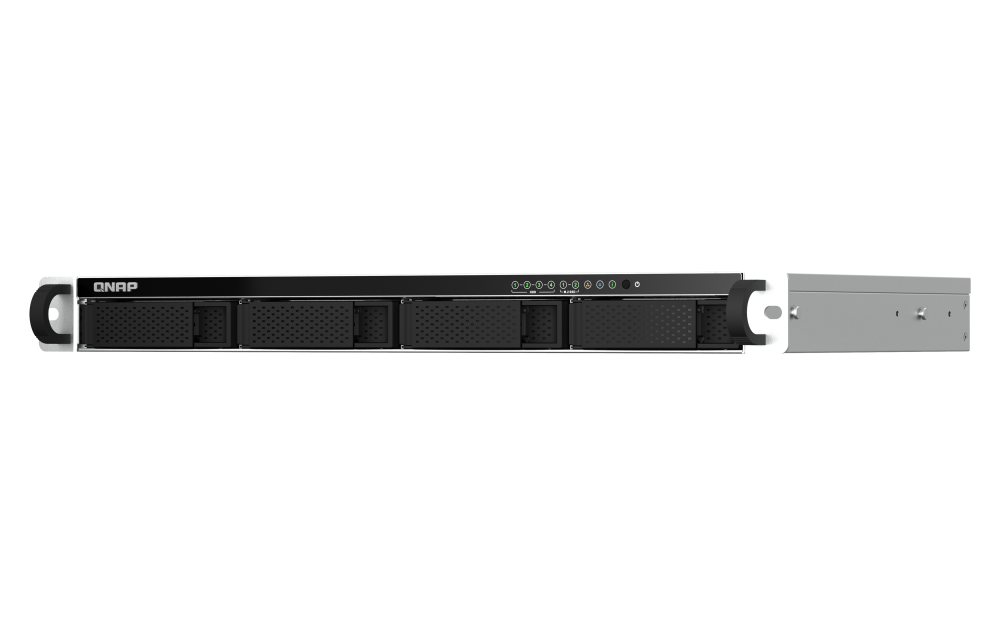
The TS-464eU-8G-US is a rack-mounted NAS for a buyer who wants four conventional drive trays in a 1U chassis rather than a small desktop box. QNAP's current U.S. product page and hardware selector describe two built-in 2.5GbE ports, two M.2 NVMe positions, and an Intel Celeron N5095 platform. The exact U.S. Store item identifies an 8GB configuration. This is a document-based assessment, not a hands-on review: it does not establish any individual seller's stock, condition, package contents, installed drives or network performance.
Four SATA positions; M.2 is a separate layer
The four native positions are specified for 3.5-inch SATA hard drives. The current U.S. selector also lists 2.5-inch SATA SSDs, while the older English TS-x64eU user guide lists 2.5-inch SATA HDDs as well. That media-list difference should not be silently reconciled: use QNAP's current compatibility records for the exact drive model, capacity and firmware, and confirm that the intended media is supported for the delivered revision. The manufacturer package selector does not establish that data drives are included; the QNAP Store page is configurable and presents selectable drive/RAID options, so its configurable parent is not proof that the default base NAS ships with them or a pre-built array.
Two M.2 2280 PCIe Gen 3 x1 NVMe slots are listed separately from the SATA trays. They may be useful for a compatible cache or storage arrangement, but they do not create two more native SATA bays. QNAP's compatibility list is the right next check for the precise NVMe part. Decide whether the NAS is intended as a four-drive file store, a mixed SATA/NVMe workload, or a backup destination before choosing media; do not treat the presence of M.2 sockets as free capacity or as a promise of an application-level speed gain.
2.5GbE is the single-port ceiling in this assessment
The chassis has two individual 2.5GbE RJ45 ports. QNAP advertises up to 5Gbps through port trunking, but that combines two links; it is not a single 5Gbps Ethernet port and does not make the individual-port minimum higher. This distinction matters if a switch, client, or workflow is built around one faster link. For a two-port trunk, matching switch configuration, client connections and workloads still matter, and aggregate link rating is not a promise of one file transfer at that rate.
For a shortlist requiring a 2.5Gbps individual port, this model clears the nominal link-rating threshold. A 3Gbps-or-higher single-port requirement excludes it. Check that the other end of the connection, cabling and network equipment can use 2.5GbE; a mixed path can negotiate down, and the port rating is not a benchmark. The finder deliberately compares one built-in port rather than the product page's combined-link claim.
Choose an owner-created mirror, then maintain a separate backup
QNAP's current QTS four-bay table lists RAID 1. With two compatible user-selected SATA drives and a pool created by the owner, the TS-464eU can support a two-drive mirror while leaving the other native positions available for a separately planned layout. QNAP's RAID documentation explains the array behavior; neither the guide nor the Store configurator establishes a pre-installed mirror in the standard NAS. Verify the exact drive model and supported capacity before ordering, then follow current setup documentation and retain a recovery copy that is independent of the NAS.
A mirror helps with a member-drive failure under the operating system's stated conditions. It does not restore a deleted file, protect against ransomware, theft, fire or loss of the appliance, and it is not a substitute for versioned or offline backup. Buying two drives does not by itself create RAID 1: the owner must initialize and configure the pool, and a later change of layout can involve data risk. The shopping decision should include the backup target and restore process, not just drive count.
What the 8GB configuration changes
The current selector identifies TS-464eU-8G with one 8GB DDR4 SODIMM and lists a 16GB ceiling across two slots. That starting capacity meets QNAP's stated 8GB minimum for running QuTS hero, but it does not automatically qualify every optional feature or firmware combination. QNAP states 16GB is required for inline deduplication, with 32GB recommended; the product's listed maximum is 16GB, so do not assume the recommended 32GB is available on this chassis. If using QuTS hero, verify the exact model, OS release, RAM and feature requirement together. QTS remains the conservative plan described here; the matcher does not treat an optional OS as proof that a specific workflow is compatible.
The selector describes an Intel Celeron N5095 four-core processor, two USB 3.2 Gen 2 Type-A ports and HDMI 1.4b. Those are manufacturer specifications, not workload test results. Confirm any planned client, application, display or peripheral use against current QNAP software requirements; the ports alone do not establish a supported workflow.
Short-depth rack does not mean fit is automatic
QNAP's current U.S. selector lists a 1U chassis at 43.3 x 430 x 292.1mm and 10.93lb net. The older English guide instead gives 43.3 x 482.6 x 321.33mm and 4.35kg, with the older width/depth presentation materially different from the selector. These are conflicting manufacturer specifications, not measurements of a unit in hand. Confirm which envelope applies to the exact revision, including ear/handle width, rear cables, rack-post spacing, rail travel, cabinet depth, ventilation and loaded rack capacity. The hardware selector identifies an optional rail accessory; the package selector and standard guide do not prove that rails are included. QNAP lists RAIL-S01 as end-of-life and other rail options separately, so verify the exact NAS and rack compatibility before ordering accessories.
Where it fits—and where it does not
This is a plausible comparison candidate for a small office that specifically wants a 1U, short-depth enclosure, four SATA positions, NVMe slots and built-in 2.5GbE. It is not a one-port 5GbE model, and its advertised trunk figure should not be used to pass a single-port requirement. A five-bay minimum excludes it, as does a requirement for a single port rated at least 3Gbps. The four-bay and 2.5GbE facts can coexist with QTS RAID 1, but the owner still buys compatible drives and creates the mirror.
Before committing, reconcile the exact 8G retail suffix and seller bill of materials, check drive and M.2 compatibility, identify the intended QTS or QuTS hero version, verify the actual rack envelope and accessory rails, and plan an independent backup. The 8GB configuration is distinct from the separately documented 4GB Legacy selector profile; a photograph of the shared chassis cannot tell those memory configurations apart. No price, live availability, customer rating, lab result, measured throughput or seller-installed storage is claimed here.
Key specifications
Key details at a glance
| Internal drive bays | 4 bays |
|---|---|
| Documented internal drive media | 3.5-inch SATA HDD / 2.5-inch SATA SSD |
| Built-in Ethernet ports | 2 x built-in individual 2.5GbE RJ45 |
| Fastest individual Ethernet port | 2.5 Gbps |
| Installed system memory | 8 GB |
| Maximum listed memory | 16 GB |
| Listed storage arrangements | QTS: RAID 1 (owner-created with two compatible drives) |
| Internal file systems | QTS: EXT4 / QuTS hero: ZFS |
| Hardware warranty | 3 years |
| Data drives included in listed package | No |
| System drives included (not data-bay drives) | |
| M.2 NVMe slots | 2 |
| Processor | Intel Celeron N5095 |
| CPU cores | 4 |
| CPU threads | 4 |
| Installed memory type | 8GB DDR4 SODIMM (one module; current selector profile) |
Use the exact model’s instructions for operating limits, supplied equipment and version differences.
Sources for this review
Sources for this assessment
- TS-464eU U.S. product page — QNAP
- TS-464eU rendered U.S. hardware selector — QNAP
- QNAP U.S. TS-464eU / TS-464U comparison
- TS-x64eU User Guide, English U.S. — QNAP
- TS-464eU-8G-US configurable U.S. Store item — QNAP
- QNAP U.S. Store 1U rackmount catalogue response
- QTS 5.2.x RAID types — QNAP
- QNAP QuTS hero memory requirements FAQ
Check your setup before choosing a NAS
Use the finder to narrow documented desk/shelf or rack formats, internal-bay minimums, a single Ethernet-port rating and optional redundancy requirements.