
Your needs, this model
Does it fit your priorities?
What does the TS-1655's sixteen-position count include?
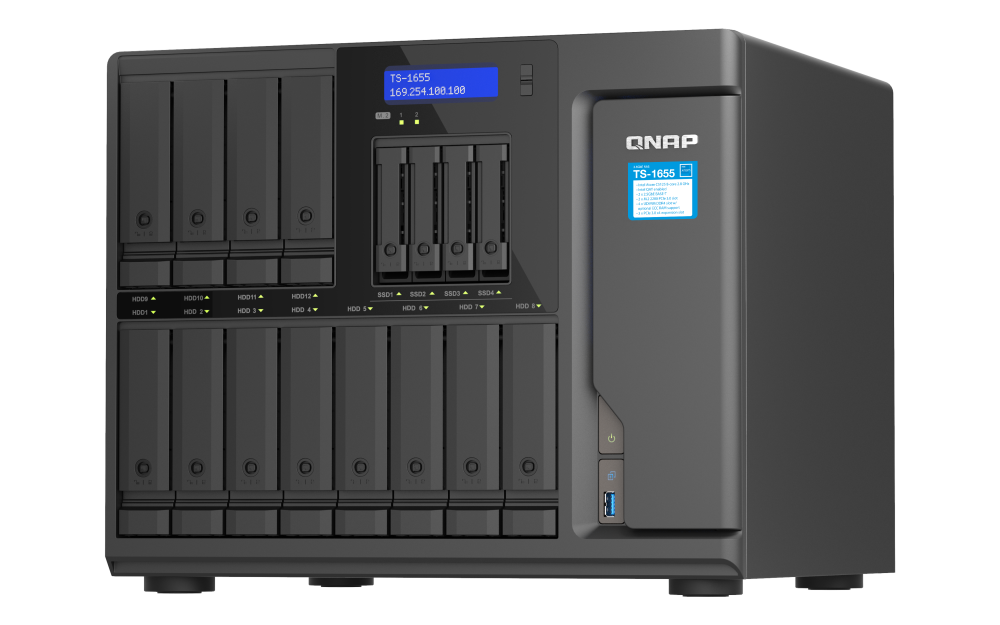
QNAP lists twelve native 3.5-inch SATA positions plus four separate 2.5-inch SATA SSD positions. The guide specifies 2.5-inch SATA SSDs in the four smaller bays; the twelve larger bays accept 3.5-inch SATA hard drives or 2.5-inch SATA SSDs. Two M.2 2280 sockets are separate from the sixteen front SATA bays. The exact package list contains no data drives, and exact model/firmware compatibility remains a buyer check.
Explore this need in the finder →Does the built-in network meet a 10GbE single-port requirement?
No. The documented native interfaces are two 2.5GbE RJ45 ports, so the fastest individual built-in port is 2.5GbE. QNAP describes optional network cards, including 10GbE, but those are PCIe additions and do not satisfy a built-in 10GbE requirement in the base configuration. Port trunking does not make two connectors a guaranteed faster single-client path.
Explore this need in the finder →Can this exact configuration support a documented two-drive mirror?
Yes, as an owner-created setup: QNAP lists RAID 1 in both the QTS and QuTS hero eight-bay-and-larger tables for this sixteen-position model. Choose one OS, confirm two compatible SATA drives and create the pool yourself; the guide's package list does not include data drives or a pre-built array. Keep an independent backup because a mirror does not protect against deletion, malware or whole-system loss.
Explore this need in the finder →What differs from the similarly named TS-h1655XeU-RP?
The TS-1655-8G-US is a tower with sixteen native SATA positions and two built-in 2.5GbE ports. The TS-h1655XeU-RP-8G-US is a separate 3U short-depth rack model with twelve native SATA bays, separate E1.S/M.2 PCIe positions, built-in 10GbE and redundant power supplies. The extra NVMe positions on the rack model are not extra SATA bays; compare exact chassis and installed network needs rather than relying on similar names.
Explore this need in the finder →The QNAP TS-1655-8G-US is a tower NAS for a team that can use a large hybrid SATA layout but does not need more than 2.5GbE on any single built-in Ethernet port. QNAP’s U.S. product page describes the TS-1655 as a business-oriented 16-position system with an eight-core Atom processor and support for both QTS and QuTS hero. The manufacturer’s English-U.S. guide identifies the ordering part as TS-1655-8G, while the U.S. Official Store names the exact package TS-1655-8G-US. This is a documentation-based assessment, not a hands-on test.
Sixteen positions, but two kinds of SATA bay
The number is not sixteen interchangeable hard-drive trays. QNAP lists twelve 3.5-inch SATA positions plus four 2.5-inch SATA positions. The larger trays support 3.5-inch SATA hard drives and 2.5-inch SATA SSDs; the four smaller bays are specified for 2.5-inch SATA SSDs. That layout allows a buyer to plan a large HDD group alongside a smaller SATA flash group, but the source does not make those groups equivalent. Decide which capacities, performance roles and RAID groups belong in each before ordering drives.
Two internal M.2 2280 PCIe Gen 3 x2 slots are separate from the sixteen SATA bays. QNAP describes those sockets for NVMe cache, a storage pool, or a QuTS hero system-drive arrangement; it also names an Edge TPU use. They are not front trays, do not make the NAS an 18-bay SATA system and are not listed as hot-swappable. QNAP’s guide calls out M.2 SSDs as an exception to drive hot-swap support. The exact models, firmware and use of any M.2 device still need to be checked against QNAP’s compatibility information.
QNAP’s package list names the NAS, one power cord, a Cat5e cable, the twelve 3.5-inch and four 2.5-inch trays, drive screws, tray keys and a quick-install guide. It does not list data drives or a pre-built storage array. The distinction matters: the chassis provides positions, not usable capacity. Check the full drive model and firmware for each intended SATA or NVMe device on the current compatibility list; I did not verify a drive-specific compatibility row for this assessment.
Built-in network ceiling and optional expansion
The TS-1655 has two built-in 2.5GbE RJ45 ports. They negotiate with slower network links, but the fastest individual built-in port is still rated 2.5 Gbps. That can suit a home office or workgroup whose switch, client and wiring support multigigabit Ethernet; it does not meet a requirement for one built-in 10GbE port. QNAP lists port trunking and failover, but two separate connectors are not a guarantee of one faster client connection or a particular file-transfer rate.
There are three PCIe Gen 3 x4 slots, and QNAP describes optional network adapters for 5, 10 or 25GbE. That creates an upgrade path, not an as-shipped port: an expansion card has to be bought, checked for model and slot compatibility, installed, and paired with a suitable switch or direct-connected client and cabling. A faster adapter can also occupy a slot that might otherwise serve a storage or other expansion card. If your essential filter is “at least one built-in 10GbE port,” do not count this optional path as meeting it.
QNAP’s page publishes laboratory transfer results, but those results depend on specified drive, RAID, host and network arrangements. They are not measurements of this review, and they do not predict a diskless package’s performance on an unspecified client path. A 2.5GbE link rating is one part of the path; drive choices, storage layout, client interface, switch, cable, protocol and workload all affect observed transfers.
Choose one software profile and plan the mirror yourself
The QNAP U.S. software page exposes QTS and QuTS hero as separate profiles. QTS uses EXT4; QuTS hero uses ZFS. The current eight-bay-and-larger RAID tables for both list RAID 1, so the exact sixteen-position model supports a documented way for an owner to create a two-drive mirror under either chosen environment. These are alternatives, not two systems running on the same pool. QuTS hero also calls for more system resources than QTS for some features, so check the memory needs of the intended applications rather than treating the operating-system choice as cosmetic.
Neither profile means a mirror is already configured. The buyer must select compatible drives, choose one OS, create the storage pool and decide where the rest of the bays go. Two selected SATA drives can form a RAID 1 set; that may preserve availability after one member-drive failure, but it does not protect against accidental deletion, malware, theft, site damage or every system failure. Keep a separate backup on another device or location and test restoration. A mirrored pair is only one part of a storage plan.
The 8G base profile has one 8 GB DDR4 UDIMM. QNAP lists four memory slots, a 128 GB maximum and ECC memory support, while its guide tells buyers to use QNAP modules with matching specifications. The factory stick is described as non-ECC; do not assume any third-party module will work or mix modules without checking QNAP’s requirements. The Intel Atom C5125 is an eight-core 2.8 GHz processor. Those are useful documented platform facts, not an independent workload benchmark.
A substantial tower, not a short-depth rack unit
The guide identifies a tower enclosure measuring 11.59 × 14.56 × 12.59 inches (H × W × D), with a listed net weight of 29.01 pounds and a 550 W power supply. These figures help screen a shelf or work area, but they are not required ventilation clearance or evidence of measured power draw. Plan space for cable bend, airflow, tray access and safe handling. A single listed power supply also differs from a redundant-supply rack design.
That form factor separates it from QNAP’s similarly named TS-h1655XeU-RP. The TS-1655 is a tower with sixteen native SATA positions and two built-in 2.5GbE ports; the TS-h1655XeU-RP-8G-US is a 3U short-depth rack system with twelve native SATA positions, separate E1.S/M.2 PCIe positions, built-in 10GbE and two power supplies. The rack model’s extra NVMe positions do not make them SATA bays, and the tower model does not gain 10GbE from its optional-card path. Confirm which chassis and exact suffix are on a quote—the similar names conceal different installation and networking choices.
Who should shortlist this exact package?
The TS-1655-8G-US is worth evaluating when sixteen native SATA locations—including four 2.5-inch SSD-only positions—are useful, a tower fits the room, and built-in 2.5GbE is sufficient for the network requirement. The two M.2 sockets, three PCIe slots, four memory slots and two OS choices provide flexibility, but every expansion and storage decision brings its own compatibility check. A buyer seeking built-in 10GbE, a compact desktop chassis, rack rails in the box, all-SATA interchangeable positions or a ready-populated mirror should compare another configuration instead.
Before committing, confirm the exact TS-1655-8G-US identifier and the seller’s written contents; check every intended drive and firmware against QNAP’s live list; choose QTS or QuTS hero and verify application memory requirements; map a single 2.5GbE link through the client, switch and cable; and reserve PCIe slots for the actual expansion plan. Verify the intended room’s ventilation and power as well. These are document checks still to make, not tests performed here.
Key specifications
Key details at a glance
| Internal drive bays | 16 bays |
|---|---|
| Documented internal drive media | 3.5-inch SATA hard disk drives in 3.5-inch bays / 2.5-inch SATA solid-state drives in 3.5-inch bays / 2.5-inch SATA solid-state drives in 2.5-inch bays |
| Built-in Ethernet ports | 2 x built-in 2.5GbE RJ45 (backward-compatible link rates per QNAP documentation) |
| Fastest individual Ethernet port | 2.5 Gbps |
| Installed system memory | 8 GB |
| Maximum listed memory | 128 GB |
| Listed storage arrangements | QTS: RAID 1 (among the listed eight-bay-and-larger arrangements) / QuTS hero: RAID 1 (among the listed eight-bay-and-larger arrangements) |
| Internal file systems | EXT4 (QTS alternative) / ZFS (QuTS hero alternative) |
| Weight | 13.16 kg |
| Hardware warranty | 3 years |
| Data drives included in listed package | No |
| M.2 NVMe slots | 2 |
| M.2 SSD storage-pool support | Yes |
| Processor | Intel Atom C5125 |
| CPU cores | 8 |
| Installed memory type | 8 GB non-ECC DDR4 UDIMM (1 x 8 GB in the TS-1655-8G profile) |
Use the exact model’s instructions for operating limits, supplied equipment and version differences.
Sources for this review
Sources for this assessment
- QNAP U.S. Tower/SMB product grid — TS-1655 family card
- TS-1655 — QNAP U.S. product page
- TS-1655 User Guide, English (U.S.)
- TS-1655-8G-US — QNAP U.S. Official Store product identity
- QNAP U.S. Official Store SMB Desktop page 4 — TS-1655-8G-US card
- TS-1655 software profiles and RAID tables — QNAP U.S.
- TS-1655 manufacturer product rendering — QNAP U.S.

Check your setup before choosing a NAS
Use the finder to narrow documented desk/shelf or rack formats, internal-bay minimums, a single Ethernet-port rating and optional redundancy requirements.