
Your needs, this model
Does it fit your priorities?
What does this exact 12-bay configuration support, and are disks included?
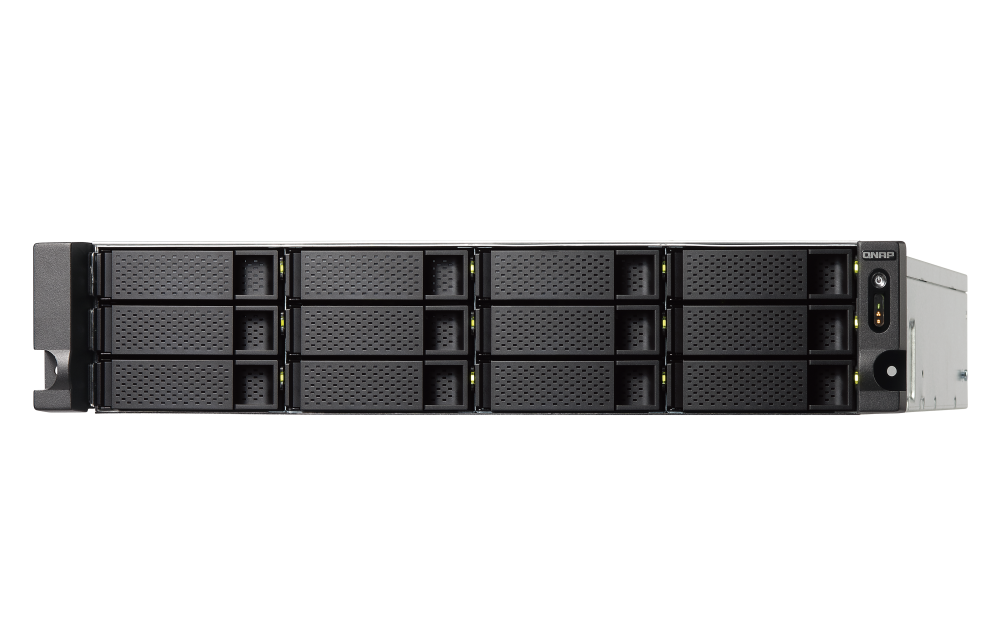
QNAP's TS-1232XU-4G profile lists twelve native 3.5-inch SATA positions for 3.5-inch SATA HDDs or 2.5-inch SATA HDDs/SSDs. The standard TS-x32XU guide lists drive screws but not data disks or a prepared pool. Verify the exact drive model and firmware with QNAP's current compatibility information; optional M.2 cards or external shelves do not add native bays.
Explore this need in the finder →Can one of its built-in ports meet a 10-Gbps link floor?
Yes on paper: the exact profile lists two individual 10GbE SFP+ ports. SFP+ is not a 10GBASE-T RJ45 jack; choose a compatible transceiver or DAC and verify the switch, peer NIC and cable path. QNAP warns that the single PCIe 2.0 x2 slot can constrain add-in networking, and two ports are not one guaranteed 20-Gbps client link.
Explore this need in the finder →Can a two-drive mirror coexist with the twelve-bay profile?
QNAP's QTS specifications list RAID 1 for its eight-bay-and-larger class, which includes the twelve-bay TS-1232XU-4G. A buyer can choose compatible drives and create a two-drive mirror in native trays; the package list does not include disks or an initialized array. RAID 1 is not a separate backup, and drive/firmware approval remains model-specific.
Explore this need in the finder →What changes if I include earlier models in the shortlist?
The exact QNAP selector labels TS-1232XU-4G as EOL, so it appears only when earlier models are included. The separate TS-1232XU-RP family is not this product: the non-RP 4G configuration has one 250-W supply, while the RP chassis is the redundant-power version.
Explore this need in the finder →Assessment basis: this is a document-led assessment of QNAP's non-RP TS-1232XU-4G configuration, not a hands-on test. QNAP identifies the exact hardware profile as EOL. Its twelve native bays and built-in SFP+ ports are substantial, but this is an earlier 2U platform with one power supply, a limited PCIe link and an unresolved published weight discrepancy. A buyer should verify the exact delivered chassis and support terms before treating it as an infrastructure purchase.
Twelve native trays, with the drive bill left to you
QNAP's U.S. hardware selector names the TS-1232XU-4G and lists twelve 3.5-inch SATA positions. The supported media classes include 3.5-inch SATA hard drives, 2.5-inch SATA hard drives and 2.5-inch SATA solid-state drives. That is a useful starting point for a rack plan that needs many internal trays, but the bay count says nothing about usable capacity after a storage layout is chosen. QNAP's standard TS-x32XU guide package list includes drive screws and network cables, not data drives or an initialized storage pool. Check the exact model, capacity and firmware of each planned disk against QNAP's current compatibility information rather than treating the broad media list as approval of every drive.
Expansion is also separate from the twelve internal trays. QNAP describes optional PCIe cards and compatible external expansion enclosures, but a shelf is another chassis and an add-in card is an additional compatibility and cost decision. If the work depends on a particular expansion unit, SAS adapter or disk model, verify that exact combination before selecting this older NAS.
Two 10GbE links, but they are SFP+
The exact hardware selector lists two built-in 10GbE SFP+ ports and two 1GbE RJ45 ports. Either SFP+ interface can satisfy a requirement for one built-in 10Gbps link; neither is a 10GBASE-T copper socket. The transceiver or direct-attach cable, switch, client NIC and cabling need to fit the intended SFP+ path. The product page's historical lab figures describe a named configuration with twelve SSDs, QTS 4.3.4 and a 10GbE client setup. They are not an independent result and should not be read as the speed a new system will deliver with a different drive set, protocol or network.
There is one PCIe 2.0 x2 slot. QNAP itself warns that the narrow host link can restrict NAS 10GbE performance, so adding another card does not guarantee more usable bandwidth. Cards that need more host bandwidth, a copper link, or M.2 storage deserve a model-specific compatibility check. Do not count two 10GbE ports as one guaranteed 20Gbps file-transfer channel.
The non-RP suffix is an operational distinction
This profile is the standard TS-1232XU-4G, not the TS-1232XU-RP-4G. QNAP's U.S. selector lists one 250W supply for the non-RP unit; the family guide separately identifies two supplies for the RP model. The difference matters when an installation requires a second power module or supply-path resilience. This NAS does not meet that requirement through its base configuration. Even on a dual-supply product, independent feeds depend on separate upstream circuits; here, verify any replacement or repair path for the single supply rather than assuming redundancy from the product family name.
QNAP lists an Annapurna Labs AL-324 four-core, 1.7GHz ARM processor, 4GB of DDR4 UDIMM memory in one slot and a 16GB maximum. That makes this a more modest legacy platform than newer virtualization-oriented rack NAS lines. The manufacturer page describes QTS, EXT4 and file services, snapshots and backup software, but feature listings are not a workload qualification. Confirm app and firmware support for the exact model and current OS release, especially if a new deployment depends on a particular container, surveillance or virtualization feature.
A mirror is a setup choice, not a second backup
QNAP's software specifications list RAID 1 among the RAID modes for its eight-bay-and-larger NAS class, and its TS-x32XU guide describes replacing a failed member of a RAID 1 set. A buyer can therefore plan an owner-created two-drive mirror in this twelve-bay model, leaving other bays for additional groups. The disks, pool and recovery plan are not part of the standard documentation package. Select compatible drives, create the desired layout during setup and keep a separately recoverable backup: a mirror does not protect both copies from deletion, malware, theft or a chassis-wide failure.
Rack fit and lifecycle need extra attention
The hardware selector and guide agree on a 2U body around 89 x 482 x 534mm. They do not agree on net weight: the current selector reports 21.67lb, while the manual gives 11.3kg (24.91lb) for the TS-1232XU. Because both are manufacturer sources, neither value should be silently preferred. Confirm the shipped unit's specification and loaded weight in writing. The guide's package list does not name rack rails; confirm the exact rail kit, post depth, rear cable room, airflow and cabinet load before installation.
For a managed rack that can accept an EOL QTS model, needs twelve native SATA positions and already has an SFP+ network, the TS-1232XU-4G-US is a distinct configuration to investigate. It is a poor shortcut if the requirement includes redundant power, a 10GBASE-T port, current-generation application headroom or a known rail-and-weight plan. The exact U.S. Store identity bridges to the non-RP 4G configuration, but it does not establish an Amazon listing, a current seller offer or seller-added contents. Buy only against a written model and package confirmation, and check firmware and drive support before moving production data.
Key specifications
Key details at a glance
| Internal drive bays | 12 bays |
|---|---|
| Documented internal drive media | 3.5-inch SATA HDD / 2.5-inch SATA HDD / 2.5-inch SATA SSD |
| Built-in Ethernet ports | 2 x built-in 10GbE SFP+ / 2 x built-in 1GbE RJ45 |
| Fastest individual Ethernet port | 10 Gbps |
| Installed system memory | 4 GB |
| Maximum listed memory | 16 GB |
| Listed storage arrangements | JBOD / Single / RAID 0 / RAID 1 / RAID 5 / RAID 6 / RAID 10 / RAID 50 / RAID 60 |
| Internal file systems | EXT4 (QTS) |
| Hardware warranty | 3 years |
| Data drives included in listed package | No |
| Processor | Annapurna Labs Alpine AL-324 ARM Cortex-A57 |
| CPU cores | 4 |
| Installed memory type | 4 GB DDR4 UDIMM |
Use the exact model’s instructions for operating limits, supplied equipment and version differences.
Sources for this review
Sources for this assessment
Check your setup before choosing a NAS
Use the finder to narrow documented desk/shelf or rack formats, internal-bay minimums, a single Ethernet-port rating and optional redundancy requirements.