
Your needs, this model
Does it fit your priorities?
Are there twelve internal bays, and what drives fit them?
The exact TS-1232PXU-RP-4G profile lists twelve native 3.5-inch SATA positions and lists 3.5-inch SATA HDDs, 2.5-inch SATA HDDs and 2.5-inch SATA SSDs as media classes. The standard guide package does not list data drives. That media description is not approval of every individual disk: match the drive model, capacity and firmware to QNAP's compatibility list. M.2 adapter devices and external shelves do not add native bays.
Explore this need in the finder →Can one built-in Ethernet port meet a 10-Gbps minimum?
The model lists two 10GbE SFP+ ports and two 2.5GbE RJ45 ports; one SFP+ port is enough for the rated single-port 10-Gbps requirement. It is not a copper 10GBASE-T jack, so check the exact compatible SFP+ transceiver or DAC and the receiving NIC, switch and cabling. The port's nominal link rate is not an expected file-transfer speed.
Explore this need in the finder →Does it support an owner-created two-drive mirror?
QNAP's exact U.S. comparison lists RAID 1 for the TS-1232PXU-RP-4G and QTS documentation describes the two-disk mirror. The owner must supply compatible drives and create the array; no data disks or prepared pool are listed in the standard manual package. QNAP's current FAQ does not list this family among supported QuTS hero models, so plan around QTS rather than ZFS unless QNAP confirms an exact exception. RAID 1 is not a separate backup.
Explore this need in the finder →What needs checking before it goes into a rack?
The exact profile is a 2U unit with two 250-W power supplies, but the guide says RAIL-B02 is separate and the current comparison and guide disagree on dimensions and net weight. Measure the actual chassis, rack posts, cabinet depth, rail travel, rear power/cable clearance, ventilation and loaded rack capacity. Also check the installed PSU revision before buying a replacement pair.
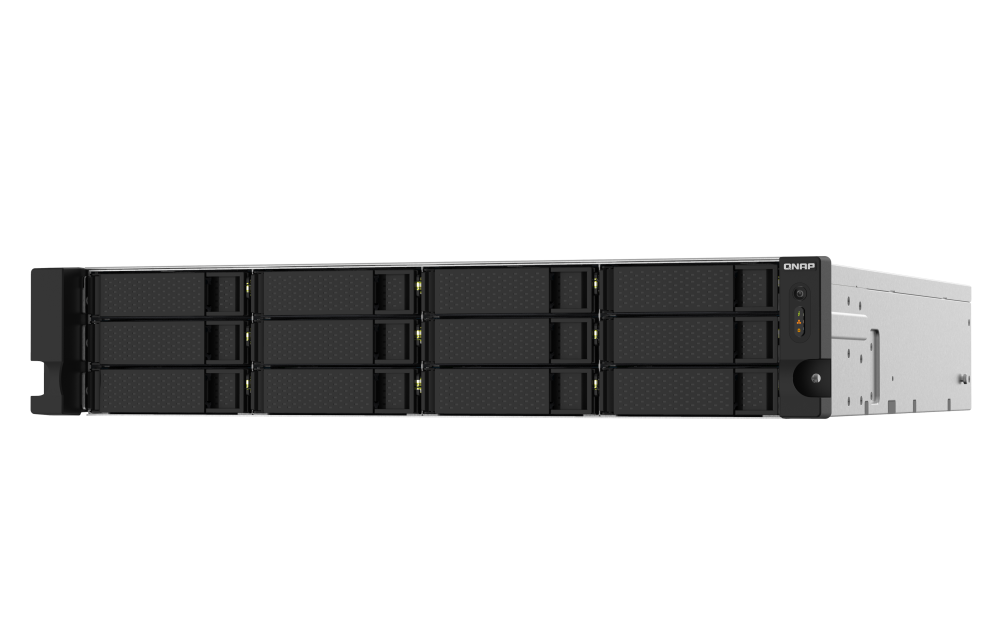
Explore this need in the finder →The TS-1232PXU-RP-4G-US is a high-density, 2U rack NAS whose clearest differentiator is its built-in network mix: two 10GbE SFP+ links alongside two 2.5GbE RJ45 links. It also has twelve internal SATA bays and redundant power supplies. Those capabilities make it a plausible fit for a managed rack build, but this is not a ready-to-run storage pool. The standard manual package list does not include data drives or rail hardware, and the exact drive and cabinet fit still need buyer verification.
Twelve native SATA bays, not a capacity promise
QNAP's exact U.S. TS-1232PXU-RP-4G profile lists twelve 3.5-inch SATA positions. Its published media classes include 3.5-inch SATA hard drives, 2.5-inch SATA hard drives and 2.5-inch SATA SSDs. Each tray is a physical opportunity to add media; it does not tell you how much usable space your selected RAID layout will leave, and neither the model count nor the 12-bay label establishes that disks are supplied. The TS-x32PXU guide's standard package list names the chassis, power cords, a Cat5e Ethernet cable and drive screws, but no data drives or preconfigured array.
For a buyer who wants a mirror, QNAP's comparison page lists RAID 1 for this exact 4G profile, and its QTS guide describes a two-member mirror with tolerance for one member failure. The owner still chooses the disks, confirms exact drive and firmware compatibility, creates the array and restores data if needed. A mirror reduces one particular drive-failure risk; it is not a second copy against accidental deletion, malware, controller problems or a site-level incident. Plan a separately recoverable backup. Optional M.2 media requires a compatible PCIe adapter, and external expansion shelves are separate systems; neither should be counted as one of the twelve native positions.
The network headline is useful only if the links match
The two built-in 10GbE ports use SFP+, while the two 2.5GbE ports use RJ45. That distinction matters at purchase: there is no built-in 10GBASE-T copper jack. A 10GbE SFP+ port can satisfy a 10-Gbps single-port requirement, but the network must also have an appropriate compatible SFP+ module or direct-attach cable, a peer or switch with the right interface, matching client hardware and a suitable path. QNAP's port counts do not promise sustained file-copy speed. Disk choice, RAID work, protocol, client, switch and workload all affect actual transfers. The two 2.5GbE jacks remain separate links; adding their ratings together is not a guarantee that one client or flow can send at the sum.
There is one PCIe Gen 2 x2 slot for expansion. It offers a route to a compatible card, but it is not an unlimited upgrade bay: QNAP itself cautions that PCIe bandwidth can limit 10GbE performance in expansion-card setups. An adapter for M.2, another network card and any resulting lane or fit constraint should be settled from QNAP's exact compatibility material before buying. Do not assume that any familiar card fits merely because it is PCIe.
One evidenced 4G U.S. profile, with an operating-system caveat
The U.S. hardware selector and product comparison identify a TS-1232PXU-RP-4G configuration: one 4-GB DDR4 UDIMM, one memory slot and a listed 16-GB maximum. The U.S. Official Store indexed title supplies the -4G-US order-code bridge, but the Store page itself blocked direct inspection. That indexed identity is not proof of a current offer, condition, shipment details or included seller additions. The English TS-x32PXU guide covers this RP family and documents QTS installation and the two power-cord configuration.
QNAP's current FAQ says the TS-1232PXU family is not supported by current QuTS hero h5.2.x documentation. For this review, that makes the defensible plan QTS rather than assuming a ZFS/QuTS hero alternative. The review treats the current unmarked hardware selector as a current reference, not a stock claim or a support-horizon promise. A compatibility row for a specific memory module, disk, SFP+ transceiver or expansion card is still necessary; the published class or maximum alone does not validate the exact part.
Rack fit and redundant power deserve separate checks
The RP specification lists two 250-W power supplies and a 2U chassis. Redundant power may help a system stay powered through one supply failure when the equipment is configured and connected correctly, but it does not protect data. The model guide describes two power cords and a hot-swappable replacement procedure with technician precautions. QNAP's current product page also warns that some older DPS-250AB-81 A units need a particular replacement set and cage; identify the installed supply revision before ordering a replacement rather than mixing PSU generations by name alone.
Rack dimensions are a material uncertainty, not a footnote to ignore. The U.S. comparison reports 3.49 × 17.01 × 20.12 inches and 28.53 pounds net, noting that its dimension excludes the ear hook and protruding PSU section. The TS-x32PXU v03 guide instead gives 3.50 × 18.97 × 21.02 inches and 25 pounds for the RP chassis. The sources do not provide one complete loaded installation drawing that resolves the difference. Measure the actual unit and allow room for ears, rail travel, ventilation, rear plugs and cable bends; check rack depth and loaded cabinet capacity. The guide names RAIL-B02 as compatible but says the rail kit is separately purchased. QNAP's accessory note describes a 25-inch mounting depth and cautions that shorter racks may need adjustment space, so the rail model still needs a direct fit check.
How it compares and who should keep looking
Among the reviewed 12-bay rack choices, the TS-1232PXU-RP-4G is most relevant when built-in SFP+ ports and dual power are the priority. The current TS-1264U-RP-8G-US is a different 12-bay reference with 8 GB memory, two built-in 2.5GbE ports and support for a QuTS hero option; it does not reproduce this model's native pair of 10GbE SFP+ ports. Conversely, the TS-1232PXU-RP's 4-GB profile, QTS-only evidence and narrow expansion slot may be poor tradeoffs if your plan assumes ZFS, a memory-heavy software stack or 10GBASE-T direct connection. The model does not become a better fit just because it has more ports on paper.
This is a research-based assessment of manufacturer documentation, not a hands-on test. I did not measure throughput, noise, power draw, thermals, rails or failure behavior, and I do not convert QNAP's lab figures into an expected result for a different disk and network setup. Before buying, confirm the exact -4G-US identity, condition and seller BOM; check approved drives and firmware; choose the correct SFP+ link hardware; verify the PSU generation; and independently confirm rack clearance and RAIL-B02 compatibility. A verified product identity does not tell you whether a seller has stock or what it will cost.
Key specifications
Key details at a glance
| Internal drive bays | 12 bays |
|---|---|
| Documented internal drive media | 3.5-inch SATA HDD / 2.5-inch SATA HDD / 2.5-inch SATA SSD |
| Built-in Ethernet ports | 2 x built-in 10GbE SFP+ / 2 x built-in 2.5GbE RJ45 |
| Fastest individual Ethernet port | 10 Gbps |
| Installed system memory | 4 GB |
| Maximum listed memory | 16 GB |
| Listed storage arrangements | QTS: RAID 1 |
| Internal file systems | QTS: EXT4 |
| Hardware warranty | 3 years |
| Data drives included in listed package | No |
| M.2 NVMe slots | 0 |
| Processor | AnnapurnaLabs Alpine AL-324 ARM Cortex-A57 |
| CPU cores | 4 |
| Installed memory type | 4 GB DDR4 UDIMM (one 4-GB module in one memory slot) |
Use the exact model’s instructions for operating limits, supplied equipment and version differences.
Sources for this review
Sources for this assessment
- QNAP U.S. Tower/SMB 95-card product grid
- TS-1232PXU-RP — QNAP U.S. product page
- TS-1232PXU-RP-4G hardware specification — QNAP U.S.
- TS-1232PXU-RP U.S. product comparison — QNAP
- TS-x32PXU User Guide, English-U.S., version 03 — QNAP
- RAID types — QTS 5.2.x User Guide
- Can I use QuTS hero on my NAS, such as the TS-1232PXU? — QNAP FAQ
- TS-1232PXU-RP-4G-US — QNAP U.S. Official Store indexed identity
- QNAP U.S. Official Store indexed 12-bay NAS filter
- TS-1232PXU-RP official QNAP product rendering

Check your setup before choosing a NAS
Use the finder to narrow documented desk/shelf or rack formats, internal-bay minimums, a single Ethernet-port rating and optional redundancy requirements.