
Your needs, this model
Does it fit your priorities?
Which processor and memory package is this review actually about?
The reviewed U.S. Store identity is TDS-h2489FU-R2-4314-256G-US: QNAP's selector lists two Xeon Silver 4314 processors, each 16 cores/32 threads, and 256 GB DDR4 ECC RDIMM. The selector separately lists a 128 GB 4314 option, a 64 GB dual 4309Y option, and 512 GB and 1 TB 4314 options marked By Request. The 1 TB Store page identity appears in official-domain search excerpts; direct Store access failed, and the 512 GB row has no verified U.S. Store SKU. Those are distinct CPU/memory choices, not interchangeable seller packages or evidence of current stock.
Explore this need in the finder →Can ordinary SATA SSDs fill all 24 front bays?
No. QNAP describes sixteen 2.5-inch U.2 NVMe positions and eight positions, numbered 17-24, that accept U.2 NVMe or SATA 6Gbps SSDs. The system ships without SSDs, and this review did not verify any exact compatible drive SKU, capacity and firmware. Check the complete drive identifier in QNAP's TDS-h2489FU R2 compatibility list before building a BOM. The two M.2 positions are a separate, non-hot-swap storage layer and do not add another pair of front drive trays.
Explore this need in the finder →What does the 25GbE and two-drive redundancy screen mean in practice?
The reviewed configuration has a preinstalled dual-port 25GbE SFP28 adapter in PCIe slot 4, so its fastest documented individual port is rated at 25GbE. A compatible peer, transceiver or cable, switch, client interface and workload still determine the end-to-end path; the two ports are not automatically a 50-Gbps single-client link. QNAP's software selector lists RAID 1 under QTS and QuTS hero, and the QuTS hero reference describes a two-drive mirror that tolerates one member-drive failure while healthy. The diskless NAS requires two separately selected compatible SSDs and an actual RAID configuration; a mirror is not a backup of deletion, malware, site loss or whole-system failure.
Explore this need in the finder →What this assessment covers
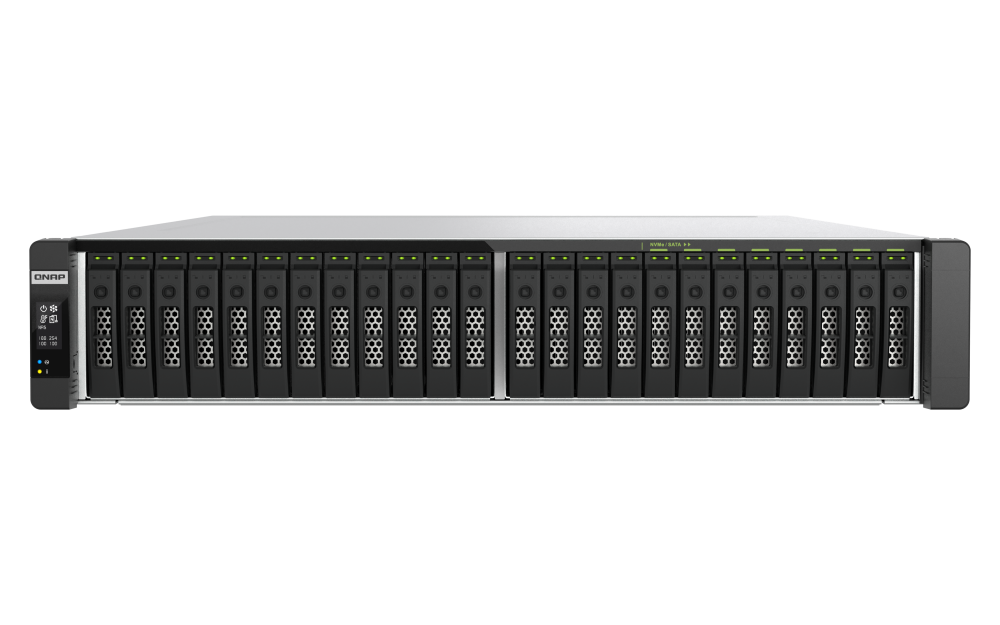
This review covers the QNAP TDS-h2489FU R2 in the exact U.S. configuration identified as TDS-h2489FU-R2-4314-256G-US: two Intel Xeon Silver 4314 processors and 256 GB of DDR4 ECC RDIMM. It is an evidence-based assessment of QNAP's product and specification material, not a hands-on test, installation report or independent performance measurement. The front image is the shared R2 chassis and cannot identify its installed CPU, memory or drives.
The key purchase question is not whether a 24-bay all-flash rack system looks impressive on a feature sheet. It is whether a project needs this exact U.2 NVMe layout, has a compatible SSD set and 25GbE path ready, and can accommodate a nearly 29-inch-deep, 50.2-pound chassis with redundant power. For a small file share or ordinary SATA disk array, this is likely much more platform than necessary.
Five CPU and memory choices are not one package
QNAP's rendered R2 hardware selector presents five configurations. The reviewed TDS-h2489FU-R2-4314-256G-US has two 16-core/32-thread Xeon Silver 4314 processors and 256 GB ECC memory, listed as eight 32 GB modules. The TDS-h2489FU-R2-4314-128G-US shares the 4314 processors but starts at 128 GB. The separately listed TDS-h2489FU-R2-4309Y-64G-US uses two Xeon Silver 4309Y processors with eight cores and sixteen threads each, plus 64 GB. QNAP also lists TDS-h2489FU-R2-4314-512G and TDS-h2489FU-R2-4314-1T choices as “By Request.” Official U.S. Store search excerpts identify the exact 128G, 256G, 64G-US and 1T-US package codes; direct Store retrieval did not succeed, so this review makes no claim about their price, stock, lead time or present orderability. I did not verify a U.S. Store SKU for the 512G selector row.
Those differences matter more than a cosmetic suffix: the lower-memory 4309Y option changes both processor model and per-socket core count, while the 4314 variants carry distinct initial RAM capacities. Do not assume that a listing for “TDS-h2489FU R2” includes the 256G configuration reviewed here, or that an offered configuration matches a benchmark setup. Ask for the complete package identifier, module count and bill of materials in the seller's written quote. QNAP lists up to 1 TB for the current R2 selector; do not transfer older-generation memory ceilings or assumptions to this configuration.
Twenty-four positions, but only eight accept SATA
The chassis is an all-flash rackmount design with sixteen 2.5-inch U.2 PCIe Gen 4 x4 NVMe positions and eight more positions that accept U.2 NVMe or 2.5-inch SATA 6Gbps SSDs. QNAP numbers the SATA-capable positions 17 through 24. A plan to fill all trays with SATA drives therefore does not fit the documented media layout. Nor does “24-bay” mean 24 drives are supplied: QNAP's selector says the system ships without SSDs.
There are two M.2 2280 positions as a separate storage layer. The first supports PCIe Gen 3 x4 NVMe or SATA; the second supports Gen 3 x2 NVMe or SATA. QNAP says the M.2 drives are not hot-swappable, so they are not interchangeable with the front trays for service planning. They also do not make this a 26-bay chassis. Before choosing even a single U.2 SSD, check its complete model, capacity and firmware in QNAP's current compatibility list. No exact compatible drive row was verified for this review, so I cannot recommend an SSD SKU or imply that a generic U.2 drive will work.
Built-in 25GbE is useful only with the rest of the path
The reviewed configuration has four built-in 2.5GbE RJ45 ports and a dual-port 25GbE SFP28 SmartNIC preinstalled in PCIe slot 4. For a requirement expressed as the fastest single built-in Ethernet port, the 25GbE adapter clears a 25Gbps floor; the 2.5GbE ports do not add to that rating. Two 25GbE interfaces are not automatically a 50Gbps link to one client. Cabling or transceivers, switches, client adapters, protocol configuration, SSDs and workload all affect actual transfers.
QNAP lists four PCIe Gen 4 slots and describes optional 25/100GbE and storage expansion cards. Because slot 4 is already occupied by the standard 25GbE adapter, a later expansion plan should start with a slot map rather than treating all four slots as vacant. A 100GbE card, storage card, or other add-in may bring further compatibility, width and peer-network questions. This review does not convert QNAP's lab figures into an expected speed: the published result uses a different memory upgrade, several additional NICs, a fully populated SSD array, RAID 50 and multiple test clients.
Choose the operating system before populating it
QNAP's model-specific software selector lists both QuTS hero h6.1.0 and QTS 6.1.0, together with SMB/CIFS and NFS file services. QuTS hero uses ZFS; QTS uses EXT4. Each selector includes RAID 1 for systems with at least eight bays, so a buyer can build a two-drive mirror plan in either OS, subject to the exact compatible drive set and the chosen pool layout. The RAID configuration is not pre-created, and the base package includes no data SSDs. With two equal drives, RAID 1 retains the capacity of one drive before overhead and can tolerate one member-drive failure while healthy. It does not preserve a separate copy against deletion, malware, site loss or failure of the whole NAS.
QNAP warns that changing the installed OS requires a data backup and removal of all disks. Treat QTS versus QuTS hero as a deployment decision made before production data is loaded, not a harmless mode switch. QNAP also describes active/passive high availability using two TDS-h2489FU R2 systems. That requires a second separately provisioned unit; it is not dual-controller redundancy inside this one chassis and does not replace a backup strategy.
Rack, power, service and package checks
The listed dimensions are 3.48 × 17.57 × 28.08 inches (height × width × depth) and net weight is 50.2 pounds before a drive set. Verify cabinet depth, door clearance, rear cabling, lift and service access. The manufacturer package list shows the NAS, Ethernet cable, two power cords, M.2 screws, 96 drive screws, tray key and quick-install guide; it does not list customer SSDs or rack rails. RAIL-E03 appears among separate accessories, so confirm the precise rail kit and seller bill of materials instead of assuming it is in the box.
Two 1200 W power supplies are specified. QNAP's 467.59 W “typical” figure was tested with drives fully populated; it is useful as a manufacturer reference under that condition, not an independent measurement or a universal estimate for every drive set and workload. Plan for the site's power, cooling and redundant-feed requirements using the actual installation design. QNAP lists a five-year standard warranty, but confirm the applicable service terms and coverage for the exact quote and purchase channel.
Who should shortlist it?
Consider the reviewed 4314-256G configuration when a project specifically needs a dense 24-position NVMe-heavy rack NAS, its compatibility and capacity plan supports the U.2/SATA split, the application can use the dual-CPU/256-GB platform, and the installation can support 25GbE, rack depth, weight, power and cooling. Its native RAID and operating-system options are substantial, but turn those into a detailed build sheet before procurement: exact SSD model and firmware, bay placement, RAID group, backup target, network topology, rails and OS selection.
Look elsewhere if the requirement is simply “many bays,” if the whole array must use SATA, if available network gear is only gigabit or 2.5GbE, or if the rack and electrical plan cannot accommodate this system. More CPU and memory do not compensate for the wrong drive interface or an incomplete network path. QNAP's own compatibility lookup and a written seller configuration should settle those questions before a purchase; neither the marketing benchmark nor a model photo does.
Primary references
- QNAP U.S. TDS-h2489FU R2 product page
- QNAP hardware selector and specifications
- QNAP software selector and package contents
- QNAP QuTS hero RAID types reference and TDS-h2489FU R2 drive-compatibility lookup
Key specifications
Key details at a glance
| Internal drive bays | 24 bays |
|---|---|
| Documented internal drive media | 2.5-inch U.2 PCIe Gen 4 x4 NVMe SSD (positions 1-24) / 2.5-inch SATA 6Gbps SSD (positions 17-24 only) |
| Built-in Ethernet ports | 4 x built-in 2.5GbE RJ45 / 2 x 25GbE SFP28 SmartNIC ports on included dual-port adapter preinstalled in PCIe slot 4 |
| Fastest individual Ethernet port | 25 Gbps |
| Installed system memory | 256 GB |
| Maximum listed memory | 1024 GB |
| Listed storage arrangements | QuTS hero: Single, RAID 0, RAID 1, RAID 5, RAID 6, RAID 10, RAID 50, RAID 60, Triple Mirror, Triple Parity (8-bay and larger selector) / QTS: RAID 1 and additional supported modes (model-specific QTS selector) |
| Internal file systems | ZFS (QuTS hero) / EXT4 (QTS) |
| Hardware warranty | 5 years |
| Data drives included in listed package | No |
| M.2 NVMe slots | 2 |
| Processor | 2 x Intel Xeon Silver 4314 |
| CPU cores | 32 |
| CPU threads | 64 |
| Installed memory type | 256 GB DDR4 ECC RDIMM (8 x 32 GB) in the reviewed 4314-256G configuration |
Use the exact model’s instructions for operating limits, supplied equipment and version differences.
Sources for this review
Sources for this assessment
- QNAP U.S. Tower / SMB product grid observation
- QNAP U.S. TDS-h2489FU R2 product page
- QNAP U.S. TDS-h2489FU R2 hardware selector and specifications
- QNAP U.S. TDS-h2489FU R2 software selector
- QNAP U.S. TDS-h2489FU R2 package-content selector
- QNAP U.S. Store TDS-h2489FU R2 4314-256G configuration identity
- QNAP QuTS hero RAID types reference
- QNAP compatibility list and TDS-h2489FU R2 drive lookup
Check your setup before choosing a NAS
Use the finder to narrow documented desk/shelf or rack formats, internal-bay minimums, a single Ethernet-port rating and optional redundancy requirements.