
Your needs, this model
Does it fit your priorities?
How many internal positions does this profile provide?
Five E1.S NVMe positions. The M.2 adapter route uses the same positions, not extra bays; this is not a SATA HDD tray system.
Explore this need in the finder →Can one built-in Ethernet interface meet 10Gbps?
Yes. QNAP lists a 10GBASE-T port and a separate 2.5GbE port; neither adding them nor counting Thunderbolt as Ethernet gives one faster Ethernet link. Network components and workload determine actual transfer results.
Explore this need in the finder →Is a supported two-drive mirror possible?
The English-U.S. guide lists RAID 1 for two drives with one-drive failure tolerance. Verify media and create the array yourself; maintain a separate backup. Current-reference status does not guarantee seller stock.
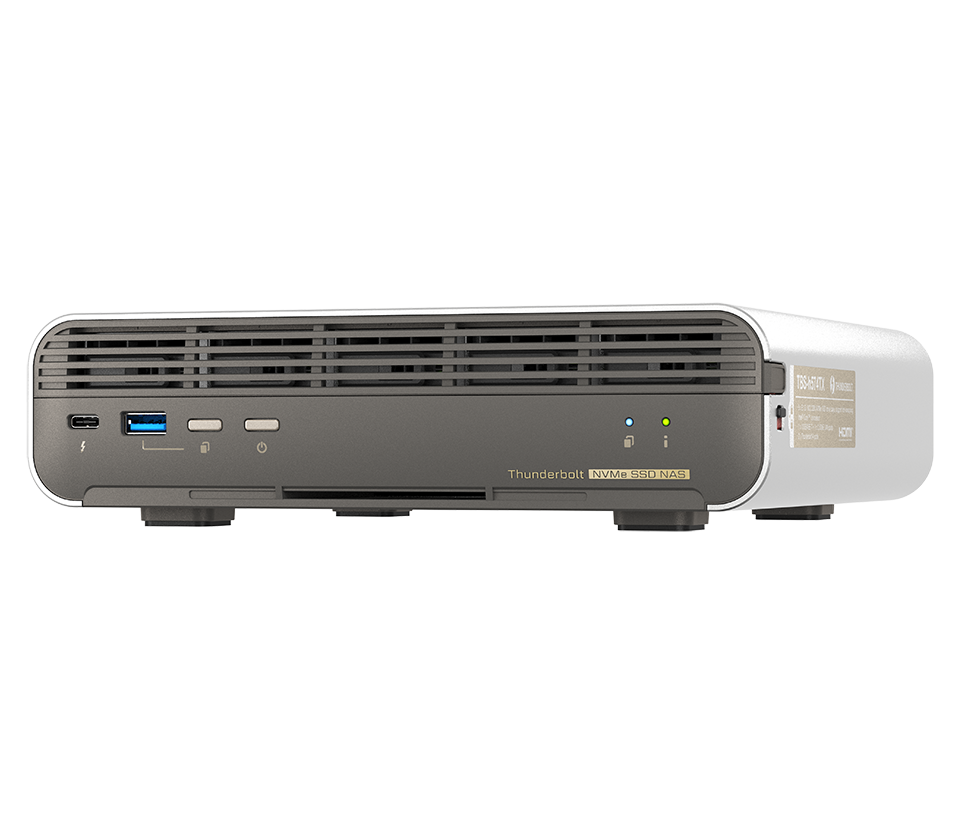
Explore this need in the finder →QNAP’s U.S. product page describes a five-drive, 3.84 TB E1.S package for the TBS-h574TX, and the English-U.S. guide identifies the ordering P/N as TBS-h574TX-i5UC-05S02. The guide places it in the 16 GB Intel Core i5-1235U group. The exact U.S. Official Store SKU was not verified: a guessed “-US” item path returned no product page, so this review does not add that suffix or imply an offer. Its profile is nonetheless distinct from the 1.92 TB S01 bundle and diskless i5U model because the documented package contains five larger SSDs. The chassis illustration does not show drive labels, capacities or package contents.
19.2 TB is the five-drive nominal sum
Five 3.84 TB E1.S NVMe devices total 19.2 TB by nominal capacity. That manufacturer figure is not the same as user-available formatted space, and RAID choice changes the resulting usable capacity. The manual documents a two-drive RAID 1 option; creating it is the owner’s task after confirming the exact SSDs and initializing storage. A mirror uses two positions and can continue after a member-drive failure, but it is not protection against deletion, ransomware, theft or losing the NAS. A separate backup and a tested restore plan remain necessary. The drive package’s precise SSD model and firmware are important purchase details; do not infer them from capacity alone.
QNAP documents five E1.S PCIe Gen 3 x2 positions for the family. The M.2 2280 route uses adapters in those positions rather than adding new bays. For SSD-loaded packages, the guide says the M.2 adapter is optional; the included E1.S drives occupy the available slots. Check the model-specific compatibility data, firmware and physical thickness limits before swapping any media. The system is a network-attached all-flash NASbook and not a conventional multi-inch SATA HDD tower.
i5U base and network caveats
The S02 package uses the current-reference Core i5-1235U profile with 16 GB onboard, non-expandable memory. It shares the same family’s one 10GBASE-T Ethernet port, one 2.5GbE port and two data-only Thunderbolt 4 ports. A 10-Gbps matcher result refers to one built-in Ethernet port, not aggregated Ethernet or a predicted data-copy rate. A proper 10GbE workflow also requires compatible client hardware, switching, cabling and storage workload. Thunderbolt provides a separate potential path for a compatible workstation, but it should not be reported as Ethernet or as a guaranteed speed. QNAP family benchmark claims have not been independently reproduced for this package.
QNAP lists QuTS hero preinstalled and QTS as an alternative. Its guide’s RAID 1 row establishes a supported owner-created two-drive plan, not a ready-made array. Decide on OS, pool layout, backup and software before placing production data. QTS and QuTS hero have different filesystems; switching requires data preservation and setup changes rather than assuming an in-place conversion. The included SSD capacity does not remove the need to validate the selected layout or maintain another copy.
Identity and package checks
For this profile, check that the model paperwork states TBS-h574TX-i5UC-05S02 and five 3.84 TB E1.S devices. QNAP’s U.S. family page and manual support those model/package facts, but the saved evidence did not bridge the P/N to a matching U.S. Official Store item or seller offer. Treat any reseller’s exact suffix, warranty, drive contents and current availability as unresolved until documented. Do not infer that a seller includes network adapters, spare drives, a prebuilt RAID set or other additions.
The chassis is only 60 × 215 × 199 mm, but it still needs proper ventilation, cable access and stable placement. This higher-capacity factory-loaded package may simplify media selection for a buyer who wants five E1.S drives and has verified support, but its package identity and exact SSD codes matter more—not less—because it has an unresolved U.S. retail bridge. It is a poor fit for ordinary 3.5-inch disk economics or a requirement for field-upgradable system memory. No direct purchase offer, price, stock, rating, or hands-on result is claimed.
Key specifications
Key details at a glance
| Internal drive bays | 5 bays |
|---|---|
| Documented internal drive media | E1.S NVMe SSD / M.2 2280 PCIe NVMe SSD via compatible adapter |
| Built-in Ethernet ports | 1 x 10GBASE-T Ethernet / 1 x 2.5GbE Ethernet / 2 x Thunderbolt 4 data-only |
| Fastest individual Ethernet port | 10 Gbps |
| Installed system memory | 16 GB |
| Listed storage arrangements | RAID 1 (two-drive arrangement; owner chooses media and creates storage) |
| Processor | Intel Core i5-1235U |
| CPU cores | 10 |
| CPU threads | 12 |
| Installed memory type | Onboard, non-expandable |
Use the exact model’s instructions for operating limits, supplied equipment and version differences.
Sources for this review
Sources for this assessment
- QNAP U.S. Tower/SMB grid — TBS-h574TX family card
- QNAP U.S. Official Store SMB Desktop page 3
- TBS-h574TX — QNAP U.S. product page
- TBS-h574TX profiles — QNAP U.S. comparison
- Rendered TBS-h574TX hardware selector observation
- TBS-h574TX User Guide, English U.S., v5 (2025-04-09)
- TBS-h574TX official family chassis image

Check your setup before choosing a NAS
Use the finder to narrow documented desk/shelf or rack formats, internal-bay minimums, a single Ethernet-port rating and optional redundancy requirements.