
Your needs, this model
Does it fit your priorities?
How many internal positions does this profile provide?
Five E1.S NVMe positions. The M.2 adapter route uses the same positions, not extra bays; this is not a SATA HDD tray system.
Explore this need in the finder →Can one built-in Ethernet interface meet 10Gbps?
Yes. QNAP lists a 10GBASE-T port and a separate 2.5GbE port; neither adding them nor counting Thunderbolt as Ethernet gives one faster Ethernet link. Network components and workload determine actual transfer results.
Explore this need in the finder →Is a supported two-drive mirror possible?
The English-U.S. guide lists RAID 1 for two drives with one-drive failure tolerance. Verify media and create the array yourself; maintain a separate backup. This exact configuration is marked Legacy; include earlier models to compare it.
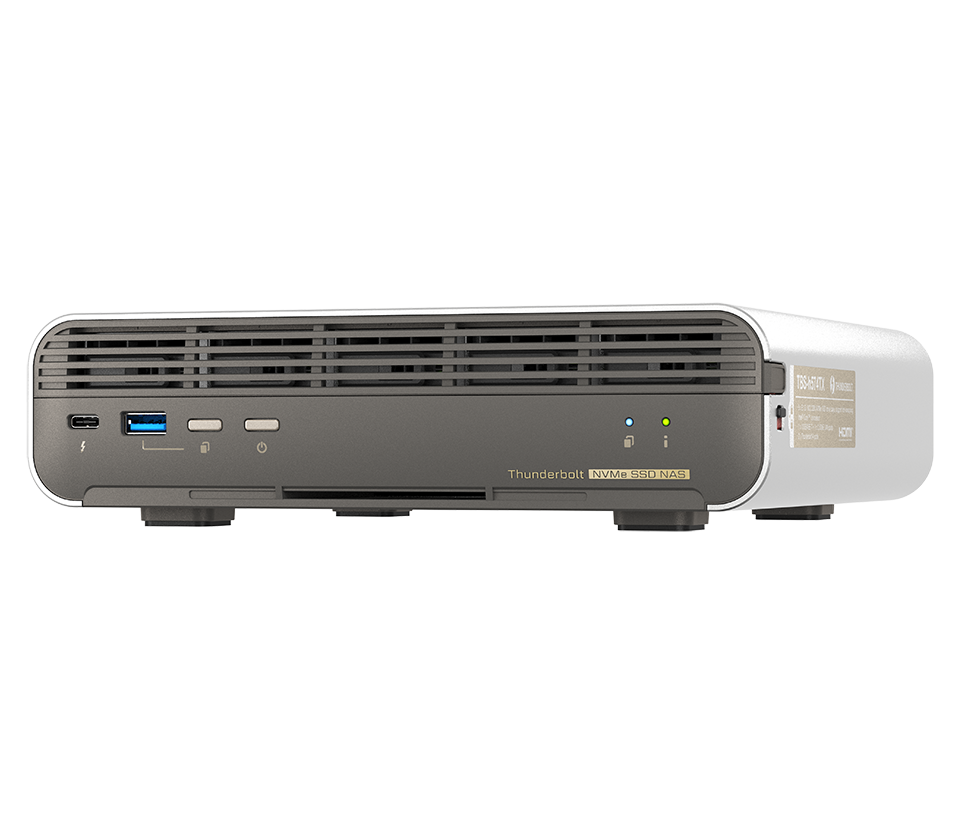
Explore this need in the finder →The TBS-h574TX-i5-16G is the earlier Core i5 configuration in QNAP’s compact, five-position all-flash NASbook line. QNAP’s English-U.S. guide identifies the profile as an Intel Core i5-1340P/PE system with 16 GB onboard memory and no preinstalled SSDs; QNAP’s rendered selector marks it Legacy. The exact configuration is distinguishable from the current i5U-16G by its processor, and from the earlier i3-12G by both processor and installed memory. No exact U.S. Store suffix was confirmed, and a legacy label is not a real-time stock check. The pictured family enclosure does not expose these internal distinctions.
Five E1.S/NVMe slots, not five SATA bays
This profile uses five E1.S NVMe positions on PCIe Gen 3 x2. QNAP’s model guide also describes adapters that let M.2 2280 PCIe NVMe media occupy positions; that does not add positions to the five-slot count. This is not a conventional hard-disk tower with 3.5-inch SATA carriers. Before selecting drives, check exact model and firmware support and the manual’s physical thickness and heatsink limits. A drive that fits a connector is not automatically listed as a compatible part.
The i5-16G ships without preinstalled SSDs according to the guide’s ordering table. QNAP separately describes packages with five 1.92 TB or five 3.84 TB E1.S drives, but those are distinct configurations, not included extras in this bare profile. Their advertised totals of 9.6 TB and 19.2 TB are simple package sums and do not tell you the usable space after a selected storage layout. If configuring RAID 1, two compatible SSDs consume two of the five positions; QNAP documents the arrangement but the user selects media and initializes the pool. Redundancy against a drive failure is not another backup copy.
Port ratings do not say how fast a workflow will be
The comparison lists one built-in 10GBASE-T port and one separate 2.5GbE port. Ten gigabits per second is the fastest individual Ethernet interface; these unlike links should not be added to imply a faster one-client connection. A real transfer can be limited by workstation, switch, cable, protocol, SSD layout or simultaneous users. The two Thunderbolt 4 ports are for data and offer another potential direct-connection workflow, not an Ethernet link or a guaranteed performance figure. Confirm compatible host systems and software before depending on that path.
The main model distinction against the current version is CPU: this older profile uses the Core i5-1340P/PE while the current i5U uses an i5-1235U; both are listed with 16 GB non-expandable memory. The i3-1320PE variant has 12 GB, and the current comparison identifies its separate processor. This review does not rank real application speed from those labels. QNAP’s published marketing numbers are not independent tests of the exact i5-16G build, and actual results depend on the complete workflow.
System choice and buying checks
QNAP lists QuTS hero preinstalled on the family and describes QTS as an alternative. QNAP’s user guide lists RAID 1 for two drives; an owner must select compatible SSDs, choose the OS/filesystem and create the pool. Because QuTS hero and QTS use different filesystem setups, changing later is not a harmless switch—keep data elsewhere before reinitializing. Back up separately even when a mirror is used. The guide’s standard-package listing describes the NAS, power adapter, cord, network cable and documentation, but does not list the five data SSDs for this bare i5-16G model.
For a purchase based on a reseller listing, verify the profile label, CPU, memory and whether it is the bare model or one of the separately documented SSD packages. Also confirm warranty, firmware support, any installed drive health and the seller’s written bill of materials; none follows from the lifecycle label. This earlier profile could suit a buyer who wants the all-flash footprint and is comfortable validating an older i5 configuration, but not someone whose brief requires current-reference status, expandable RAM, ordinary SATA drives or factory-installed 10GbE network peers. No ownership, hands-on test, current offer, or customer rating is implied.
Key specifications
Key details at a glance
| Internal drive bays | 5 bays |
|---|---|
| Documented internal drive media | E1.S NVMe SSD / M.2 2280 PCIe NVMe SSD via compatible adapter |
| Built-in Ethernet ports | 1 x 10GBASE-T Ethernet / 1 x 2.5GbE Ethernet / 2 x Thunderbolt 4 data-only |
| Fastest individual Ethernet port | 10 Gbps |
| Installed system memory | 16 GB |
| Listed storage arrangements | RAID 1 (two-drive arrangement; owner chooses media and creates storage) |
| Processor | Intel Core i5-1340P/PE |
| CPU cores | 12 |
| CPU threads | 16 |
| Installed memory type | Onboard, non-expandable |
Use the exact model’s instructions for operating limits, supplied equipment and version differences.
Sources for this review
Sources for this assessment
- QNAP U.S. Tower/SMB grid — TBS-h574TX family card
- QNAP U.S. Official Store SMB Desktop page 3
- TBS-h574TX — QNAP U.S. product page
- TBS-h574TX profiles — QNAP U.S. comparison
- Rendered TBS-h574TX hardware selector observation
- TBS-h574TX User Guide, English U.S., v5 (2025-04-09)
- TBS-h574TX official family chassis image

Check your setup before choosing a NAS
Use the finder to narrow documented desk/shelf or rack formats, internal-bay minimums, a single Ethernet-port rating and optional redundancy requirements.