
Your needs, this model
Does it fit your priorities?
Are 36 QVP-63B camera channels included in the purchase?
No. The QVP-xxB guide lists eight embedded channels and a maximum of 36; it directs buyers to purchase additional channel licenses in the License Center. The product package does not list cameras, and stream compatibility still needs checking.
Explore this need in the finder →What changes between QVP-63B and QVP-85B?
The 63B lists six SATA bays, Core i3-12100, 16GB memory and up to 36 camera channels; the 85B lists eight bays, Core i5-12400, 32GB memory and up to 64. Both have QVP OS and two built-in 2.5GbE ports. Compare the camera/retention plan rather than buying the larger ceiling by default.
Explore this need in the finder →Can the QVP-63B mirror two drives?
QNAP documents RAID1 using two drives, with one member failure tolerance. A buyer must supply compatible drives and configure the array. The mirror occupies two of six SATA trays and is not a separate backup.
Explore this need in the finder →Assessment basis: this is an original, documentation-based assessment of the QNAP QVP-63B-US listing, mapped to the six-bay QVP-63B and its English QVP-xxB guide. No hands-on use or independent performance test is claimed. It belongs in a NAS library because QNAP describes QVP as a NAS device with storage, network and file-management utilities; its primary role is a dedicated QVR Pro surveillance server.
The middle QVP tier is a storage-and-camera choice
The QVP-63B occupies the middle of this three-model surveillance group: six internal 3.5-inch SATA positions, between the QVP-41C's four and the QVP-85B's eight. QNAP's manual lists 16GB of preinstalled DDR4 memory, an Intel Core i3-12100 processor and two memory slots with a 64GB manufacturer maximum. The current product page describes a tower-based network surveillance server and up to 36 IP camera channels. That makes it the relevant step-up when an installation outgrows a four-bay or 24-channel ceiling, not automatically the best choice for a general-purpose office NAS.
QVP runs QVR Pro OS rather than the ordinary QTS/QuTS hero combination. QNAP's QVP documentation describes storage, networking, privilege and file-management utilities, so the system can manage its own volumes and recordings. However, its product documentation emphasizes video surveillance; do not assume QTS package availability or treat this model as interchangeable with a mainstream QTS NAS. Confirm every non-surveillance service your installation needs before making it the only shared-storage appliance.
Eight embedded channels; 36 is a ceiling
The guide lists eight embedded channels and a maximum of 36. It explicitly directs buyers to purchase additional channel licenses through the License Center. The 36-channel specification is not a statement that 36 cameras are included, nor does it promise a particular camera combination, resolution or frame rate. The current hardware table reports 1,188 Mbps maximum throughput and local-display limits under specified H.264 settings. Treat these as manufacturer specification conditions to compare with the actual camera streams, not as a measured recording benchmark. A camera model can appear in a general compatibility list and still require a specific firmware, feature or stream configuration for the intended job.
Two built-in 2.5GbE ports connect the recorder to the network, and one HDMI 1.4b output supports direct local display. The port speed is a per-port link rating, not an expected file-transfer rate or a combined 5Gbps single connection. Switch capacity, camera layout, cabling, client paths and stream bitrates matter. The local display path also has its own stream limits, so validate the desired monitor count and camera layout separately from recording throughput.
Six drive positions leave room for a deliberate layout
The six SATA bays accept the drive classes QNAP lists for this chassis: 3.5-inch SATA hard drives and 2.5-inch SATA hard drives or solid-state drives. Two additional M.2 2280 PCIe Gen 4 x4 positions are separately described; they are not two more SATA bays. QNAP's guide says the M.2 positions support SSD caching, but buyers should still check the exact approved SSD list and workload support rather than assuming every M.2 module is interchangeable. Data drives are not listed as part of the standard box contents.
QVP supports RAID 1, 5, 6 and 10 among its documented storage choices. A two-drive RAID 1 arrangement is the straightforward documented mirror for a two-drive redundancy requirement, and it leaves four of the six SATA trays open. A larger RAID group may be more appropriate for a sustained video workload, but that is a separate capacity-versus-failure-tolerance decision. QNAP's guide describes a failed-member hot-swap path for supported arrays; the buyer must still choose compatible drives and prepare for rebuild time. RAID does not replace an independent copy of recordings or a tested recovery process.
How it differs from the smaller and larger QVPs
Compared with the QVP-41C, the 63B has two extra SATA positions, a newer Core i3 platform, 16GB of standard memory, a single HDMI output and a higher published maximum channel count. Compared with the eight-bay QVP-85B, it has two fewer drive positions, a lower CPU/memory starting point and a 36-channel rather than 64-channel ceiling. The 85B's higher capacity can matter when the camera and retention plan needs it; it is not an advantage if the project does not use those resources. The QVP-63B's two 2.5GbE ports and QVR Pro software are not a substitute for checking the exact retention and camera plan.
What to verify before purchase
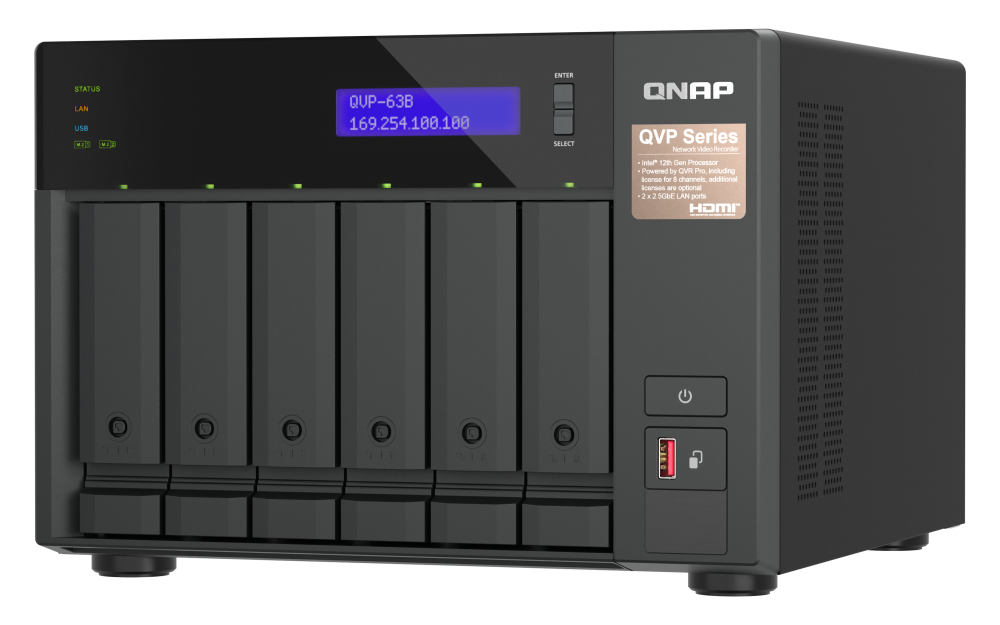
Confirm camera compatibility, channel licenses, the number and type of drives, useful retention under real camera bitrates, local-display needs and the network design. QNAP's manual package list includes the tower, power cords, cable, drive screws, M.2 heatsinks, tray keys and quick-start guide, but no HDDs. Verify the exact QVP-63B-US seller package instead of inferring a populated array. If you need general file sharing or backup as well as surveillance, confirm the relevant QVP services and recovery tools rather than extrapolating from a QTS NAS. The product photograph identifies the chassis only; it does not show a drive bundle. No current price, stock, shipping promise, measured performance, noise, power consumption or user experience is asserted.
Primary references: QNAP's QVP-63B product page, hardware specifications, the QVP-xxB User Guide, and QNAP's About QVP documentation.
Key specifications
Key details at a glance
| Internal drive bays | 6 bays |
|---|---|
| Documented internal drive media | 3.5-inch SATA hard disk drives / 2.5-inch SATA hard disk drives in the SATA bays / 2.5-inch SATA solid-state drives in the SATA bays |
| Built-in Ethernet ports | 2 x built-in 2.5GbE RJ45 |
| Fastest individual Ethernet port | 2.5 Gbps |
| Installed system memory | 16 GB |
| Listed storage arrangements | RAID 0 / RAID 1 / RAID 5 / RAID 6 / RAID 10 |
| Data drives included in listed package | No |
| M.2 NVMe slots | 2 |
| Processor | Intel Core i3-12100 |
| CPU cores | 4 |
| CPU threads | 8 |
| Installed memory type | DDR4 SODIMM, 1 x 16GB preinstalled |
Use the exact model’s instructions for operating limits, supplied equipment and version differences.
Sources for this review
Sources for this assessment

Check your setup before choosing a NAS
Use the finder to narrow documented desk/shelf or rack formats, internal-bay minimums, a single Ethernet-port rating and optional redundancy requirements.