
Your needs, this model
Does it fit your priorities?
Is the QVP-41C the same kind of general-purpose NAS as a QTS tower?
No. QNAP describes QVP as the system for a NAS appliance dedicated to QVR Pro surveillance. QVP includes storage, network and file-management utilities, but its documented workflow centers on cameras and recordings. Verify each non-surveillance service and recovery path instead of assuming QTS/QuTS hero app support.
Explore this need in the finder →How many QVR Pro camera channels are included?
The QVP-x1C guide lists eight embedded channels and a maximum of 24. It directs users to the License Center to purchase additional channels. Cameras are not listed in the standard package, and the maximum does not guarantee a particular camera-stream combination.
Explore this need in the finder →Can a two-drive QVP-41C mirror tolerate one member disk failure?
QNAP's QVP storage guidance documents RAID 1 with two drives and one-drive failure tolerance. You must buy compatible media and create the mirror; it uses two of the four SATA positions and still needs a separate backup and restore plan.
Explore this need in the finder →Can I upgrade the 8GB QVP-41C memory later?
Do not budget on an upgrade without confirming the unit revision. QNAP's current table lists two SO-DIMM slots and a 16GB maximum, but its English QVP-x1C guide calls the 8GB QVP-41C memory non-expandable. The U.S. Store suffix does not settle that conflict.
Explore this need in the finder →Assessment basis: this documentation-based assessment covers QNAP's U.S.-listed QVP-41C-US, mapped to the QVP-41C model page and its English user guide. It is not a hands-on review. The product is a dedicated surveillance NAS, not a regular QTS NAS with a surveillance app added as one of many workloads.
A four-bay recorder built around QVR Pro
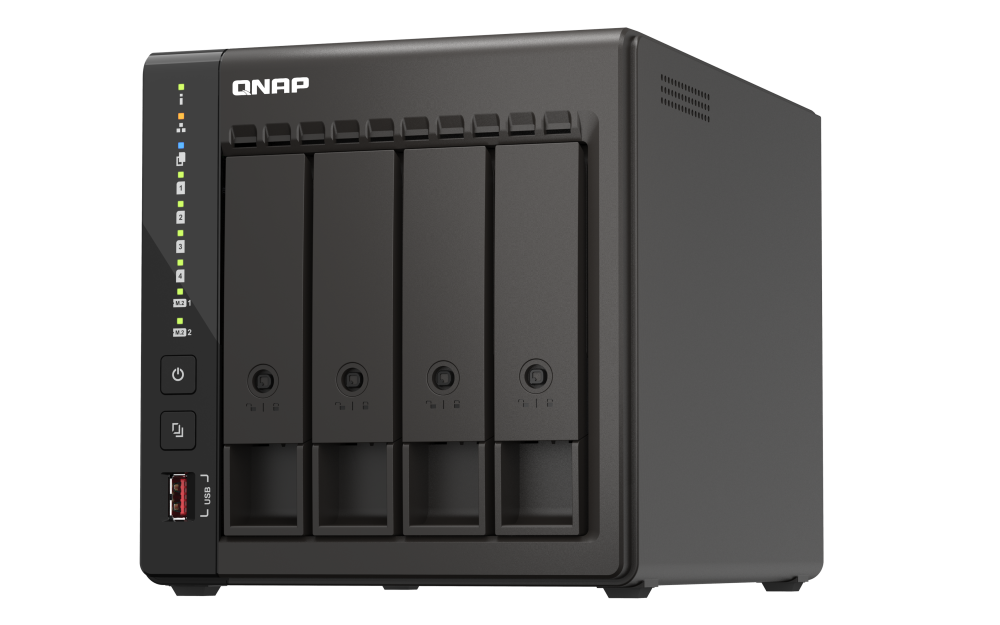
QNAP describes the QVP-41C as a tower NVR/network surveillance server. QVP is its system for the QVR Pro appliance, which QNAP also describes as a NAS device dedicated to surveillance. Storage, networking and file-management tools are present, but the product's design center is recording and managing camera streams. That distinction matters: do not assume the same broad application catalog or setup workflow as a QTS or QuTS hero NAS. If general household backup, media serving or a particular third-party package is your main job, verify the exact QVP service and restore path first, or compare a conventional NAS.
The manual identifies four 3.5-inch SATA bays, with 2.5-inch SATA SSD support in those positions. It also lists two M.2 2280 PCIe Gen 3 x2 slots, but those do not increase the four-bay SATA count. QNAP's QVP guides describe SSD caching; check the exact media support and current compatibility information before treating the M.2 positions as part of a surveillance design. The published material includes no preinstalled data drives. You need to select and install compatible drives, create the storage layout, and account for usable capacity rather than assuming a recording volume is ready out of the box.
Channel capacity is not the same as free licenses
QNAP's guide lists eight embedded camera channels and up to 24 total channels for the QVP-41C. Its note says additional channel licenses can be purchased in the License Center. Eight included channels do not mean eight cameras are supplied, and the 24-channel ceiling is not a guarantee that any arbitrary set of cameras will run at full resolution and frame rate. The current specification gives a 300 Mbps maximum throughput and model-specific local-display figures; use those as manufacturer limits under stated conditions, not as independently measured results. Camera stream settings, encoding, retention goals and the rest of the installation affect the design.
There are two built-in 2.5GbE RJ45 ports and two HDMI outputs. The Ethernet link rating is useful only if the switch, cabling and camera/network layout support the intended traffic. Two ports do not promise a single 5Gbps file path. The dual HDMI outputs give a local display option for multi-channel monitoring, which may be relevant in a guard desk or small office. They do not replace checking monitor resolution, QVR Pro display limits or camera-stream settings.
Four bays can trade growth for a mirror
The QVP guide documents RAID 1 for two drives and lists one failed member drive as the scenario that the array can tolerate. A buyer-supplied, compatible two-drive mirror therefore gives a documented redundant arrangement while leaving two of the four SATA positions unoccupied. That is still a design choice, not a bundled configuration: the unit ships without HDDs, and the buyer must choose the drives and create the array. A mirror protects against one member-drive failure; it does not protect against accidental deletion, malware, theft, fire, loss of the whole appliance or a bad retention policy. A separate backup and a tested restore remain necessary.
QNAP's QVP documentation lists additional RAID layouts, including RAID 5, RAID 6 and RAID 10, but those require different disk counts and trade usable capacity against resilience. The right layout depends on camera bitrates, retention target, camera count and how long recordings must remain available. The four physical bays are the fixed starting constraint; an expansion unit may be supported only when the exact model and connection are verified. Do not count an optional shelf as native bays.
A processor and memory question worth checking
The English QVP-x1C guide identifies an Intel Celeron J6412 quad-core processor, 8GB preinstalled memory and calls the QVP-41C memory non-expandable. QNAP's current hardware table, however, shows two DDR4 SO-DIMM slots and a 16GB maximum for this model. Those statements conflict. The matching U.S. Store label does not resolve the hardware revision, so this assessment treats 8GB as the documented configuration and does not recommend an upgrade or rely on the 16GB maximum. Confirm the exact revision with QNAP before purchasing or opening the unit if memory capacity matters.
Who should consider it
The QVP-41C is a plausible fit for a small surveillance deployment that values a dedicated QVR Pro appliance, four internal bays, two 2.5GbE links and two local HDMI outputs. It is a poor shortcut if you want an ordinary general-purpose NAS and have not verified QVP's supported applications for that task. Compare it with the six-bay QVP-63B if more internal recording positions or higher published channel capacity matter; the eight-bay QVP-85B raises those ceilings further. Check the camera compatibility list, license requirements, drive compatibility, site network and backup plan before ordering. QNAP's standard guide lists an adapter, cable, trays and hardware but no data drives; a seller's particular package may differ. No price, retailer stock, measured speed, noise, power use, reliability result or customer experience is claimed here.
Primary references: QNAP's QVP-41C product page, hardware specifications, the QVP-x1C User Guide, and QNAP's About QVP documentation.
Key specifications
Key details at a glance
| Internal drive bays | 4 bays |
|---|---|
| Documented internal drive media | 3.5-inch SATA hard disk drives / 2.5-inch SATA solid-state drives in the SATA bays |
| Built-in Ethernet ports | 2 x built-in 2.5GbE RJ45 |
| Fastest individual Ethernet port | 2.5 Gbps |
| Installed system memory | 8 GB |
| Listed storage arrangements | RAID 0 / RAID 1 / RAID 5 / RAID 6 / RAID 10 |
| Data drives included in listed package | No |
| M.2 NVMe slots | 2 |
| Processor | Intel Celeron J6412 |
| CPU cores | 4 |
| CPU threads | 4 |
| Installed memory type | DDR4 SODIMM, listed 8GB configuration |
Use the exact model’s instructions for operating limits, supplied equipment and version differences.
Sources for this review
Sources for this assessment

Check your setup before choosing a NAS
Use the finder to narrow documented desk/shelf or rack formats, internal-bay minimums, a single Ethernet-port rating and optional redundancy requirements.