
Your needs, this model
Does it fit your priorities?
Does a QSN-7530 meet a 30-bay minimum?
QNAP's U.S. QuTS MEGA and scale-out lineup pages list thirty 2.5-inch SATA positions. They do not specify the supported drive type or exact model compatibility in those cards, so check QNAP's model-specific compatibility list and the quote before selecting drives. The 30 positions belong to a node in a multi-node system, not a standalone NAS.
Explore this need in the finder →Does the QSN-7530 meet a built-in 10-Gbps network requirement?
QNAP's model card lists two built-in 10GbE BASE-T ports and two 2.5GbE BASE-T ports. That is a 10-Gbps individual-port link rating, not a measured file-transfer result; confirm the switch, client, cabling, cluster network and service design. No optional or third-party 25GbE adapter is counted here.
Explore this need in the finder →Does QNAP document a QSN-7530 local two-drive mirror?
No model-specific local two-drive mirror plan was documented in the inspected QSN-7530 pages. The QuTS MEGA overview instead discusses protection and availability at distributed platform level. The required-mirror finder option therefore does not treat QSN-7530 as a confirmed two-drive arrangement; obtain an exact system design and keep a separate backup.
Explore this need in the finder →Is QSN-7530 a complete single-node NAS?
No. QNAP describes QSN-7530 as a QuTS MEGA node, and the platform page says clusters start with three nodes. The reviewed individual route did not provide a model-specific role or package table, so ask QNAP or its integrator to document the complete cluster, node roles, drive compatibility, switches, support, installation and quote before purchasing.
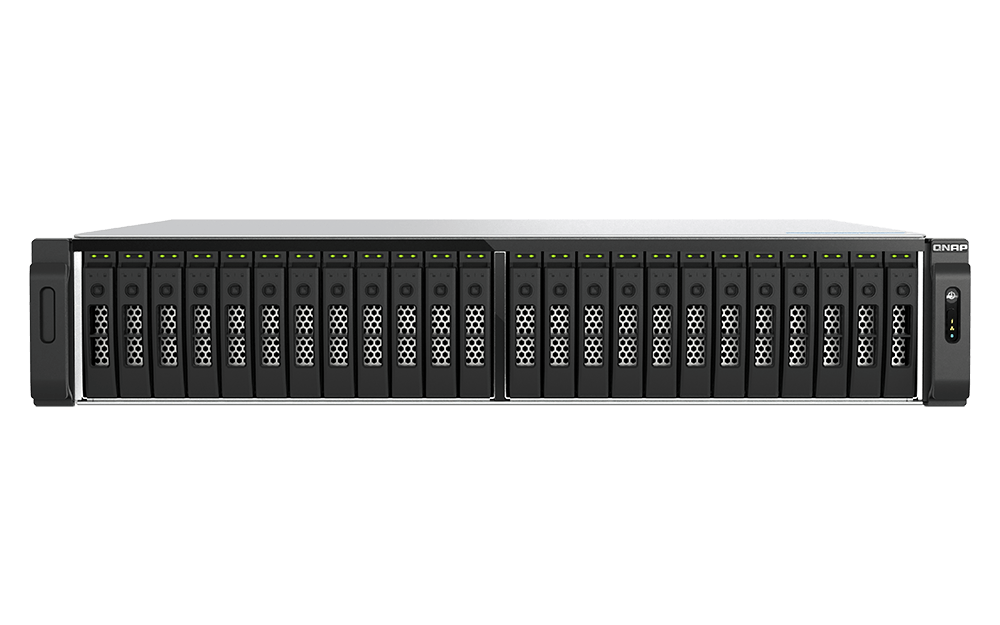
Explore this need in the finder →The QNAP QSN-7530 appears in QNAP's U.S. QuTS MEGA and scale-out lineup as a dense, 2U node. The public model cards identify thirty 2.5-inch SATA positions, 192 GB of DDR5 ECC RDIMM and an AMD Ryzen 9 PRO 7945 processor. Its profile is distinct from the mixed-media QSN-3050 even though both list thirty positions. The evidence is thinner than for the QSN-3050: the QSN-7530 individual U.S. specification route returned no readable content, so package contents, exact drive support, cluster role counts and several setup details remain unresolved. This is a document-based assessment, not a product test or ownership report.
A dense 30-position chassis with an important media unknown
QNAP lists the QSN-7530 as a 2U node with thirty 2.5-inch SATA positions. That is enough to meet a 30-bay threshold, but the reviewed U.S. model cards do not say which 2.5-inch drive types, capacities, hot-swap behavior or exact part numbers are supported. Do not translate “2.5-inch SATA” into “any small SATA drive fits,” or assume that the positions take SSDs only. Ask for the exact QSN-7530 drive compatibility list and a configuration-specific quotation before planning a dense array. It is not the same hardware layout as the QSN-3050's twenty-four 3.5-inch plus six 2.5-inch bays, and it should not inherit the other model's compatibility notes or package list.
The model card lists 192 GB of DDR5 ECC registered DIMM memory and a 12-core/24-thread Ryzen 9 PRO 7945. QNAP's U.S. solution table lists the processor at 3.7 GHz. Those numbers identify the published configuration; they are not a workload benchmark or evidence that the QSN-7530 is faster than a competing server in a particular job. The 2U height is relevant when rack space is constrained, but the page-level lineup does not provide a full model-specific drawing, rail details, weight, power data or required service clearance.
Plan for cluster services, not one-box setup
QNAP describes QuTS MEGA as a distributed storage and cluster-management platform. Its U.S. operating-system page says a cluster can start at three nodes and expand as high as 96. The platform overview describes SMB and NFS file access, S3-compatible object storage, high availability, monitoring and protection through replication or erasure coding. Those are platform-level descriptions; the empty QSN-7530 individual route did not provide a model-specific list of software versions, role minimums or deployment restrictions. A buyer should ask QNAP or its integrator to confirm that the proposed QSN-7530 configuration is supported for the intended cluster, and to document management, gateway and storage roles for the actual design.
No local two-drive mirror plan was documented in the inspected QSN-7530 pages. The finder therefore does not count the node for a required in-chassis two-drive arrangement. Distributed protection is a different layer, and it cannot replace an independent recovery copy. The buyer should identify the failure cases the cluster is meant to handle, the chosen redundancy policy, rebuild and restore process, and a separate backup destination. The general QuTS MEGA material is not enough to calculate usable capacity for this node or predict performance for a particular data set.
Two built-in 10GbE ports do not settle the topology
QNAP lists two 10GbE BASE-T ports and two 2.5GbE BASE-T ports for the QSN-7530. It consequently clears a screening requirement for one built-in 10-Gbps interface. That is a link rating, not a combined four-port speed or a measured client transfer rate. Cluster traffic, management, gateways and file services may have separate network needs. Confirm which ports serve each role, which switches and cables are required, and whether clients, storage media and workload can use the proposed path. The QSN-7530 model card does not establish that a 25GbE adapter is installed or supported, so do not add one to the base-port comparison without a model-specific confirmation.
Make the quote answer the missing questions
QNAP's U.S. scale-out page routes buyers to a request for quote, while its QuTS MEGA overview sends a prospective buyer to product details. The direct QSN-7530 hardware, software and package pages supplied no readable table in this research cycle. As a result, no exact box contents, data-drive inclusion, rails, cabling, warranty, seller SKU, stock or price can be stated. Ask for a written quote identifying the QSN-7530 configuration and revision, compatible drive models, supplied adapters and network parts, node count, rack hardware, power requirements, software/support entitlement, deployment scope and return or acceptance terms. Do not assume the broader QNAP solution bundle is included with an individual node.
Who should shortlist it?
The QSN-7530 merits a closer enterprise evaluation when the target is a 2U dense node with thirty listed 2.5-inch SATA positions, substantial ECC memory and built-in 10GbE inside QNAP's QuTS MEGA system. It is not a sensible match for someone who needs a familiar home NAS, a standalone first server, a verified local two-drive mirror or an orderable disk-included appliance. Its sharpest comparison is with the QSN-3050: the two have the same published bay count, but their media formats, memory type and chassis heights differ, and the 7530's drive compatibility and package remain less documented in the sources reviewed here.
Bottom line: the model card establishes a useful shortlist profile, not a complete purchasing specification. Treat the QSN-7530 as a candidate cluster node and keep its 30 x 2.5-inch positions and 10GbE in the screening comparison; before buying, require QNAP or its integrator to resolve the model-specific media list, role plan, package, support and cluster configuration in writing.
Key specifications
Key details at a glance
| Internal drive bays | 30 bays |
|---|---|
| Documented internal drive media | 2.5-inch SATA drives (type not specified in the reviewed U.S. model cards) |
| Built-in Ethernet ports | 2 x built-in 10GbE BASE-T / 2 x built-in 2.5GbE BASE-T |
| Fastest individual Ethernet port | 10 Gbps |
| Installed system memory | 192 GB |
| Internal file systems | QuTS MEGA distributed storage platform; model-specific internal filesystem table not obtained |
| Processor | AMD Ryzen 9 PRO 7945 |
| CPU cores | 12 |
| CPU threads | 24 |
| Installed memory type | DDR5 ECC RDIMM |
Use the exact model’s instructions for operating limits, supplied equipment and version differences.
Sources for this review
Sources for this assessment
- QNAP U.S. MEGA Scale-out NAS lineup and quote route
- QNAP U.S. QuTS MEGA model and operating-system overview
- QNAP U.S. QSN-7530 individual model route (access result only)
- QNAP U.S. QSN-7530 direct specification routes (access results only)
- QNAP U.S. QuTS MEGA cluster scale and protection overview
- QNAP U.S. QuTS MEGA QSN-7530 model-card image
Check your setup before choosing a NAS
Use the finder to check bay count, the network link you need, and whether a documented two-drive redundant arrangement is essential.