
Your needs, this model
Does it fit your priorities?
Does one QSN-3000 node meet an 18-bay minimum?
QNAP lists 18 internal positions per node: twelve 3.5-inch SATA positions and six 2.5-inch SATA positions. The smaller positions are listed for SATA SSDs; exact drive models and support must be checked. The 18 positions belong to a node in a minimum three-node QuTS MEGA cluster, not a standalone NAS.
Explore this need in the finder →Can the QSN-3000 meet a 10-Gbps built-in-port requirement?
QNAP lists two built-in 10GBASE-T ports and two built-in 2.5GbE ports. That meets a 10-Gbps single-port floor, but two ports are not one combined link and the optional 25GbE PCIe adapter is not part of the base built-in specification. Link speed is not a throughput result.
Explore this need in the finder →Does the QSN-3000 satisfy a required two-drive mirror?
No. QNAP describes replication or erasure coding across storage nodes in the QuTS MEGA cluster, not a documented local two-drive RAID 1 arrangement for this node. The matcher therefore excludes it when a two-drive redundant arrangement is required; cluster protection is not an independent backup.
Explore this need in the finder →Is the QSN-3000 eligible when earlier models are excluded?
Yes, as a current-reference U.S. manufacturer model. “Current-reference” is not a retail availability claim. Selecting earlier models does not change this node’s cluster requirement or turn it into a standalone NAS.
Explore this need in the finder →The QNAP QSN-3000 is best understood as one building block in an enterprise storage cluster, not as an 18-bay NAS you can switch on by itself. QNAP documents QuTS MEGA as a distributed scale-out system with SMB, NFS and S3-compatible services, and specifies a minimum three-node cluster with role-count requirements. That deployment boundary matters more than the server-like Xeon processor or the 2U chassis: one QSN-3000 cannot independently provide the documented cluster services. This assessment follows QNAP's U.S. product and specification pages, its deployment FAQ and its scale-out solution material; it is not based on a physical unit or hands-on testing.
Count all 18 positions, but keep the two media groups distinct
QNAP's detailed hardware table lists 12 3.5-inch SATA positions and six 2.5-inch SATA positions, or 18 internal positions per node. That clarifies the Tower/SMB card's shorter “12-bay” label: the card reflects the larger 3.5-inch group, while the hardware page adds six 2.5-inch positions. The media notes are not interchangeable. QNAP lists 3.5-inch SATA hard drives in the large positions and 2.5-inch SATA solid-state drives in the smaller positions; it also lists 2.5-inch SATA SSDs as supportable in the 3.5-inch positions. The table does not list 2.5-inch SATA hard drives, and no exact drive model, capacity or firmware should be inferred from these general media categories. Check the complete drive identifiers and support terms for the offered system before specifying a cluster.
QNAP specifies 128 GB of ECC DDR4 UDIMM memory across four slots, with 128 GB as the maximum in the cited configuration, and an Intel Xeon E-2336 processor. These are manufacturer specifications, not a performance result. The chassis is 2U and approximately 88.6 × 432 × 511.2 mm (H × W × D), so rack depth, rail fit, airflow, service clearance and power design remain deployment questions. QNAP lists two 550 W power supplies; those ratings do not tell you the actual draw or facility requirement of a populated system.
QuTS MEGA is a multi-node service, not standalone NAS software
QNAP names QuTS MEGA and CephFS for this platform and lists SMB, NFS and S3-compatible object services. Its software specification calls for at least three cluster nodes, at least three management nodes, at least one gateway node and at least three storage nodes. QNAP says those roles may overlap, but the minimum is still a multi-node system. Its FAQ recommends six or more nodes for production data protection. Before treating a QSN-3000 as suitable, ask QNAP or a qualified integrator to map how many nodes, switches, gateways, storage roles and management roles the specific deployment requires. Role overlap does not mean a single node can satisfy the minimum.
QNAP describes replication and erasure coding across storage nodes, so the failure domain is the distributed node or cluster arrangement. That is a different proposition from a two-drive mirror inside one NAS. The QSN-3000 does not have a documented two-drive RAID 1 plan in the cited QuTS MEGA sources; it therefore should not be read as satisfying a requirement for a local two-drive redundant arrangement. Conversely, cluster-level protection does not replace an independent backup, versioned copy or recovery test. Have the architect specify failure scenarios, node count, rebuild behavior, capacity overhead and recovery responsibilities rather than translating “replication” into an assumed RAID level.
10GbE is built in; 25GbE is an expansion choice
The reviewed hardware table lists two built-in 10GBASE-T ports and two built-in 2.5GbE ports. For a minimum asking for one built-in 10GbE port, the node clears the hardware screen without an add-in card. QNAP also lists optional 25GbE PCIe networking, but that is not part of the base built-in-port count and should not be treated as installed. Link speed is not file-transfer throughput: confirm the selected switch, client adapters, cable plant, protocol, storage layout, concurrent workload and full cluster topology. Two 10GbE ports remain two interfaces; their labels do not promise one 20-Gbps client path.
Box contents and procurement need a written quote
The hardware package listing names the QSN-3000, a 10G cable, two power cords and screws; it does not list data drives. QNAP presents the wider scale-out NAS as a quote and deployment engagement, and separately illustrates full-service configurations that can include additional system components. Those solution examples are not proof that every QSN-3000 box includes disks, switches, rails, support terms or a selected software configuration. Request a bill of materials for the full intended cluster: exact QSN model and revision, drives and compatibility, adapters, rack rails, switches and transceivers, software/support entitlements, installation services, warranty coverage and acceptance criteria. No retail SKU, seller stock, current price or orderable package is established here.
Who should consider it?
The QSN-3000 belongs on a shortlist only when an organization is planning the larger QuTS MEGA system, needs 18 documented drive positions per node, and has a network design that calls for built-in 10GbE. Its scale-out file and object services, ECC memory and mixed bay layout are meaningful evaluation facts, but the reviewed evidence does not establish benchmarks, workload suitability or total-system cost. It is a poor fit for someone looking for a single-box home or office NAS, a local two-drive mirror, a ready-populated server or an uncomplicated retail purchase.
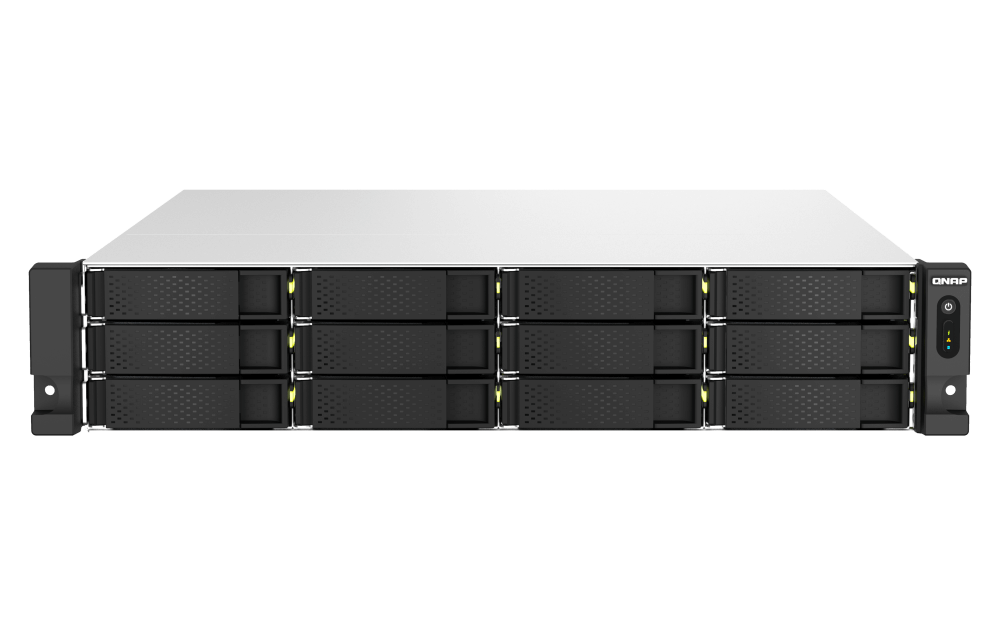
Bottom line: treat QSN-3000 as an enterprise node to be evaluated inside a quoted, multi-node QuTS MEGA design. Verify that 12 large SATA positions plus six SSD-oriented 2.5-inch positions fit the planned media, and design for at least the documented cluster and role counts before comparing node-level bay or link specifications. The accompanying QNAP QuTS MEGA model-card render is explicitly identified as QSN-3000, but it shows only the front face; it does not establish the six additional 2.5-inch positions, installed drives or box contents. A separate product-gallery asset whose filename identifies TS-h1887XU remains excluded.
Product and deployment sources checked 2026-10-30; exact image association checked 2026-11-04. Sources: QNAP U.S. QSN-3000 product page; QSN-3000 hardware specifications; QSN-3000 software specifications; QNAP QuTS MEGA minimum-node FAQ; QNAP U.S. scale-out NAS solution and model lineup; QNAP U.S. QuTS MEGA model page and QSN-3000 image association; QNAP 2025 scale-out NAS datasheet. Direct verified HTTPS requests to several specification/FAQ routes returned HTTP 202 with empty bodies; the rendered first-party pages were inspected separately, and the challenge bodies were not used as evidence. A different QSN-3000 gallery candidate was excluded because its linked filename identifies TS-h1887XU.
Key specifications
Key details at a glance
| Internal drive bays | 18 bays |
|---|---|
| Documented internal drive media | 3.5-inch SATA HDD (3.5-inch positions) / 2.5-inch SATA SSD (supported in 3.5-inch positions) / 2.5-inch SATA SSD (2.5-inch positions) |
| Built-in Ethernet ports | 2 x built-in 10GbE BASE-T / 2 x built-in 2.5GbE BASE-T |
| Fastest individual Ethernet port | 10 Gbps |
| Installed system memory | 128 GB |
| Maximum listed memory | 128 GB |
| Internal file systems | CephFS |
| Dimensions (H × W × D) | 88.6 x 432 x 511.2 mm (H x W x D); 2U rackmount |
| Weight | 14.87 kg |
| Hardware warranty | 5 years |
| Data drives included in listed package | No |
| Processor | Intel Xeon E-2336 |
| CPU cores | 6 |
| CPU threads | 12 |
| Installed memory type | ECC DDR4 UDIMM |
Use the exact model’s instructions for operating limits, supplied equipment and version differences.
Sources for this review
Sources for this assessment
- QNAP U.S. Tower / SMB product grid, QSN-3000 card
- QNAP U.S. QSN-3000 product page
- QNAP U.S. QSN-3000 hardware specifications
- QNAP U.S. QSN-3000 software specifications
- QNAP FAQ: minimum nodes in a QuTS MEGA cluster
- QNAP U.S. full-service scale-out NAS solution and lineup
- QNAP 2025 full-service scale-out NAS datasheet
- QNAP U.S. QuTS MEGA model page (QSN-3000 image association)
Check your setup before choosing a NAS
Use the finder to check bay count, the network link you need, and whether a documented two-drive redundant arrangement is essential.