
Your needs, this model
Does it fit your priorities?
Can the ES2486AFdc meet a 24-bay, 10GbE and two-drive RAID 1 screen?
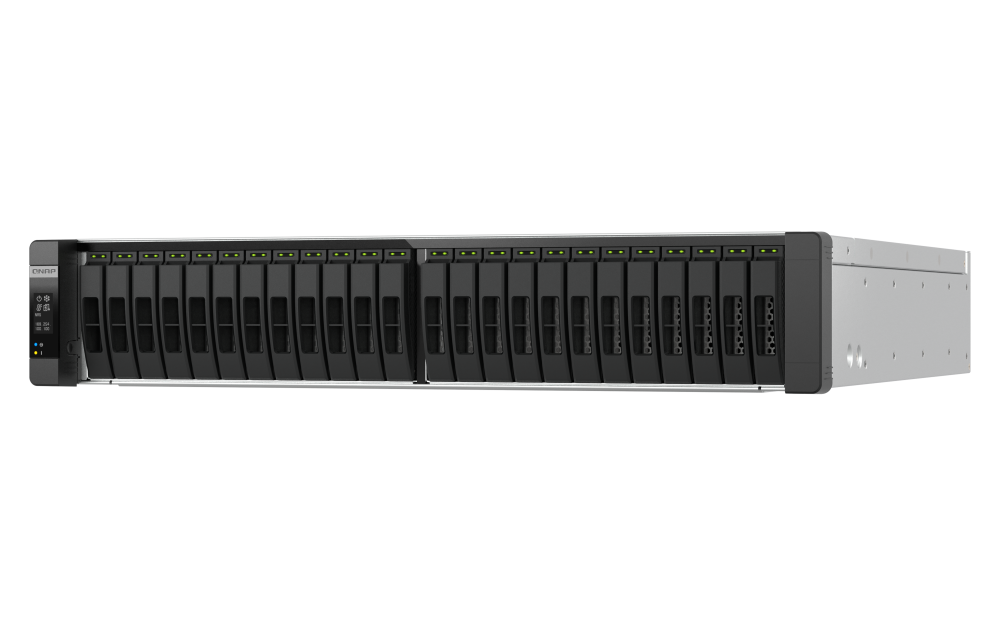
QNAP's U.S. table lists 24 native 2.5-inch positions for dual-port U.2/U.3 NVMe PCIe SSDs and four built-in 10GbE SFP+ ports per controller. Its model-specific software table lists RAID 1, and QES help defines RAID 1 as a two-drive arrangement. The ES2486AFdc-2142IT-128G therefore meets those documentation-level floors when the buyer separately selects compatible drives and an appropriate network path. The bundle itself is not shown with data SSDs, and this is not a tested-throughput claim.
Explore this need in the finder →Does the listed package include 24 NVMe data drives?
No data-bay SSDs appear in QNAP's package contents list. It lists the chassis, cables, two power cords, rail kit, screws and two NVRAM-cache backup battery units. Confirm the seller's exact bill of materials rather than treating the 128G hardware configuration as a drive bundle.
Explore this need in the finder →Is active-active controller failover the same as a RAID 1 mirror?
No. The two active-active controller modules address controller/service availability; the QES RAID 1 layout is a separate choice that mirrors data across two compatible SSDs and tolerates one member-drive failure. Neither feature is an independent backup. The drives, supported firmware and QES storage plan must be confirmed and provisioned separately.
Explore this need in the finder →Enterprise all-flash assessment · QNAP
The ES2486AFdc-2142IT-128G is best read as a specialized enterprise storage platform rather than a large home NAS. QNAP’s U.S. hardware table identifies a two-controller, 2U system with 24 2.5-inch positions intended for dual-port U.2/U.3 NVMe SSDs. Its model page documents SMB and NFS file services as well as iSCSI and Fibre Channel, so this is NAS-capable hardware, but it is also designed for block storage and high-availability deployment. The fit depends less on the headline bay count than on whether your organization can source the right enterprise SSDs, build the network path, fit the chassis and operate QES.
Its 24 positions are a narrow, all-flash drive plan
Twenty-four positions is substantial density for a 2U chassis, but do not translate that into generic “24-drive NAS” compatibility. The exact U.S. table says the positions accept dual-port U.2/U.3 NVMe PCIe SSDs. It does not list SATA or SAS data drives for those bays. QNAP’s model-filtered compatibility route explains that its certified-drive list is the place to confirm each full device model and firmware, but this research did not recover the dynamic ES2486AFdc drive rows. That leaves the exact SSD candidates, capacities and any mixing rules unresolved. Before a quote or design is approved, verify each intended part number and firmware against the live list and have the seller state which drives, if any, are supplied.
QNAP lists 64 GB of ECC RDIMM memory in each controller under the 128G configuration, with an eight-core Xeon D-2142IT processor per controller. The overview presents controller-specific failover and simultaneous active-active operation; those are manufacturer-described architecture, not an independent availability test. Its stated QES 2.2.1 environment uses ZFS and supports file services alongside block protocols. This is a different operating proposition from a typical single-controller NAS built chiefly for household apps.
Controller availability and disk redundancy solve different failures
The word “redundancy” can mislead here. The chassis has two active-active controllers, while QES separately lists RAID 1. QNAP’s QES 2.2.x help defines RAID 1 as two disks storing an identical copy, tolerating one member-disk failure at the cost of half the pair’s raw capacity. That supports a buyer-selected two-SSD plan; it does not show that the machine arrives with a pair installed or that an array is already configured. The package list names no data-bay SSDs. A mirror also cannot protect against deletion, ransomware, site loss or a bad change, so enterprise backup and recovery remain separate design work.
The same distinction matters when evaluating the vendor’s failover claims. Two controllers may address a controller fault, but real service continuity also depends on network design, firmware, hosts, paths and operating procedures. The QES user-facing software table lists HA and fail-over features, but this review did not test failover or measure recovery time. Treat the architecture as a reason to examine the platform, not a guarantee that a workload will have zero downtime.
Ten-gigabit ports are useful only with a complete path
QNAP lists four built-in 10GbE SFP+ ports per controller, plus three 2.5GbE ports per controller, with one 2.5GbE port assigned for remote management. For a questionnaire asking whether the appliance has one built-in 10GbE-class port, the answer is yes. That says nothing about throughput at a client. The host adapter, optics or DAC, switch, cabling, storage workload and configuration have to support the intended rate. QNAP’s package list shows two 1GbE cables; it does not establish that the 10GbE transceivers, switch ports or client hardware are included.
There is also a specification discrepancy worth resolving before buying expansion cards: the feature overview describes two PCIe Gen4 slots per controller, whereas the exact U.S. hardware table lists two PCIe Gen3 x8 slots per controller. The table is the safer basis for a preliminary design, but the difference should be confirmed with QNAP or the integrator for the specific controller revision and card. The overview separately calls each NVMe bay Gen4 x4; the hardware table confirms the U.2/U.3 interface without restating a per-bay generation. Do not use those marketing claims as a substitute for a drive or card compatibility check.
Rack, power and package checks are part of the shortlist
QNAP’s table lists a 2U enclosure, 48.5 lb net weight, redundant hot-swap 700 W supplies, and a 656.4 W “typical” figure tested with drives fully populated. That power number is a manufacturer test condition, not an estimate for every SSD population or a measured operating bill. Confirm cabinet depth, loaded rail rating, airflow, circuit capacity, noise expectations, delivery handling and installation responsibility with the deployment team. QNAP lists an RAIL-E03 kit and two power cords in its package contents, but the seller’s written bill of materials still controls what arrives.
Where it sits beside another QNAP enterprise option
Compared with the reviewed ES1686Adc-2142IT-128G, the ES2486AFdc has eight more native positions, but the media plan differs: the former’s table describes a hybrid SAS/U.3 chassis, while this model’s exact table specifies dual-port U.2/U.3 NVMe SSDs. That is not a simple capacity upgrade or a drive-compatibility shortcut. If 24 all-flash NVMe positions, QES and controller-level availability are not requirements, a lower-bay system may be easier to provision and cool. If they are, compare exact controller revisions, SSD bills of material, host multipathing, service coverage and recovery requirements—not headline IOPS claims. QNAP’s product-page performance statements are manufacturer claims; no independent benchmarks or hands-on tests are represented here.
Assessment: The ES2486AFdc is a credible documented candidate for a planned enterprise NVMe NAS/SAN role, not a general recommendation for an unqualified home setup. Its strongest fit is the combination of 24 dual-port NVMe positions, QES/ZFS, multiple built-in 10GbE links and two controllers. The limiting work is procurement and engineering: exact drive validation, the PCIe-slot discrepancy, SFP+ components, rack/power planning, and a recovery design that extends beyond RAID.
Key specifications
Key details at a glance
| Internal drive bays | 24 bays |
|---|---|
| Documented internal drive media | 2.5-inch dual-port U.2/U.3 NVMe PCIe SSD |
| Built-in Ethernet ports | 4 x 10GbE SFP+ per controller / 3 x 2.5GbE per controller (one assigned for remote management) |
| Fastest individual Ethernet port | 10 Gbps |
| Installed system memory | 128 GB |
| Maximum listed memory | 1024 GB |
| Listed storage arrangements | RAID 0 / RAID 1 / RAID 5 / RAID 6 / RAID 10 / RAID 50 / RAID 60 / RAID TP / Triple Mirror |
| Internal file systems | ZFS (QES) |
| Dimensions (H × W × D) | 88.4 x 483.1 x 525.3 mm (H x W x D; converted from QNAP's 3.48 x 19.02 x 20.68 inches) |
| Weight | 22 kg |
| Data drives included in listed package | No |
| System drives included (not data-bay drives) | One 64 GB M.2 Copy-to-Flash SSD per controller (cache-protection device, not a data-bay SSD) |
| Processor | Intel Xeon D-2142IT per controller |
| CPU cores | 16 |
| Installed memory type | DDR4 ECC RDIMM, 64 GB in each of two controller modules in the listed 128G configuration |
Use the exact model’s instructions for operating limits, supplied equipment and version differences.
Sources for this review
Sources for this assessment
- QNAP U.S. Tower / SMB listing and current dual-controller NAS navigation
- QNAP U.S. ES2486AFdc product overview
- QNAP U.S. ES2486AFdc hardware specifications
- QNAP U.S. ES2486AFdc software specifications
- QNAP U.S. ES2486AFdc package contents
- QNAP model-filtered U.S. drive compatibility list route, model 841
- QNAP QES 2.2.x Web Help: RAID types
- QNAP U.S. model-filtered ES2486AFdc Download Center route
- QNAP ES2486AFdc official U.S. product image

Check your setup before choosing a NAS
Use the finder to check bay count, the network link you need, and whether a documented two-drive redundant arrangement is essential.