
Your needs, this model
Does it fit your priorities?
Can the 128G configuration meet a 16-bay, 10GbE and two-drive-mirror screen?
QNAP lists 16 native SAS positions, four built-in 10GbE SFP+ ports per controller, and QES RAID 1. That is a documented hardware/configuration fit, not a supplied or pre-created mirror; confirm two exact compatible SAS drives and the whole 10GbE path.
Explore this need in the finder →Does the 128G suffix include sixteen data drives?
No such inference is supported. QNAP's package list does not name data-bay drives; the 128G suffix identifies the memory configuration. Get the exact drive count and complete model numbers on the seller's written bill of materials.
Explore this need in the finder →Can I buy the same documented chassis with 96G instead?
QNAP's U.S. hardware selector lists the 2142IT-96G variant at 48 GB per controller, while the exact U.S. Store route inspected for this review identifies 2142IT-128G-US. The separate 96G seller suffix was not verified, so request the full quote code and installed memory per controller before comparing.
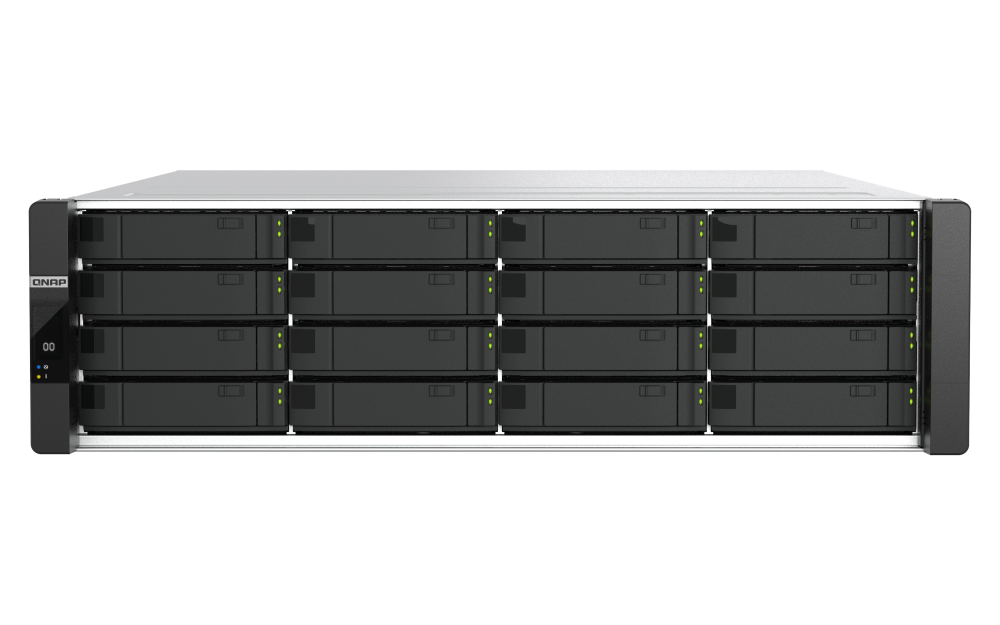
QNAP's ES1686dc R2 is a 3U, 16-bay rack NAS built around a QES/ZFS dual-controller design. The specific configuration assessed here is the U.S. Store-listed ES1686dc-R2-2142IT-128G-US: two Intel Xeon D-2142IT controllers, each with eight cores and 64 GB of ECC memory. This is a documentation-based assessment, not a hands-on or failover test. Its strongest case is an organization that already has a rack, SAS procurement, and an operator responsible for storage design. The “128G” suffix describes the installed memory total, not the capacity or number of data drives.
Sixteen SAS positions require an exact drive plan
QNAP's U.S. R2 hardware selector lists sixteen native 3.5-inch SAS 12Gb/s positions, backward-compatible with SAS 6Gb/s. It lists 3.5-inch SAS hard drives and 2.5-inch SAS drives or SSDs in those bays. It does not list SATA media for this R2 configuration, so an adapter or a compatibility note from another ES-series model is not a safe substitute. Before building a quote, check each complete drive model, capacity and firmware in QNAP's live compatibility data and ask the integrator to document any permitted mix. The tray shape alone does not establish support.
The sixteen positions are chassis capacity, not shipped storage. QNAP's rendered package list names power cords, network cables, fasteners, a rail kit, console cable, NVRAM battery units and a quick-install guide, but no customer data drives. Have the seller itemize the exact suffix, controller memory, drive models and quantities, rails, support and included accessories in writing. The hardware page also describes one 64 GB M.2 Copy-to-Flash SSD per controller; those are controller cache modules, not two data-bay drives or an operating-system mirror.
Separate controller redundancy from a disk arrangement
The R2 has two active-active controllers within one chassis. QNAP describes distributing storage-pool ownership between them to make use of both controllers, and it discusses failover and failback. That is a controller architecture, not a claim that a second complete NAS, second site, or recoverable backup is included. We did not test takeover behavior, failover time, recovery, application continuity or availability.
Separately, QNAP's software table lists QES 2.2.1 and RAID 1, while QES 2.2 help specifies a two-disk group that tolerates one member-disk failure. A buyer can plan a RAID 1 pair from compatible SAS disks, but the pair must be selected and the group created during configuration; the published package list does not present it as a prebuilt array. This arrangement consumes two of the sixteen positions and roughly half of those drives' combined raw capacity before other storage considerations. A mirror can help with a drive failure. It does not protect against deletion, theft, malware, controller-wide damage or a failed backup process, so design an independent copy and a restore procedure too.
10GbE is a port rating, not the result at a client
Each controller is listed with four 10GbE SFP+ links and three 2.5GbE ports; QNAP assigns one 2.5GbE port on each controller to remote management. The built-in 10GbE link clears the review's single-port 10-Gbps finder threshold without summing ports. It does not show that one workstation will transfer at 10 Gbps, or that eight ports combine into one link. The real path also depends on the selected SFP+ transceiver or DAC, switch, cable, client interface, storage layout and workload. QNAP publishes lab results for particular multi-port test setups, but those are vendor conditions rather than a guarantee for a buyer's network; this review did not reproduce them.
QNAP lists two PCIe Gen 3 x8 slots per controller for expansion. Networking cards and SAS expansion can change the deployment design, but check model compatibility, card dimensions, cabling, switch capacity and support before counting an add-on as a requirement met. The two base 10GbE ports and optional expansion should not be blended into a fictional out-of-box speed.
Memory variants are different configurations
The 128G-US configuration uses 64 GB RDIMM DDR4 ECC per controller with the eight-core D-2142IT. QNAP's U.S. selector also lists the same processor with 48 GB per controller in the 96G variant. I did not verify a separate U.S. Store suffix for that 96G option, so a displayed selector entry is not enough to treat it as the configuration on a seller quote. Obtain the full order code and installed memory per controller. The distinct ES1686dc-R2-2123IT-64G-US uses a four-core Xeon D-2123IT and 32 GB per controller; its differences are discussed in its own assessment. QNAP warns against mixing RDIMM and LRDIMM and recommends supported modules. None of these memory figures is a benchmark or proof that a given application will run well.
Plan the rack, operation and purchase as one system
A 3U enclosure brings rack depth, cabinet load, lift, airflow, heat, power circuits, cable routing and service clearance into the buying decision. The product is not a quiet desktop appliance, and QNAP's full-bay power figure is a manufacturer test condition, not a prediction for an unpopulated or differently populated installation. Confirm the exact chassis weight, rail compatibility and electrical requirements from the delivered configuration, then budget for drives, optics or DACs, compatible switches, expansion, support and installation. A complete written bill of materials is more useful than a bare model-family label.
For an enterprise design with sixteen SAS positions, a QES dual-controller architecture and a separately sourced 10GbE path, the 128G variant is a plausible assessment candidate if its memory configuration matches the project's plan. It is not a default recommendation for a household photo library or a buyer who wants a nearly turnkey one-box setup. Drive eligibility, exact package, deployed QES build, supported expansion, controller behavior and restore readiness all remain questions for QNAP and the integrator. No seller inventory, transaction price, independent performance, sound, power draw, reliability or customer experience is claimed here.
Key specifications
Key details at a glance
| Internal drive bays | 16 bays |
|---|---|
| Documented internal drive media | 3.5-inch SAS HDD / 2.5-inch SAS HDD / 2.5-inch SAS SSD |
| Built-in Ethernet ports | 4 x 10GbE SFP+ per controller / 3 x 2.5GbE per controller; one 2.5GbE port per controller is assigned to remote management |
| Fastest individual Ethernet port | 10 Gbps |
| Installed system memory | 128 GB |
| Maximum listed memory | 1024 GB |
| Listed storage arrangements | RAID 0 / RAID 1 / RAID 5 / RAID 6 / RAID 10 / RAID 50 / RAID 60 / RAID TP / Triple Mirror |
| Internal file systems | ZFS (QES) |
| Data drives included in listed package | No |
| System drives included (not data-bay drives) | One 64 GB M.2 Copy-to-Flash SSD per controller; these are controller cache modules, not customer data-bay drives. |
| Processor | Intel Xeon D-2142IT per controller |
| Installed memory type | DDR4 ECC RDIMM; 64 GB per controller in the selected 128G configuration |
Use the exact model’s instructions for operating limits, supplied equipment and version differences.
Sources for this review
Sources for this assessment
- QNAP U.S. ES1686dc R2 product page
- QNAP U.S. ES1686dc R2 hardware specification selector
- QNAP U.S. ES1686dc R2 software specifications
- QNAP U.S. ES1686dc R2 package contents
- QNAP U.S. Store ES1686dc R2 128G configuration page
- QNAP U.S. Store Enterprise 3U NAS category
- QNAP QES 2.2.x Web Help: RAID types
- QNAP U.S. ES1686dc R2 front product image

Check your setup before choosing a NAS
Use the finder to narrow documented desk/shelf or rack formats, internal-bay minimums, a single Ethernet-port rating and optional redundancy requirements.