
Your needs, this model
Does it fit your priorities?
Can the 64G configuration meet a 16-bay, 10GbE and two-drive-mirror screen?
QNAP lists 16 SAS positions, four built-in 10GbE SFP+ ports per controller, and QES RAID 1. Those documented traits meet the screen, but a compatible drive pair must be bought and configured separately; validate the full 10GbE path.
Explore this need in the finder →What does 64G mean on this exact U.S. configuration?
QNAP identifies 64 GB total as four 8-GB DDR4 ECC RDIMMs per controller, or 32 GB on each of the two controllers, with a four-core Xeon D-2123IT per controller. Do not confuse it with the 64 GB-per-controller 128G package.
Can I assume it accepts ordinary SATA NAS drives?
No. QNAP's current U.S. R2 hardware selector lists SAS media for the bays and does not list SATA. Check the exact drive model on QNAP's live compatibility page; do not borrow SATA adapter support from another ES model.
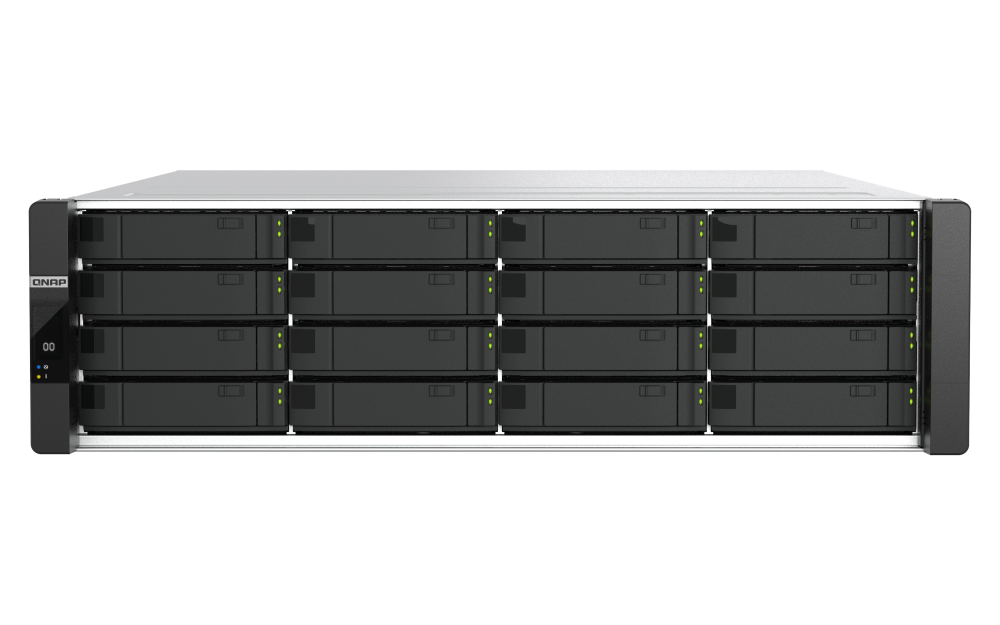
Explore this need in the finder →This assessment covers the exact QNAP U.S. configuration ES1686dc-R2-2123IT-64G-US, not every ES1686dc R2 selector entry. QNAP pairs the 64G package with two four-core Xeon D-2123IT controllers and 32 GB of DDR4 ECC RDIMM memory per controller. The base chassis still provides sixteen SAS drive positions, a QES dual-controller design and built-in 10GbE SFP+ links. This is a source-based review; no physical installation, performance test, ownership or failover test is claimed.
What “64G” changes, and what it does not
The memory label represents 64 GB across the two controllers: 32 GB in each, with four 8-GB modules per controller according to QNAP's specification. The CPU is the four-core D-2123IT at 2.2 GHz per controller, with a listed burst frequency up to 3.0 GHz. That is not the same compute configuration as the 2142IT options: QNAP lists eight cores per controller for both the 96G and 128G versions, with 48 GB or 64 GB per controller respectively. A separate review of the 128G configuration explains its memory and package checks.
These are meaningful configuration distinctions, not a numerical ranking of application performance. Core count and base memory alone do not establish how a database, virtual-machine set, deduplication job or file workload will behave. Ask the software vendor and QNAP or an integrator to size the actual concurrency, cache, protection settings, growth and support requirements. The manufacturer page lists additional memory slots and a larger platform maximum, but supported-module details and the desired final configuration should be confirmed before buying; QNAP warns that unsupported memory can affect operation and says not to mix RDIMM with LRDIMM.
Sixteen SAS bays, not sixteen included disks
The R2 hardware selector gives this 64G version sixteen native 3.5-inch SAS 12Gb/s positions with backward compatibility to SAS 6Gb/s. QNAP lists 3.5-inch SAS HDDs and 2.5-inch SAS HDDs or SSDs for the tray format. It does not list SATA drives as supported in this R2 specification, so do not assume SATA is usable because a 3.5-inch tray might physically hold one. Verify every disk's exact model, size and firmware in QNAP's current product-specific compatibility list. The page's supported drive classes do not identify a drive brand, capacity, mixture or reseller offer.
QNAP's standard package contents are listed separately from the drive compatibility table. Cords, cables, screws, a rail kit, console cable, NVRAM battery units and a quick-install guide appear in that list, while data-bay disks do not. Get a written bill of materials with the complete 64G-US suffix and all drive part numbers. The controller's Copy-to-Flash M.2 modules are cache equipment; they are not the data-bay set or a substitute for selecting a storage layout.
Network capacity is one part of a path
QNAP documents four built-in 10GbE SFP+ ports per controller. One port therefore clears a 10-Gbps single-link minimum; the six 2.5GbE ports listed across controllers should not be added to claim one faster interface. The product specification assigns a 2.5GbE port on each controller to remote management. To use a 10GbE link, the client, switch, transceiver or DAC and cable must form a compatible path, and storage and workload can still limit actual transfers. QNAP also lists two PCIe Gen 3 x8 slots per controller, but an optional network card is not part of the verified 64G base capability unless it appears on the quote and is supported in the intended setup.
QES, controllers and the separately created mirror
The U.S. software table identifies QES 2.2.1, ZFS, and NAS protocols including SMB/CIFS and NFS alongside iSCSI and Fibre Channel. QNAP's RAID list and QES 2.2 help support a buyer-created RAID 1 group from two compatible SAS drives. That is a selected storage arrangement, not a pre-installed two-drive array. It uses two of the sixteen positions. The R2's active-active controllers are two modules in the same chassis; they are not themselves a disk mirror, and they do not make a backup. No controller-takeover, drive-rebuild or restore exercise was performed. Treat the mirror as one protection measure and plan an independent backup plus a tested recovery route.
Rack installation is a project requirement
The R2 is a 3U rackmount unit with redundant hot-swappable power supplies in QNAP's hardware table. Rack depth, rails, cabinet load, access for service, airflow, cooling and electrical capacity belong in the same project plan as the NAS. QNAP reports a fully populated typical power figure under its own test condition; that is neither an independent measurement nor a draw estimate for the buyer's exact drive mix. Confirm operating requirements for the exact order code and allow for the drives and network equipment needed to realize the planned service.
The 64G configuration may be a useful comparison point where the four-core CPU and 32 GB per controller match a professionally sized workload. It should not be selected solely because a model card shares a chassis name or because 64G sounds large. Compare it with the documented 96G/128G 2142IT options using the complete CPU and per-controller memory, then validate compatibility and service needs. No current price, stock, installed bill of materials, independent performance or customer feedback is represented in this assessment.
Key specifications
Key details at a glance
| Internal drive bays | 16 bays |
|---|---|
| Documented internal drive media | 3.5-inch SAS HDD / 2.5-inch SAS HDD / 2.5-inch SAS SSD |
| Built-in Ethernet ports | 4 x 10GbE SFP+ per controller / 3 x 2.5GbE per controller; one 2.5GbE port per controller is assigned to remote management |
| Fastest individual Ethernet port | 10 Gbps |
| Installed system memory | 64 GB |
| Maximum listed memory | 1024 GB |
| Listed storage arrangements | RAID 0 / RAID 1 / RAID 5 / RAID 6 / RAID 10 / RAID 50 / RAID 60 / RAID TP / Triple Mirror |
| Internal file systems | ZFS (QES) |
| Data drives included in listed package | No |
| System drives included (not data-bay drives) | One 64 GB M.2 Copy-to-Flash SSD per controller; these are controller cache modules, not customer data-bay drives. |
| Processor | Intel Xeon D-2123IT per controller |
| Installed memory type | DDR4 ECC RDIMM; 32 GB per controller (4 x 8 GB per controller) |
Use the exact model’s instructions for operating limits, supplied equipment and version differences.
Sources for this review
Sources for this assessment

Check your setup before choosing a NAS
Use the finder to narrow documented desk/shelf or rack formats, internal-bay minimums, a single Ethernet-port rating and optional redundancy requirements.