
Your needs, this model
Does it fit your priorities?
Can the ES1686Adc meet a 16-bay, 10GbE and documented two-drive mirror screen?
QNAP lists 16 native bays, a 10GbE SFP+ port, and QES RAID 1 support, so the ES1686Adc-2142IT-128G meets those catalogue-level requirements. The mirror is a separately selected configuration, not a claim that two compatible data drives are included; check the exact drive list and network path.
Explore this need in the finder →Does active-active controller failover mean that a RAID 1 mirror is already installed?
No. Active-active describes the two controller modules. QNAP separately lists RAID 1 as a selectable QES arrangement; its package list does not list data drives, so an installer must select compatible drives and create the intended array. A mirror does not replace an independent backup.
Explore this need in the finder →Does the ES1686Adc belong in a current-model comparison?
QNAP's current U.S. navigation and product pages identify ES1686Adc as a new dual-controller NAS and list the ES1686Adc-2142IT-128G configuration. That supports current-reference classification, not a promise of seller stock, an exact offer, warranty or package contents.
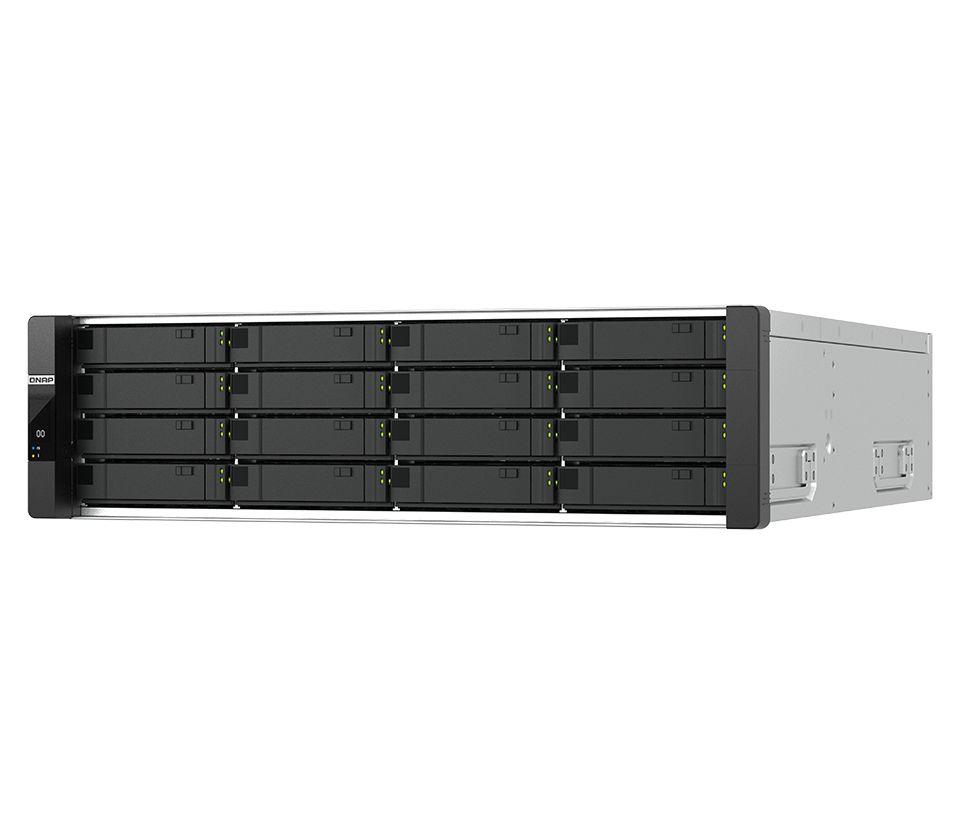
Explore this need in the finder →The QNAP ES1686Adc is an enterprise dual-controller storage array, not a larger version of a desk-side home NAS. QNAP's current U.S. product material describes a 3U, 16-position system with active-active controllers, QES storage software, a ZFS file system, and both file and block-storage protocols. The question is whether a deployment has the rack, network, drive plan, staff and operating process to make those capabilities useful. This is a source-based assessment of QNAP's listed configuration, not a report of hands-on testing or measured performance.
Two active controllers change the operating brief
The ES1686Adc's defining distinction is that it has two controllers processing I/O at the same time. QNAP says the surviving controller can take over drives and network addresses when a controller fails, and lists SMB/NFS file service alongside iSCSI and Fibre Channel block service. That makes the enclosure relevant to a business environment that needs one shared system for file workloads and storage presented to servers or virtualisation infrastructure. It is also a more involved platform than a single-controller household NAS: plan its QES administration, maintenance windows, recovery procedures and supported client path before procurement.
QNAP lists the ES1686Adc-2142IT-128G configuration with two Intel Xeon D-2142IT processors, one per controller, and 64 GB of DDR4 ECC RDIMM per controller. The page describes QES 2.2.1 and ZFS, not QTS or QuTS hero. The paired controllers are an availability feature; they are not a data backup, and their failover behavior should be treated as a design objective that your deployment still has to validate.
Sixteen bays do not settle the drive plan
QNAP lists sixteen 3.5-inch SAS 12Gb/s bays, with backward compatibility to SAS 6Gb/s. Its hardware table identifies 3.5-inch SAS hard drives, 2.5-inch SAS hard drives and dual-port 2.5-inch U.3 NVMe SSDs among the supported media. The product page also describes the chassis as a hybrid SAS/U.3 system. Those details make tiering possible in principle, but they are not a list of specific compatible drive models. QNAP's compatibility list is the important next check for a drive's full model number, interface, firmware and supported use. Do not assume a SATA disk, any 2.5-inch SSD, or a drive that merely fits a tray is supported.
The U.S. hardware table names a 128 GB starting configuration and says the system can be expanded to 512 GB per controller, up to 1 TB total, subject to QNAP's memory rules. QNAP cautions against mixing registered and load-reduced DIMM types. That ceiling is not a reason to start adding memory: first establish the software version, workload, supported memory bill of materials and whether the offered configuration is actually the 128G model. The standard package list includes mounting screws, two power cords, two 1GbE cables, an E02 rail kit, two NVRAM battery backup units, a console cable and a quick-start guide; it does not list data drives.
Budget for the network and the rack, not just the port label
QNAP's hardware table lists four 10GbE SFP+ ports per controller and three 2.5GbE ports per controller, with one 2.5GbE port assigned for remote management. The U.S. product copy also highlights 10GbE and optional 25GbE expansion. Treat a 10-Gbps rating as the capacity of one built-in port, not a guaranteed file-copy speed or the combined rate of several links. A useful installation needs compatible switch ports, SFP+ optics or DAC cables, matching client interfaces, and a plan for link aggregation or failover if those functions matter. Optional network cards and transceivers are not the same as built-in ports.
The chassis is 3U and measures 132 x 446.2 x 587.75 mm, with a listed net weight of 23.82 kg. The package page lists the 57 kg-rated rail kit, but the cabinet still needs sufficient depth, clearance and safe lifting access. QNAP lists redundant hot-swap 700 W power supplies and a typical 588.33 W consumption figure when the unit is fully populated with drives. That is manufacturer test context, not an independent measurement; it is enough to make power, heat, airflow, noise, rack loading and service access part of the deployment review. The product's USB ports are identified as engineering-only, not as a supported route for USB disks or a UPS.
RAID 1 is a separate choice from controller failover
QNAP lists RAID 1 among the ES1686Adc's QES options, so a two-drive mirror is a documented arrangement a system designer can select. That does not mean the unit arrives with drives installed or a mirror preconfigured. Choose the exact compatible pair and array deliberately, and check the intended design against QES documentation. A mirror uses two drive positions to retain duplicate data and is not a second backup. Active-active controllers address a different failure: the controller path. Neither feature protects against deletion, malware, damaged files, theft, loss of the whole rack or a mistake during maintenance. A separate backup and a tested restore remain necessary.
Who should shortlist it
The ES1686Adc makes sense to investigate when an organization needs a substantial, dual-controller NAS/SAN platform and already has the networking, rack, power, compatible drives and staff to operate it. It is a poor fit for a casual home library or a buyer who wants a quiet, small, pre-populated appliance with simple setup. QNAP's pages identify a 128G hardware configuration, but the U.S. Official Store route could not be inspected here; exact seller suffix, offer contents, warranty terms and current availability therefore remain unverified. Before ordering, match the controller model, memory configuration, drive models, network accessories, rack kit, support terms and QES release on the actual seller's paperwork. The model's 16-bay and 10GbE facts are useful screening inputs, not proof that a particular installation is ready.
Key specifications
Key details at a glance
| Internal drive bays | 16 bays |
|---|---|
| Documented internal drive media | 3.5-inch SAS HDD / 2.5-inch SAS HDD / 2.5-inch dual-port U.3 NVMe SSD |
| Built-in Ethernet ports | 4 x 10GbE SFP+ per controller / 3 x 2.5GbE per controller (one assigned for remote management) |
| Fastest individual Ethernet port | 10 Gbps |
| Installed system memory | 128 GB |
| Maximum listed memory | 1024 GB |
| Listed storage arrangements | RAID 0 / RAID 1 / RAID 5 / RAID 6 / RAID 10 / RAID 50 / RAID 60 / RAID TP / Triple Mirror |
| Internal file systems | ZFS (QES) |
| Dimensions (H × W × D) | 132 x 446.2 x 587.75 mm (H x W x D) |
| Weight | 23.82 kg |
| Data drives included in listed package | No |
| System drives included (not data-bay drives) | One 64 GB M.2 Copy-to-Flash SSD per controller (QNAP-listed controller cache; not a data-bay drive) |
| Processor | Intel Xeon D-2142IT per controller |
| CPU cores | 8 |
| CPU threads | 16 |
| Installed memory type | DDR4 ECC RDIMM; 64 GB per controller |
Use the exact model’s instructions for operating limits, supplied equipment and version differences.
Sources for this review
Sources for this assessment
- QNAP U.S. Tower/SMB product catalogue observation and current dual-controller product navigation
- QNAP U.S. ES1686Adc product overview
- QNAP U.S. ES1686Adc hardware specifications
- QNAP U.S. ES1686Adc QES software specifications
- QNAP U.S. ES1686Adc package contents
- QNAP U.S. model-filtered compatibility-list route for model 851
- QNAP ES1686Adc official item image 851
- QNAP QES 2.2.x Web Help: RAID types
Check your setup before choosing a NAS
Use the finder to check bay count, the network link you need, and whether a documented two-drive redundant arrangement is essential.