
Your needs, this model
Does it fit your priorities?
How much memory is installed in the E5-96G system?
QNAP lists 48 GB DDR3 ECC RDIMM per controller, split into 32 GB main memory and 16 GB write cache per controller. Across two controllers the configuration label totals 96 GB, but that is not 96 GB of ordinary memory available to either controller.
Explore this need in the finder →Does the ES1640dc v2 meet a 16-bay, 10GbE, RAID 1 screen?
At the documentation level, yes: QNAP’s exact selector lists 16 SAS positions, a 10GbE port on each controller, QES 2.2.1 and RAID 1. The older guide’s 12+4 cache layout differs; keep the physical arrangement unresolved until the exact chassis revision is checked.
Explore this need in the finder →Does dual-controller mean failover was proven here?
No. QNAP describes an active-active controller/takeover architecture, but this review did not test failover. Validate firmware, multipath, host behavior, recovery steps and support availability in the actual deployment.
Explore this need in the finder →Scope: the E5-96G dual-controller profile
This review is for the exact observed U.S. Store identity ES1640dc-v2-E5-96G-US. QNAP’s hardware selector marks it EOL and lists two storage controllers, each with a six-core Xeon E5-2420 v2, 48 GB DDR3 ECC RDIMM per controller and a per-controller split of 32 GB main memory plus 16 GB protected write cache. “96G” is the combined configuration label; it should not be read as 96 GB available as ordinary host memory on either controller. This is an evidence review of published material, not a failover test or performance evaluation.
A 16-position SAS platform, with an old bay-layout discrepancy
The exact hardware selector counts 16 hot-swap 3.5-inch SAS positions, SAS 12Gb/s with backward compatibility to 6Gb/s. An older English hardware guide describes a configuration of four 2.5-inch SSD cache drives plus twelve 3.5-inch drives. Those documents do not present the same tray arrangement. This review conservatively counts sixteen positions, does not add four to produce a 20-bay claim, and does not assume the old cache layout applies to a particular chassis revision. Verify the tray map and intended drive type against the serial-specific guide before procurement.
The selector lists SAS hard drives and SSDs for these positions. A model-and-firmware compatibility check remains essential; no exact SAS drive SKU was established here. QNAP describes a SATA-to-SAS adapter accessory for some SATA installations, but this does not make a generic SATA disk an approved match or prove an adapter is included.
Two controllers are a system architecture, not a test result
The ES1640dc v2 is designed around two active-active storage controllers and QNAP describes a takeover architecture. That makes it different from a conventional single-controller NAS, but this review does not claim that a configured deployment will fail over without interruption. The host links, storage pools, QES version, application behavior, cabling, multipath setup and operational procedures all matter. Plan a maintenance and recovery exercise with the exact environment rather than treating “dual-controller” as a measured uptime guarantee.
QNAP lists QES 2.2.1, a ZFS-based system, and the model manual documents RAID 1. A two-drive SAS mirror can therefore be a supported owner-created arrangement, but the drives and pool are not shown as preconfigured. RAID 1 can tolerate one member-drive failure in a healthy pair; it cannot replace independent backups, off-site copies or restore testing. For a dual-controller deployment, document how the second copy and recovery plan survive a site-level event.
Network and rack planning
Each controller is listed with four 10GbE SFP+ ports, two 10GBASE-T RJ45 ports and one 1GbE management port. The selector also says the 10GBASE-T network card is preinstalled in a PCIe slot. A single individual data port can satisfy a 10Gbps floor, but six ports per controller are not a single faster link. Map the intended controller path, switch ports, transceivers or copper cabling, client and multipath design. The two management ports are separate from the storage data interfaces.
At 3U and 26.75 kg net, this is enterprise rack hardware, not a compact desktop NAS. QNAP lists redundant hot-swap 770 W power supplies and a package list that includes the RAIL-E02 kit, but the actual seller’s contents still need to be confirmed in writing—especially for an EOL product. Check cabinet post range, load, rear clearance, airflow and power feeds. The published 501.4 W figure is a manufacturer condition tested with the drives fully populated, not a universal estimate or an independent measurement.
Who should evaluate it?
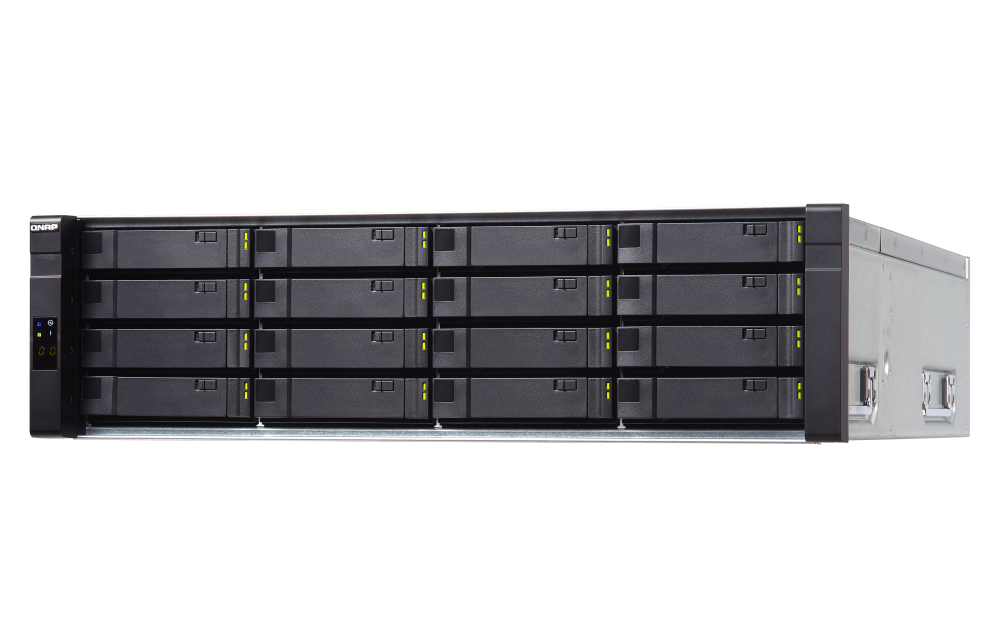
Keep this system on a shortlist only where the design calls for a specialized dual-controller QES/SAS platform and an experienced team can validate the controller, network, firmware, drive and support plan. Its EOL status is central to the buying decision: verify current software availability, security updates, replacement parts, service and the exact unit’s warranty before considering production use. The exterior image identifies the ES1640dc v2 family, not the installed memory, controller state or drive package. Do not assume a reseller listing is a supported 96 GB build merely because the family name matches.
Primary references
- QNAP ES1640dc v2 U.S. page and exact E5-96G hardware selector
- QNAP software selector
- QNAP ES NAS Hardware User Manual
- QNAP compatibility lookup (verify the exact SAS/SATA model and firmware)
Key specifications
Key details at a glance
| Internal drive bays | 16 bays |
|---|---|
| Documented internal drive media | 3.5-inch SAS HDD / 2.5-inch SAS HDD or SSD in the documented selector-supported bay context |
| Built-in Ethernet ports | Per controller: 4 x 10GbE SFP+ / Per controller: 2 x 10GBASE-T RJ45 / Per controller: 1 x 1GbE management RJ45 |
| Fastest individual Ethernet port | 10 Gbps |
| Installed system memory | 96 GB |
| Listed storage arrangements | RAID 1 / RAID 5 / RAID 6 / RAID 10 / RAID 50 / RAID 60 |
| Dimensions (H × W × D) | {'height': 132, 'width': 446.2, 'depth': 618} |
| Weight | 26.75 kg |
| Data drives included in listed package | No |
| Processor | 2 x Intel Xeon E5-2420 v2 |
| CPU cores | 12 |
| CPU threads | 24 |
| Installed memory type | 48 GB DDR3 ECC RDIMM per controller: 32 GB main memory + 16 GB write cache per controller; 96 GB across both controllers is not 96 GB per controller. |
Use the exact model’s instructions for operating limits, supplied equipment and version differences.
Sources for this review
Sources for this assessment

Check your setup before choosing a NAS
Use the finder to narrow documented desk/shelf or rack formats, internal-bay minimums, a single Ethernet-port rating and optional redundancy requirements.