
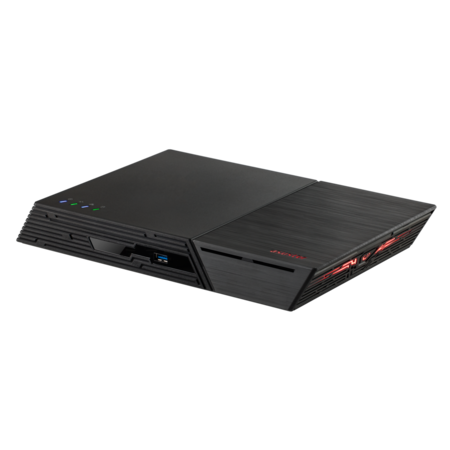
Your needs, this model
Does it fit your priorities?
Do twelve FS6812X positions mean twelve SATA hard-drive trays?
No. The FS6812X has twelve internal M.2 2280 NVMe positions and the U.S. comparison lists no SATA bays. It meets a twelve-position count only if NVMe modules are acceptable; do not use the generic twelve-HDD raw-capacity line as a statement about M.2 capacity.
Explore this need in the finder →Can the FS6812X meet a twelve-position, 10-GbE and mirror requirement at once?
The exact selector lists M.2 Volume and RAID 1, and the U.S. comparison lists two individual 10-GbE ports and twelve M.2 positions. A possible owner-created plan could use two buyer-selected compatible M.2 SSDs in RAID 1 and one of those 10-GbE ports, leaving ten positions unused. No data SSDs or initialized array are listed; verify model/firmware support, back up before initialization because it deletes data on installed SSDs, and keep a separate backup.
Explore this need in the finder →Do two built-in FS6812X Ethernet ports make one faster-than-10-GbE port?
No. ASUSTOR lists two separate 10-Gigabit RJ45 ports, each rated up to 10 Gbps, so the single-port finder ceiling is 10 Gbps, not a summed 20 Gbps. Multilink behavior depends on client, switch, cabling, configuration and workload; USB4 does not add Ethernet bandwidth.
Explore this need in the finder →This is a documentation-based assessment of the U.S.-listed model profile, not a hands-on test or a report of a seller offer. The exact English product page identifies product ID 91 as the FLASHSTOR 12 Pro Gen2 (FS6812X); ASUSTOR's 2026 U.S.-English comparison gives the corresponding hardware row. Neither source identifies a particular seller's package, stock, price or warranty channel.
Twelve positions, but not twelve SATA trays
The central buying question is what those twelve positions accept. The comparison and hardware selector describe twelve internal M.2 2280 NVMe SSD positions, while the U.S. comparison does not list ordinary drive bays. This is an all-flash, compact desktop design—not a twelve-tray chassis for a set of 3.5-inch hard disks. The site finder counts physical internal storage positions, so the FS6812X can meet a twelve-position minimum; that answer is useful only if NVMe modules fit the storage plan. It does not certify twelve drives, their capacity, or what comes in a retail bundle.
The selector assigns the twelve slots a mix of PCIe 4.0 and PCIe 3.0 interfaces: one Gen4 x4, three Gen4 x2, four Gen4 x1, one Gen3 x4, one Gen3 x2, and two Gen3 x1. The sources reviewed here give that distribution but do not map each lane width to a numbered slot, so a buyer should not assume all twelve positions have the same interface. More importantly, no exact SSD model/capacity/firmware combination was verified for this assessment. Check ASUSTOR's current FS6812X compatibility list against each intended module before ordering.
Two 10-GbE ports do not make one 20-GbE port
There are two built-in 10-Gigabit Ethernet RJ45 ports, each individually rated up to 10 Gbps. That is a substantial path option for a compatible switch, client and workload, but the finder correctly tests one port at a time: two sockets do not satisfy a 10.5-Gbps single-port floor by adding their ratings together. The product page describes multi-link use, yet any benefit depends on the client, switch, network configuration, cabling and workload. A link rating is not a file-copy speed. The three USB 3.2 Gen 2 Type-A and two USB4 Type-C ports are separate external connections, not Ethernet bandwidth; ASUSTOR's selector also says USB4 host-to-host connectivity is unsupported.
A possible mirror still needs buyer-supplied SSDs
The exact software selector lists M.2 Volume and RAID 1. One possible owner-created setup is two supported NVMe modules in a mirror, using two of the twelve positions and leaving ten unused. The base manufacturer package lists the NAS, quick guide, power cord, adapter, two Cat 6a network cables and a cord tie—not data SSDs or an initialized volume. The guide says to use compatible 2280 NVMe drives, and optional SSD heatsinks are sold separately. It also warns that initialization or creating a volume deletes data already on installed SSDs. Plan the migration and backup before initial setup; RAID 1 may help with a drive failure, but it does not protect against deletion, malware, theft or loss of the whole device. Keep a separate recoverable copy.
Compute and memory context
The FS6812X uses a quad-core AMD Ryzen V3C14 listed at 2.3 GHz with boost up to 3.8 GHz. It ships with one 16-GB ECC DDR5-4800 SO-DIMM, has two memory slots and is listed for expansion up to 64 GB. ASUSTOR warns that ECC is disabled if non-ECC memory is installed or if ECC and non-ECC memory are mixed. That is a condition to check before an upgrade, not evidence that this review installed or tested a larger kit. The processor and memory specifications do not demonstrate how a particular file service, virtual machine or editing workflow will perform.
Capacity and power numbers need careful reading
ASUSTOR's hardware selector includes a 216-TB raw figure calculated as twelve 18-TB hard disks, even though the U.S. comparison lists twelve M.2 NVMe positions and no ordinary SATA trays. That HDD arithmetic is not a supported SSD capacity ceiling and is not usable capacity after RAID. The model page also refers to an optional AS5004U external expansion unit; external expansion is separate from the twelve native M.2 positions, and this assessment does not assign it a total-capacity promise. Select exact compatible modules first, then calculate the chosen layout and usable space.
ASUSTOR's power references conflict: the hardware selector lists 32.2 W in operation, while its model datasheet says 33.2 W; both list 2.8 W for sleep. These are manufacturer figures, not independent readings, so the operation value remains unresolved. The selector also lists a 120-W adapter and 18.6-dB noise figure; neither guarantees the installed system's draw or sound in a particular room.
Who should compare it—and what to verify
This model belongs on a shortlist when twelve internal M.2 positions, two individual 10-GbE ports, ECC-capable memory and a possible two-drive mirror match the project, and the buyer is prepared to source and install compatible SSDs. Compare it with the earlier FS6712X carefully: both have twelve M.2 positions, but the FS6812X is a distinct Gen2 product with a Ryzen V3C14, 16-GB ECC DDR5 starting memory and two built-in 10-GbE ports; the earlier FS6712X has one built-in 10-GbE port and a different memory/CPU profile. The six-position FS6806X is another distinct Gen2 choice, not a twelve-slot equivalent. Do not transfer a capacity, package or internal image detail across those names.
Before purchase, confirm the exact FS6812X label and seller package; check each M.2 model and firmware in the current compatibility list; verify any separate heatsinks or expansion accessory; and map both ends of the Ethernet path. ASUSTOR's support table currently calls the model Generally Available and lists software and technical support as Supported, with a three-year entry. That is manufacturer lifecycle information, not proof of a U.S. seller's inventory, return policy or warranty route. See the cited FS6812X product page, hardware and software specification, package contents, U.S.-English comparison and FS68XX installation guide, checked 2026-11-02.
Key specifications
Key details at a glance
| Internal drive bays | 12 bays |
|---|---|
| Documented internal drive media | M.2 2280 NVMe SSD |
| Built-in Ethernet ports | 2 x built-in 10-Gigabit Ethernet RJ45 ports, each individually rated up to 10 Gbps |
| Fastest individual Ethernet port | 10 Gbps |
| Installed system memory | 16 GB |
| Maximum listed memory | 64 GB |
| Listed storage arrangements | Single / JBOD / RAID 0 / RAID 1 / RAID 5 / RAID 6 / RAID 10 |
| Dimensions (H × W × D) | 48.3 x 308.26 x 193 mm (H x W x D) |
| Weight | 1.45 kg |
| Hardware warranty | 3 years |
| Data drives included in listed package | No |
| M.2 NVMe slots | 12 |
| M.2 SSD storage-pool support | Yes |
| Processor | AMD Ryzen V3C14 |
| CPU cores | 4 |
| Installed memory type | 16 GB ECC DDR5-4800 SO-DIMM, one 16-GB module installed |
Use the exact model’s instructions for operating limits, supplied equipment and version differences.
Sources for this review
Sources for this assessment
- ASUSTOR FLASHSTOR 12 Pro Gen2 (FS6812X), exact product page, product ID 91
- ASUSTOR FS6812X hardware and software specification, product ID 91
- ASUSTOR FS6812X manufacturer package contents, product ID 91
- ASUSTOR FS6812X product datasheet route, product ID 91
- ASUSTOR FLASHSTOR 12 Pro Gen2 (FS6812X) product datasheet
- ASUSTOR 2026 All Product Comparison, U.S. English
- ASUSTOR Product Support Status table, FS6812X row
- ASUSTOR FS68XX Quick Installation Guide, English, applicable to FS6812X
- ASUSTOR exact-model FS6812X official front image

Check your setup before choosing a NAS
Use the finder to check bay count, the network link you need, and whether a documented two-drive redundant arrangement is essential.