
Your needs, this model
Does it fit your priorities?
How many internal SATA bays does AS6808T have, and do the M.2 connectors count?
ASUSTOR documents eight native internal SATA positions for 3.5-inch HDDs, 2.5-inch HDDs or 2.5-inch SATA SSDs. Its four M.2 2280 NVMe positions are separate: the enclosure meets an eight-bay minimum but not a nine-bay minimum. The manufacturer's 144-TB figure is raw arithmetic for eight 18-TB drives, not usable capacity or included storage.
Explore this need in the finder →What is AS6808T's fastest individual built-in Ethernet port?
The exact hardware table lists two individual 10-GbE ports and two individual 5-GbE ports. One port meets a 10-Gbps floor but not 10.5 Gbps. The ports cannot be added together into one faster link, and the link rating is not promised file-transfer speed.
Explore this need in the finder →Can the current-reference AS6808T meet an eight-bay, 10-GbE and two-drive-redundancy screen together?
Yes, as one possible owner-created arrangement: eight SATA trays are native, a listed RAID 1 volume can use two buyer-supplied compatible drives and one built-in 10-GbE port is available in the same enclosure. Six SATA bays remain open and four M.2 slots are separate. The package lists no data drives or initialized array; check exact drive firmware and the whole network path, and keep another backup because a mirror is not one.
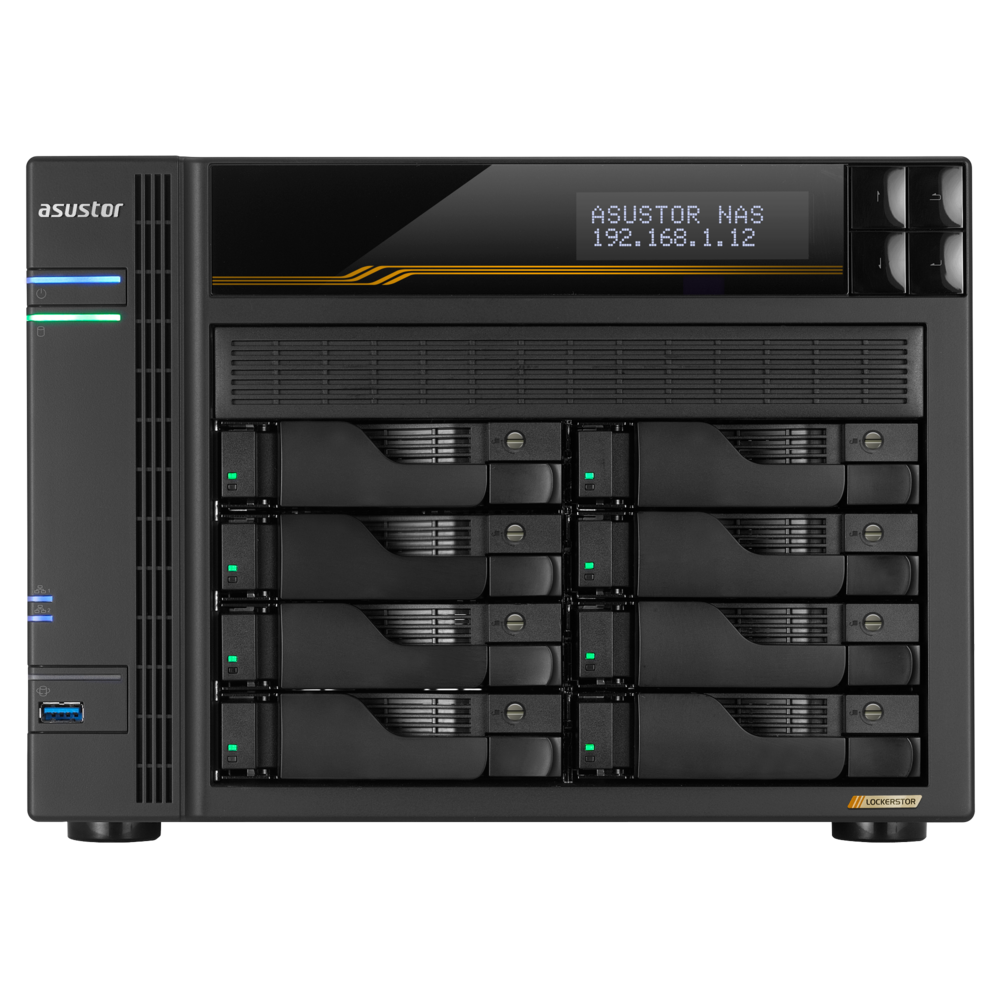
Explore this need in the finder →The ASUSTOR LOCKERSTOR 8 Gen3 (AS6808T) is an eight-bay desktop NAS with four separate M.2 NVMe positions and a busy network panel: two 10-Gigabit Ethernet ports plus two 5-Gigabit ports. This is a source-based buying assessment, not a hands-on review or a throughput test. Its strongest case is a buyer who can use the eight native SATA positions and has a real multigigabit network path to connect. Its size, drive cost and the limits of its USB4 connection matter just as much.
Eight SATA bays are the headline; M.2 is a separate layer
ASUSTOR specifies eight internal drive bays for 3.5-inch SATA hard drives, 2.5-inch SATA hard drives or 2.5-inch SATA SSDs. Four M.2 2280 NVMe slots sit alongside those trays, using PCIe 4.0 x1. They can support M.2 storage or caching, but they are not four more SATA bays.
The maker's 144-TB figure is arithmetic based on eight 18-TB drives and is explicitly subject to RAID layout. It is raw capacity, not usable space, an exact drive-compatibility approval or storage supplied in the box. ASUSTOR separately lists a 20-bay, 400-TB raw ceiling with an expansion unit. That larger arrangement needs another chassis and suitable drives; it does not change the AS6808T's eight native positions. For a buyer whose plan needs just two disks, an eight-bay tower may be more enclosure than the workload needs.
Fast network labels are not transfer-rate promises
The four Ethernet jacks are two individual 10-GbE links and two individual 5-GbE links. That gives NAS owners link choices but caps the documented one-port floor at 10 Gbps. The four ports do not combine into one 30-Gbps port, and link aggregation or SMB Multichannel depends on compatible peers, configuration and network equipment. None of these labels predicts file-copy speed. The client, switch or router, cables, installed drives, storage layout and workload all constrain the path; upgrading only the NAS may leave the bottleneck elsewhere.
USB4 is not a direct computer connection here
ASUSTOR lists two USB4 Type-C ports, each rated up to 40 Gbps, as well as three 10-Gbps USB Type-A ports. The same model specification says host-to-host connectivity is not supported, and ASUSTOR's product explanation says its Ryzen Embedded V3000 USB4 ports do not directly connect the NAS to a computer or Mac over USB4 or Thunderbolt. Do not choose this NAS expecting it to behave like a USB-attached desktop drive. Its intended access path is a network connection. Multimedia output is listed as unavailable, so the product should not be treated as an HDMI media player either.
Core hardware, footprint and setup checks
The specifications list a quad-core AMD Ryzen Embedded V3C14 at 2.3 GHz, with boost up to 3.8 GHz, and 16 GB of ECC DDR5-4800 memory. One 16-GB module is installed; two memory slots and a 64-GB maximum are listed. ASUSTOR warns that ECC functionality is disabled if non-ECC memory is used or mixed with ECC memory. Those component details help describe the platform but are not a benchmark of a particular backup, virtualization or media workload.
The tower measures 215.5 by 293 by 230 mm (height, width, depth) and the maker lists a 6.45-kg unit weight. Allow for the case, cable bends, ventilation and access to the eight removable trays before choosing a shelf. The internal 250-W power supply accepts 100–240 V AC. ASUSTOR publishes 58.5 W in operation, 25 W in disk hibernation and 2.4 W in sleep; those are manufacturer figures, not measurements from this site, and installed drives and workload affect actual use.
A possible mirror is an owner setup, not an included array
The hardware list includes RAID 1, and ASUSTOR's calculator limits one RAID 1 volume to two drives. A possible buyer-created mirror can use two compatible SATA drives in two of the eight bays, leave six trays open and coexist with one built-in 10-GbE port. The four M.2 positions are not members of that SATA mirror. This describes a supported arrangement, not a factory-installed array or a verified drive pair. The package contents list the enclosure, installation guide, AC cord, four Cat 6a 10-GbE cables and 32 screws for each of the 3.5-inch and 2.5-inch drive formats, but no data drives or prepared volume. Check the exact drive model and firmware against ASUSTOR's current compatibility information before building the volume.
A mirror may keep some services available after one member drive fails; it does not restore a deleted file, undo malware, protect against theft or recover the whole NAS after fire or power damage. Keep a separate backup copy and test a restore. The product status table currently lists AS6808T as generally available and supported with a three-year entry. That is manufacturer lifecycle/support information, not evidence of a retailer's stock, the seller's precise suffix, a bundle, a live price or the warranty terms of a particular U.S. channel.
Who should shortlist it?
Shortlist the AS6808T when eight native SATA positions are useful, the separate M.2 layer has a defined role, and compatible clients can use its multigigabit ports. It has a two-drive RAID 1 option that leaves six SATA bays free, though the drives and array remain the buyer's responsibility. Compare it with smaller models if capacity growth is hypothetical rather than planned; fewer bays can mean a simpler and less costly build. Compare a purpose-built direct-attached device if a USB4 cable to a computer is essential. Before ordering, confirm the AS6808T identity, seller package, drive/firmware fit, shelf dimensions, network path, power and independent backup plan.
Key specifications
Key details at a glance
| Internal drive bays | 8 bays |
|---|---|
| Documented internal drive media | 3.5-inch SATA HDD / 2.5-inch SATA HDD / 2.5-inch SATA SSD |
| Built-in Ethernet ports | 2 x built-in 10-Gigabit Ethernet (10G/2.5G/1G/100M each) / 2 x built-in 5-Gigabit Ethernet (5G/2.5G/1G/100M each) |
| Fastest individual Ethernet port | 10 Gbps |
| Installed system memory | 16 GB |
| Maximum listed memory | 64 GB |
| Listed storage arrangements | Single / JBOD / RAID 0 / RAID 1 / RAID 5 / RAID 6 / RAID 10 / RAID 1 + spare drive / RAID 5 + spare drive / RAID 6 + spare drive / RAID 10 + spare drive |
| Dimensions (H × W × D) | 215.5 x 293 x 230 mm (H x W x D) |
| Weight | 6.45 kg |
| Hardware warranty | 3 years |
| Data drives included in listed package | No |
| M.2 NVMe slots | 4 |
| M.2 SSD storage-pool support | Yes |
| Processor | AMD Ryzen Embedded V3C14 |
| CPU cores | 4 |
| Installed memory type | 16 GB ECC DDR5-4800 SO-DIMM, one 16-GB module pre-installed |
Use the exact model’s instructions for operating limits, supplied equipment and version differences.
Sources for this review
Sources for this assessment
- ASUSTOR Home/SOHO directory observation for LOCKERSTOR 8 Gen3 (AS6808T)
- ASUSTOR LOCKERSTOR 8 Gen3 (AS6808T), product ID 88
- ASUSTOR AS6808T exact hardware and software specification, product ID 88
- ASUSTOR AS6808T package contents, product ID 88
- ASUSTOR AS6808T manufacturer datasheet page, product ID 88
- ASUSTOR LOCKERSTOR 8 Gen3 (AS6808T) English datasheet
- ASUSTOR AS68XXT English Quick Installation Guide, applicable model list and hardware installation instructions
- ASUSTOR product support-status table, AS6808T row
- ASUSTOR RAID calculator, model ID 88, and RAID 1 drive limit
- ASUSTOR drive-compatibility selector and drive guidance
- Official ASUSTOR AS6808T product-page image

Check your setup before choosing a NAS
Use the finder to check bay count, the network link you need, and whether a documented two-drive redundant arrangement is essential.