
Your needs, this model
Does it fit your priorities?
Does AS6804T meet a four-native-bay requirement without counting its M.2 slots?
Yes. The exact product-ID-86 specification lists four internal SATA drive positions and four separate M.2 2280 NVMe positions. The M.2 slots are not additional SATA trays, so a four-bay floor includes the AS6804T and a five-bay floor excludes it.
Explore this need in the finder →What is AS6804T's fastest individual built-in Ethernet port?
ASUSTOR lists two built-in 10-GbE ports and two built-in 5-GbE ports, so the documented individual-port ceiling is 10 Gbps. That is a link rating rather than guaranteed file-transfer speed; the client, switch/router, cabling, storage and workload also matter. A 10.5-Gbps single-port minimum is not met by this profile.
Explore this need in the finder →Can AS6804T combine a current-only four-bay minimum, 10-GbE single-port minimum and two-drive redundancy?
Yes, as one possible owner-created plan: the model has four native SATA bays, RAID 1 uses two buyer-supplied compatible drives and one built-in 10-GbE port is rated at 10 Gbps. Two SATA bays remain open; the M.2 positions are separate. The package has no data drives or initialized array, exact drive/firmware compatibility needs checking, and RAID 1 is not an independent backup.
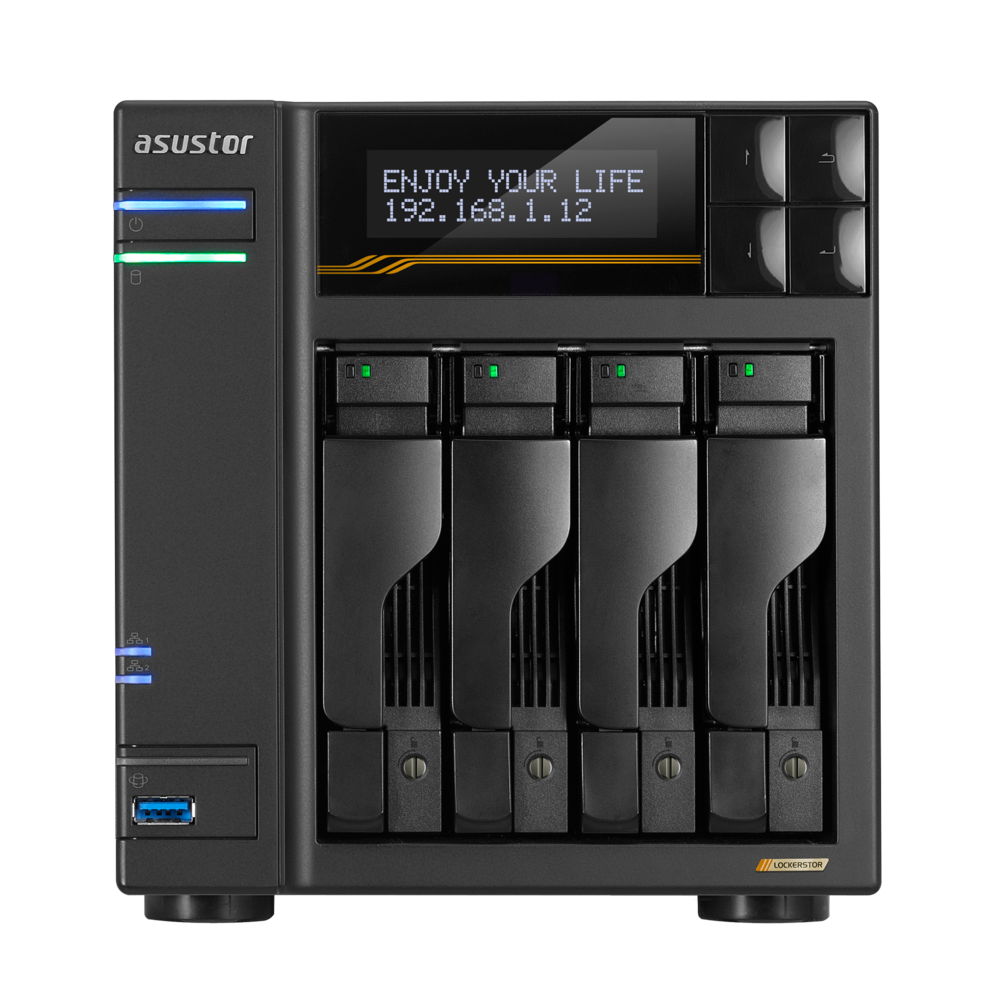
Explore this need in the finder →The ASUSTOR LOCKERSTOR 4 Gen3 (AS6804T) is a four-bay desktop NAS whose defining difference from a typical four-tray file server is its network and SSD provision: the chassis has two built-in 10-Gigabit Ethernet ports, two more 5-Gigabit ports, and four separate M.2 NVMe positions. The manufacturer lists a Ryzen Embedded V3C14 processor and 16 GB of ECC DDR5 memory. This assessment is based on the exact model documentation, not hands-on testing; link ratings are not measured file-transfer results, and the U.S. seller's precise part number or bundle remains unverified.
Four SATA bays, plus a separate M.2 layer
The product-ID-86 hardware table lists four internal SATA positions for 3.5-inch hard drives, 2.5-inch hard drives, or 2.5-inch SATA SSDs. It separately lists four M.2 2280 NVMe slots on PCIe 4.0 x1. The M.2 devices may be assigned to storage or caching in ASUSTOR's software, but they are not four extra SATA trays. Buyers counting native hard-drive bays should therefore treat this as a four-bay enclosure, not an eight-bay one. The manufacturer advertises 72 TB of maximum raw internal capacity as four 18-TB drives; that figure is a raw, component-dependent ceiling, not usable volume space or confirmation of a supported drive-and-firmware combination.
Memory and software headroom need a real workload
The documented configuration comes with one 16-GB ECC DDR5-4800 SO-DIMM and has two memory slots, with a listed maximum of 64 GB. ASUSTOR notes that ECC functionality is disabled if non-ECC memory is installed or mixed with ECC memory. The quick-install guide shows that memory replacement requires opening the chassis, powering down and disconnecting cables; check the exact module support list and warranty implications before planning an upgrade. The Ryzen V3C14 is a four-core processor listed at 2.3 GHz with boost up to 3.8 GHz. Those are specifications, not evidence that a particular number of virtual machines, containers, streams, or users will run at a promised speed. The datasheet lists virtualization and Docker applications, so buyers should separately check the current application and operating-system compatibility for their intended services.
Four built-in ports do not create one 30-Gbps connection
The exact hardware specification lists two individual 10-GbE ports and two individual 5-GbE ports. That gives this four-bay model a documented single-port ceiling of 10 Gbps without first adding a network card; the lower-rated ports may be useful for separate links, but neither their number nor aggregation makes one 30-Gbps Ethernet port. A 10-GbE link also needs a compatible client, switch or router, transceivers or copper ports, cabling, storage arrangement, and workload. Any one part can become the bottleneck, and actual throughput is not established by the port label. The quick-install guide documents an optional PCIe network-card installation path that involves removing the M.2 daughterboard before fitting the card and reinstalling it; that is a configuration to verify, not a reason to count a card as supplied or a built-in port.
Choose the storage layout before filling the trays
ASUSTOR lists Single, JBOD, RAID 0, RAID 1, RAID 5, RAID 6, RAID 10, and RAID 1 or RAID 5 with a spare drive among the volume types. One possible owner-created RAID 1 arrangement uses two buyer-selected SATA drives, occupies two of the four native bays, and leaves two bays unused. The same supported arrangement can use one of the built-in 10-GbE ports; those capabilities are not competing modes. ASUSTOR's RAID calculator states that one RAID 1 volume supports at most two drives. This mirror can help a volume remain available after a drive failure, but it does not protect against deletion, ransomware, theft, fire, or loss of the enclosure. A separate, recoverable backup is still needed. The installation guide also warns that initializing disks erases existing data, so do not migrate or initialize drives without a verified backup and model-specific instructions.
Check the package and compatibility at the exact listing
The manufacturer's package-contents page lists one AS6804T, a quick installation guide, one AC power cord, one AC power adapter, four Cat 6a 10-GbE network cables, and screws for 3.5- and 2.5-inch drives. It does not list data drives or a prepared storage volume. A reseller may change or supplement a package; no particular retail bundle, offer, stock, or price was checked. Before ordering, verify the exact model name and seller SKU, the drives and firmware against ASUSTOR's compatibility list, whether the included cables suit the intended 10-GbE path, and which warranty actually applies to the seller and region. The specification lists a 90-W power supply, a 185.5 × 170 × 230 mm (H × W × D) chassis, and a 3.2-kg unit weight; allow room for the connected cables and airflow rather than treating the bare-box dimensions as installation clearance.
Who should shortlist it?
This is a plausible reference for a small office or technically prepared home that can use a 10-GbE NAS link, wants four conventional SATA positions, and values a separate NVMe layer and ECC-capable memory. Its key advantage over the four-bay ASUSTOR LOCKERSTOR 4 Gen2+ (AS6704T v2) is not an extra SATA tray: both are four-bay machines. The Gen3 specification instead adds built-in 10-GbE alongside 5-GbE, moves to the V3C14 and ECC DDR5, and lists PCIe 4.0 M.2 positions; the earlier v2's faster-than-5-GbE route is an optional card with a daughterboard tradeoff. For a simple 1-GbE backup target, much of the Gen3's network capability may go unused, so map the whole network path before paying for the feature set. ASUSTOR's support-status table lists AS6804T as generally available and supported with a three-year warranty entry; this is not proof of retailer stock or a particular U.S. seller warranty.
Key specifications
Key details at a glance
| Internal drive bays | 4 bays |
|---|---|
| Documented internal drive media | 3.5-inch SATA HDD / 2.5-inch SATA HDD / 2.5-inch SATA SSD |
| Built-in Ethernet ports | 2 x built-in 10-Gigabit Ethernet (10G/2.5G/1G/100M each) / 2 x built-in 5-Gigabit Ethernet (5G/2.5G/1G/100M each) |
| Fastest individual Ethernet port | 10 Gbps |
| Installed system memory | 16 GB |
| Maximum listed memory | 64 GB |
| Listed storage arrangements | Single / JBOD / RAID 0 / RAID 1 / RAID 5 / RAID 6 / RAID 10 / RAID 1 + spare drive / RAID 5 + spare drive |
| Dimensions (H × W × D) | 185.5 x 170 x 230 mm (H x W x D) |
| Weight | 3.2 kg |
| Hardware warranty | 3 years |
| Data drives included in listed package | No |
| M.2 NVMe slots | 4 |
| M.2 SSD storage-pool support | Yes |
| Processor | AMD Ryzen Embedded V3C14 |
| CPU cores | 4 |
| Installed memory type | 16 GB ECC DDR5-4800 SO-DIMM, one 16-GB module pre-installed |
Use the exact model’s instructions for operating limits, supplied equipment and version differences.
Sources for this review
Sources for this assessment
- ASUSTOR Home/SOHO directory observation for LOCKERSTOR 4 Gen3 (AS6804T)
- ASUSTOR LOCKERSTOR 4 Gen3 (AS6804T), product ID 86
- ASUSTOR AS6804T exact hardware and software specification, product ID 86
- ASUSTOR AS6804T package contents, product ID 86
- ASUSTOR AS6804T manufacturer datasheet page, product ID 86
- ASUSTOR LOCKERSTOR 4 Gen3 (AS6804T) English datasheet
- ASUSTOR AS68XXT English Quick Installation Guide, applicable model list and hardware installation instructions
- ASUSTOR product support-status table, AS6804T row
- ASUSTOR RAID calculator and model-specific RAID 1 drive limit
- ASUSTOR drive-compatibility selector and drive guidance
- Official ASUSTOR AS6804T product-page image

Check your setup before choosing a NAS
Use the finder to check bay count, the network link you need, and whether a documented two-drive redundant arrangement is essential.