
Your needs, this model
Does it fit your priorities?
How many native internal SATA drive bays does the AS6508T have, and do the M.2 slots count?
ASUSTOR documents eight native SATA positions for 3.5-inch HDDs, 2.5-inch HDDs or 2.5-inch SATA SSDs. Its two M.2 SSD positions are separate, so this model meets an eight-bay minimum but not a nine-bay minimum. The listed 144-TB figure is raw arithmetic for eight 18-TB drives, not usable capacity or storage in the box.
Explore this need in the finder →What is the fastest individual built-in Ethernet port on the AS6508T?
The hardware page lists two individual 10-GbE ports and two individual 2.5-GbE ports. One built-in port meets a 10-Gbps floor but not 10.5 Gbps. The port ratings are not one combined link or promised file-transfer speed; the rest of the network and storage path still matters.
Explore this need in the finder →Can the current-reference AS6508T meet an eight-bay, 10-GbE and two-drive-redundancy screen together?
Yes, as one possible owner-created arrangement: eight SATA trays are native, a listed RAID 1 volume can use two buyer-supplied compatible drives, and one built-in 10-GbE port is available in the same enclosure. The pair leaves six SATA bays open and the two M.2 slots remain separate. The listed package has no data drives or initialized array; check exact drive firmware and the whole network path, and keep another backup because a mirror is not one.
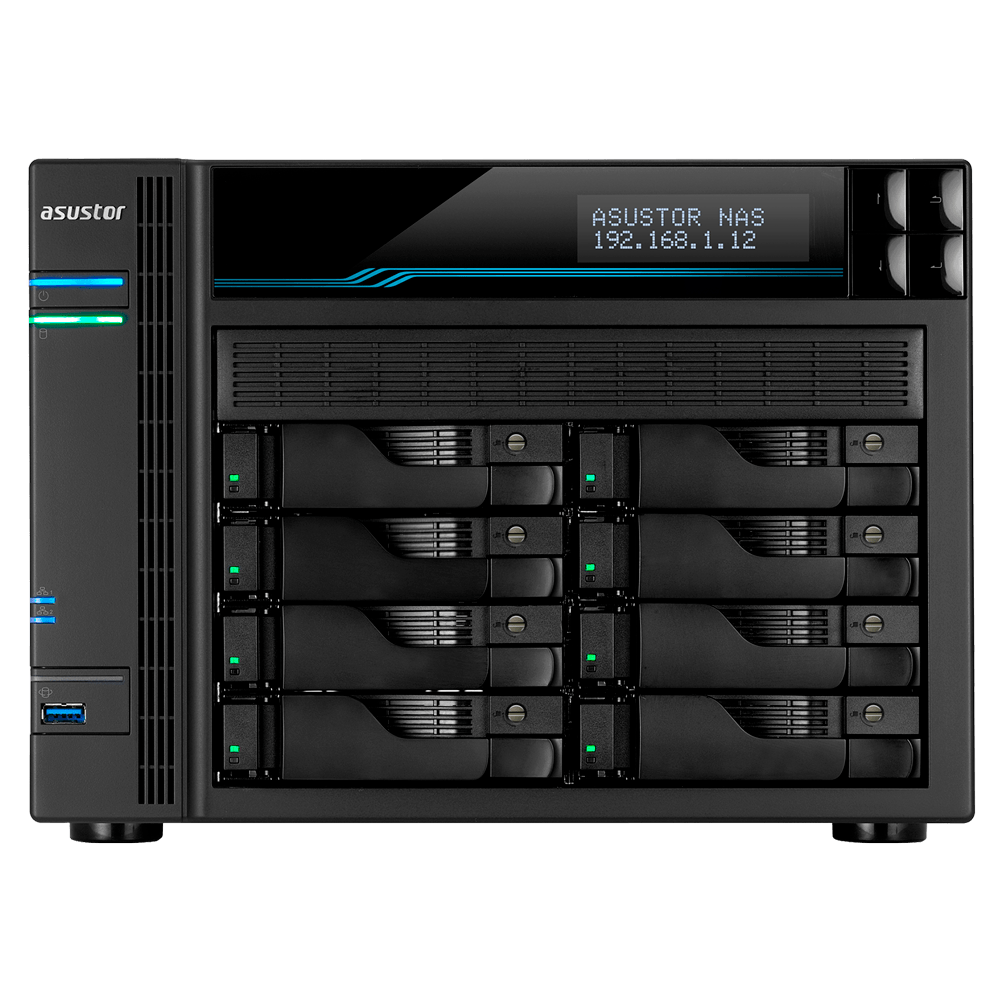
Explore this need in the finder →The ASUSTOR LOCKERSTOR 8 (AS6508T) is an eight-bay desktop NAS with two separate M.2 SSD positions, two built-in 10-GbE ports and two 2.5-GbE ports. Its appeal is a large native SATA footprint paired with a fast individual network link, not a promise of a particular file-copy rate. This is a source-based assessment of the documented model, not a hands-on review, benchmark or endorsement of an unverified seller listing. ASUSTOR lists it as Generally Available and Supported, not proof of U.S. stock or any seller package.
Eight native trays; two separate M.2 positions
The manufacturer hardware table lists eight 3.5-inch SATA HDD, 2.5-inch SATA HDD or 2.5-inch SATA SSD bays. It separately lists two M.2 drive slots. The product page describes M.2 SSD caching, and its software specification also lists an M.2 volume with RAID 1 support for expansion by complete drive replacement. These two positions do not make this a ten-bay NAS. The hardware page lists PCIe 3.0 x2 and M.2 2280 NVMe, 2280 SATA, 2260 SATA and 2242 SATA formats. The shared AS65XXT quick-install guide says to avoid mixing PCIe NVMe and SATA AHCI modules in those slots because the NAS will not boot with both types installed. Verify the exact SSD model in ASUSTOR's compatibility data before buying.
ASUSTOR's 144-TB figure is raw arithmetic for eight 18-TB disks and the maker notes that capacity varies by RAID type. It is not usable capacity, an approval for a specific drive and firmware combination, or storage included with the NAS. The separate 16-bay figure depends on an external expansion unit; an accessory does not change the AS6508T's eight native SATA trays. If expansion is hypothetical, an eight-bay tower may be more chassis and disks than a small library needs.
10-GbE is real hardware, not an end-to-end speed claim
There are two individual 10-Gigabit Ethernet ports and two individual 2.5-Gigabit ports. For a finder minimum applied to one built-in port, the AS6508T clears 10 Gbps but not 10.5 Gbps. Those four ratings cannot be added into one 25-Gbps port. ASUSTOR documents link-aggregation and failover modes, but they depend on a compatible switch, client, cabling and network configuration; the feature list does not promise a combined throughput number. Client disk speed, installed NAS disks, RAID layout and workload are further constraints. Trace the complete path before paying for 10GbE switching and cabling, and do not infer that a fast NIC alone will accelerate every workload.
A possible two-drive mirror leaves six bays free
ASUSTOR lists RAID 1, and its calculator includes the AS6508T while stating that one RAID 1 volume supports at most two drives. A possible owner-created plan can put two compatible SATA drives in a mirror across two of the eight native bays, leaving six SATA positions empty; one built-in 10-GbE port remains available in that same configuration. The M.2 slots are a separate SSD layer rather than members of that SATA mirror. The official package list includes the enclosure, guide, power cord, two regular RJ-45 cables, two 10-GbE Cat 6a cables, 32 screws for each of the listed 3.5-inch and 2.5-inch drive formats and two M.2 thumbscrews. It lists no data drives, initialized volume or prepared RAID array. Confirm the seller's exact contents and the exact drive-model/firmware row with ASUSTOR before building a volume.
RAID 1 can help keep some service available after one member drive fails, but it is not an independent backup. Deletion, malware, theft, a failed enclosure or a wider electrical event can still take the data out of reach. Keep another copy on a separate destination and test restoring it. Do not treat the maker's raw capacity example or a mirror's redundancy as a backup plan.
Platform and ownership checks
The specification lists a quad-core Intel Atom C3538 at 2.1 GHz, 8 GB of DDR4 memory in one installed SO-DIMM, two memory slots and a 64-GB maximum. Those are component descriptions, not evidence of a particular virtualization or multi-user performance level. The tower measures 215.5 by 293 by 230 mm (height, width, depth), weighs 6.2 kg, and uses a 250-W internal supply. ASUSTOR publishes 66.9 W in operation and 37.2 W in disk hibernation; these are manufacturer figures, not measurements from this site, and installed drives and workload will affect actual draw. Allow extra room for airflow, power and network cable bends, and access to the eight removable trays.
The AS6508T is a different generation from the current LOCKERSTOR 8 Gen3 (AS6808T), despite sharing the eight-bay LOCKERSTOR 8 name. The newer Gen3 has four M.2 NVMe slots, 16 GB ECC DDR5 and a pair of 5-GbE ports alongside its two 10-GbE ports; the AS6508T has two M.2 positions, 8 GB DDR4 and a pair of 2.5-GbE ports. Both list eight native SATA bays and individual 10-GbE connectivity, so the older profile is worth comparing only when its lower memory and second-pair network tier fit the intended job. ASUSTOR separately lists a ten-bay LOCKERSTOR 10 (AS6510T); do not confuse that model with this eight-bay enclosure.
Who should consider it?
Consider the AS6508T if you have a concrete plan for several SATA drives, can use its one-port 10-GbE capability and are comfortable checking a supported disk and firmware combination yourself. A two-drive RAID 1 starting layout leaves room for six more SATA drives, but neither the drives nor an initialized volume are in the maker's listed package. Compare a smaller NAS if eight bays are surplus, and compare the newer AS6808T if four M.2 positions, 5-GbE links or its ECC-memory configuration matter more than the older model's specific profile. Before ordering, confirm the listing says AS6508T, inspect the written seller bill of materials, verify disk/firmware support, size the network path and plan an independent backup. A support-status entry and an indexed listing do not replace those checks.
Key specifications
Key details at a glance
| Internal drive bays | 8 bays |
|---|---|
| Documented internal drive media | 3.5-inch SATA HDD / 2.5-inch SATA HDD / 2.5-inch SATA SSD |
| Built-in Ethernet ports | 2 x built-in individual 10-Gigabit Ethernet (10G/1G) / 2 x built-in individual 2.5-Gigabit Ethernet (2.5G/1G/100M) |
| Fastest individual Ethernet port | 10 Gbps |
| Installed system memory | 8 GB |
| Maximum listed memory | 64 GB |
| Listed storage arrangements | Single / JBOD / RAID 0 / RAID 1 / RAID 5 / RAID 6 / RAID 10 |
| USB 3.2 Gen 1 ports | 2 |
| Dimensions (H × W × D) | 215.5 x 293 x 230 mm (H x W x D) |
| Weight | 6.2 kg |
| Hardware warranty | 3 years |
| Data drives included in listed package | No |
| M.2 NVMe slots | 2 |
| M.2 SSD storage-pool support | Yes |
| Processor | Intel Atom C3538 |
| CPU cores | 4 |
| Installed memory type | 8 GB SO-DIMM DDR4, one 8-GB module pre-installed |
Use the exact model’s instructions for operating limits, supplied equipment and version differences.
Sources for this review
Sources for this assessment
- ASUSTOR product-list entry distinguishing LOCKERSTOR 8 (AS6508T) from LOCKERSTOR 10 (AS6510T)
- ASUSTOR LOCKERSTOR 8 (AS6508T), manufacturer product ID 63
- ASUSTOR AS6508T exact hardware and software specification, product ID 63
- ASUSTOR AS6508T manufacturer package contents, product ID 63
- ASUSTOR AS6508T product datasheet page, product ID 63; linked PDF retrieval returned HTTP 400
- ASUSTOR AS65XXT English Quick Installation Guide, applicable to AS6508T and AS6510T
- ASUSTOR product support-status table, AS6508T row
- ASUSTOR RAID calculator, including AS6508T and RAID 1 two-drive limit
- ASUSTOR NAS drive compatibility table and drive guidance
- Official ASUSTOR AS6508T product-page image, exact-model image path
- Preserved ASUSTOR Home/SOHO category observation for LOCKERSTOR 8 (AS6508T)

Check your setup before choosing a NAS
Use the finder to check bay count, the network link you need, and whether a documented two-drive redundant arrangement is essential.