
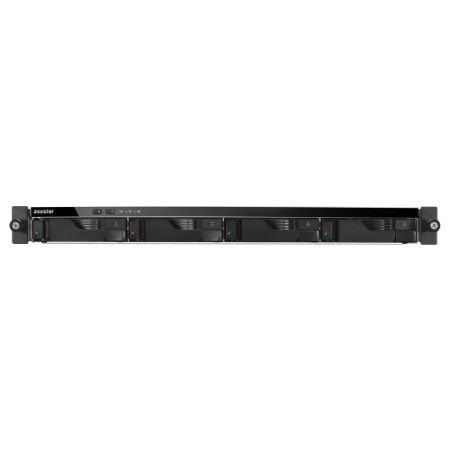
Your needs, this model
Does it fit your priorities?
How many native bays and which drive types does the AS6504RD document?
ASUSTOR lists four internal SATA positions for the exact AS6504RD and names 3.5-inch SATA HDDs, 2.5-inch SATA HDDs and 2.5-inch SATA SSDs as supported media classes. This assessment did not verify an exact model/capacity/firmware tuple, and the package list contains no data drives.
Explore this need in the finder →Can the four-bay AS6504RD mirror two drives while retaining dual-supply hardware?
The shared product selector lists RAID 1 for this four-bay model family, and the manufacturer calculator requires two drives. A buyer-created compatible pair would use two AS6504RD SATA bays and leave two open. The RD has two 250-W supplies, but that power redundancy is separate from RAID; no drives or initialized array are in the package, and RAID 1 is not a backup.
Explore this need in the finder →Does the AS6504RD have a single built-in 10GbE port?
No. ASUSTOR lists two individual 2.5GbE ports and two 1GbE ports, so the fastest built-in single-port rate is 2.5GbE. The separately listed AS-T10G2 is an optional card; two 2.5GbE ports do not combine into one 5GbE connector or a guaranteed transfer rate.
Explore this need in the finder →The LOCKERSTOR 4RD is a four-bay 1U rack NAS distinguished by its dual-power-supply configuration. ASUSTOR lists two 250-watt supplies for AS6504RD, while the separately named AS6504RS has one. They share product ID 74 and much of the hardware table, but are not interchangeable identities. This assessment is based on manufacturer documentation, not hands-on ownership, bench testing or independent performance measurement.
Four native SATA positions in a 1U chassis
The product-ID-74 selector lists four hot-swappable bays for 3.5-inch SATA hard drives, 2.5-inch SATA hard drives or 2.5-inch SATA SSDs. The 72-TB “maximum internal raw capacity” is the manufacturer's four-by-18-TB arithmetic, with a note that capacity changes with RAID type. It is not usable space, an approved-drive promise or data included in the box. ASUSTOR's compatibility link should be checked against each intended model, capacity and firmware; this review did not establish a specific drive tuple.
ASUSTOR also lists up to 20 bays with an expansion unit, but that is a separate system. It does not give the four-bay NAS sixteen additional internal trays. A four-bay owner can build a modest mirror and keep two bays open, but buyers who need a larger native-drive pool should compare actual chassis bay counts rather than rely on an expansion ceiling.
The RD's dual supplies are the point—and a real distinction
The current specification table assigns the AS6504RD two 250-W power supplies and marks redundant power supply support. The AS6504RS counterpart is explicitly one 250-W unit. The QIG's rear-panel illustrations show separate model layouts, its package table gives the RD two AC cords, and it contains a procedure for replacing a malfunctioning power supply. The spec page lists the AS6504RD at 9.3 kg (20.46 lb), versus 7.85 kg for the 4RS, while dimensions remain 44 × 439 × 515 mm (H × W × D). Those differences make the suffix relevant to both resilience and rack planning.
Dual PSUs reduce dependence on a single module only when the facility's feeds are genuinely independent. Two cords plugged into one failed PDU, branch circuit or UPS do not create separate upstream power. The QIG shows a replacement procedure; follow the current manual and site procedure rather than assume live replacement.
ASUSTOR lists 65 W in operation and 42.4 W during disk hibernation for the RD, compared with lower entries for the RS. Treat these as manufacturer figures for their stated modes, not my measurements or a prediction of a particular drive mix. Actual draw depends on disks and use; the listed numbers alone do not establish an annual bill.
RAID and power redundancy solve different problems
ASUSTOR's software table lists RAID 1, and its calculator describes a two-drive minimum. A possible owner-created plan uses two compatible SATA drives in a mirror, leaving two of the four native bays open. The package list includes no data drives or configured volume, so the buyer would select compatible members and create the array. A mirror can keep a volume available through one member-drive failure, but it is not an independent backup: deletion, malware, theft, fire and damage to the chassis can affect both copies. Preserve a separate backup target and practice restoring it.
Do not treat the two reliability features as substitutes. A RAID 1 pair handles one class of storage failure; dual supplies address a different power-module failure. Neither protects an installation whose electrical feeds share a single upstream point, and neither replaces a tested backup.
Network ports are individual links, not one combined connector
The hardware selector lists two 2.5-Gigabit Ethernet ports and two Gigabit ports. For a requirement framed as the speed of one built-in port, the RD tops out at 2.5GbE. ASUSTOR family material discusses combining the two faster interfaces through link aggregation, but that does not turn them into one 5-Gbps jack or predict a single-client file-transfer rate. A switch, client adapter, cabling, protocol, storage arrangement and workload all affect the usable path.
The model has one PCIe 3.0 x8-size slot with an x4 electrical link. ASUSTOR's accessory list names an optional network adapter as applicable to the AS6504RD. That is an add-on, not built-in 10GbE or part of the base package; confirm the exact card and slot arrangement before buying. A buyer who needs a factory-provided individual 10GbE port should not count an optional adapter as already installed.
Check the rack and the exact package before ordering
At 44 mm tall, 439 mm wide and 515 mm deep, this 1U chassis needs a compatible rack, enough rail and rear-cable depth, airflow and room for service. The QIG includes rail-kit installation guidance, while ASUSTOR lists a rail accessory separately; rack rails are not named in the hardware package contents. Measure the actual cabinet and verify the seller's package instead of assuming the NAS includes rails.
The manufacturer package page lists one AS6504RS/RD unit, two RJ-45 cables, screws and two AC cords for the AS6504RD; it does not list data drives. Its status table marks the shared 4RS/4RD family Generally Available with software and technical support supported and a three-year entry. That is a manufacturer reference, not a guarantee of a U.S. seller's stock, warranty channel or box contents. No exact U.S. retail suffix, live offer, price or seller-added bundle was verified here.
Who should consider this configuration?
The AS6504RD is a sensible shortlist candidate when four internal SATA bays and 1U rack mounting are enough and two power supplies are an explicit requirement. It is less suitable if you need many native bays, a compact desktop unit, drives and rails in the box, or built-in single-port 10GbE. Its Intel Atom C3538 is a listed quad-core 2.1-GHz processor; its 8 GB DDR4 module, four memory slots and listed 128-GB ceiling are specifications, not evidence of application speed. Check the actual package, power path, drive compatibility, rails and planned network equipment before committing.
Key specifications
Key details at a glance
| Internal drive bays | 4 bays |
|---|---|
| Documented internal drive media | 3.5-inch SATA HDD / 2.5-inch SATA HDD / 2.5-inch SATA SSD |
| Built-in Ethernet ports | 2 x built-in individual 2.5-Gigabit Ethernet (2.5G/1G/100M) / 2 x built-in individual Gigabit Ethernet (1G/100M) |
| Fastest individual Ethernet port | 2.5 Gbps |
| Installed system memory | 8 GB |
| Maximum listed memory | 128 GB |
| Listed storage arrangements | Single / JBOD / RAID 0 / RAID 1 / RAID 5 / RAID 6 / RAID 10 |
| USB 3.2 Gen 1 ports | 4 |
| Dimensions (H × W × D) | 44 x 439 x 515 mm (H x W x D) |
| Weight | 9.3 kg |
| Hardware warranty | 3 years |
| Data drives included in listed package | No |
| Processor | Intel Atom C3538 |
| CPU cores | 4 |
| Installed memory type | 8 GB SO-DIMM DDR4, one 8-GB module pre-installed |
Use the exact model’s instructions for operating limits, supplied equipment and version differences.
Sources for this review
Sources for this assessment
- Preserved ASUSTOR Home/SOHO catalogue observation for LOCKERSTOR 4RD (AS6504RD)
- ASUSTOR LOCKERSTOR 4RS (AS6504RS) / LOCKERSTOR 4RD (AS6504RD), manufacturer product ID 74
- ASUSTOR product ID 74 specifications with separate AS6504RD supply, power, weight and package fields
- ASUSTOR product ID 74 package contents; AS6504RD receives two AC cords
- ASUSTOR AS65XXR English Quick Installation Guide, explicitly applicable to AS6504RD
- ASUSTOR product support-status table, shared AS6504RS/RD row
- ASUSTOR RAID calculator and model selector support for a two-drive RAID 1 plan
- ASUSTOR NAS drive compatibility guidance; no exact drive tuple verified for this review
- ASUSTOR AS-Rail accessory page for 1U/2U/3U rack systems
- ASUSTOR network adapter listing includes AS6504RD as an applicable model
Check your setup before choosing a NAS
Use the finder to check bay count, the network link you need, and whether a documented two-drive redundant arrangement is essential.