
Your needs, this model
Does it fit your priorities?
Can the AS3302T v2 make a two-drive mirror?
Yes, as an owner-created arrangement: ASUSTOR lists two native SATA bays and RAID 1 for this exact model, and its calculator limits a single RAID 1 volume to two drives. Select two compatible disks, back up before initialization because the guide warns that setup erases existing disk data, and keep another backup separate from the mirror.
Explore this need in the finder →Does one 2.5GbE port guarantee 2.5-Gbps file transfers?
No. The specification lists one 2.5G/1G/100M Ethernet port. The switch or router, client adapter, cable, storage, protocol and workload all affect transfers; the port rating is not a tested file-copy result.
Explore this need in the finder →What disk formats can fit in its two internal bays?
ASUSTOR lists 3.5-inch SATA hard drives and 2.5-inch SATA hard drives or SSDs. Check each complete model and firmware against the current AS3302T v2 compatibility list; no specific drive approval was established for this assessment.
Explore this need in the finder →What does AS3302T v2 mean compared with the original AS3302T?
The exact AS3302T v2 specification lists a Realtek RTD1619B quad-core at 1.7 GHz; the original AS3302T page lists an RTD1296 quad-core at 1.4 GHz. This separates the named hardware profiles but does not establish a tested performance gain.
Explore this need in the finder →Are Btrfs snapshots an independent backup?
No. ASUSTOR lists Btrfs and Btrfs snapshots for this model. Snapshots can assist with some on-device rollback, but they do not create an off-device recovery copy; plan a separate backup and test that it can be restored.
Explore this need in the finder →A compact two-bay profile, not the four-bay sibling
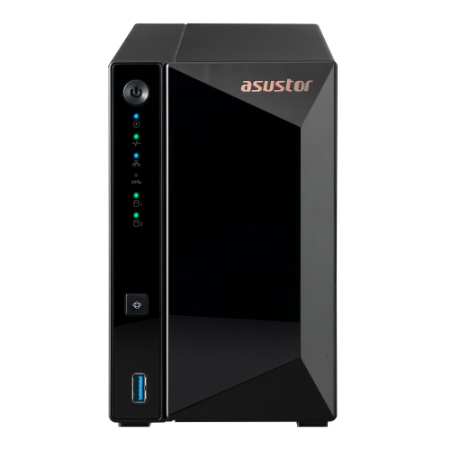
The DRIVESTOR 2 Pro Gen2 (AS3302T v2) is a desktop NAS with two native SATA drive positions. ASUSTOR lists support for 3.5-inch SATA hard drives and 2.5-inch SATA hard drives or SSDs. Its hardware page specifies a Realtek RTD1619B ARM64 quad-core processor at 1.7 GHz and 2 GB of DDR4 memory that cannot be expanded. The related DRIVESTOR 4 Pro Gen2 (AS3304T v2) is a different, four-bay model; do not let the shared family name blur the drive-position count.
The suffix matters in another direction too: ASUSTOR's page for the older DRIVESTOR 2 Pro (AS3302T, without “v2”) lists the RTD1296 at 1.4 GHz, while this v2 page lists the RTD1619B at 1.7 GHz. Those are sourced configuration differences, not a performance test or proof of an application-level speed gain. ASUSTOR currently labels the exact v2 model Generally Available and supported, but that manufacturer status does not confirm a U.S. retailer's stock, seller-specific warranty or exact package.
Two bays can make a mirror, but you supply and verify the drives
ASUSTOR lists Single, JBOD, RAID 0 and RAID 1 as storage choices for this model. Its RAID calculator includes the AS3302T v2 and limits a single RAID 1 volume to two drives, so a buyer can plan a two-disk mirror that uses both native bays. The array is not preinstalled: the standard manufacturer package list names the NAS, power items, a Cat 5e network cable, eight screws for 2.5-inch HDDs and the quick guide, but it does not list data drives. A seller may configure a different bundle, so check the exact item before assuming drives are included.
Before ordering disks, compare each complete drive model and firmware with ASUSTOR's current AS3302T v2 compatibility listing. The setup guide says to install at least one 2.5- or 3.5-inch SATA disk and warns that initialization erases data, so back up disks before building the system. Do not treat the listed 36 TB raw example (two 18 TB drives) as usable RAID 1 space or as confirmation that a particular drive and firmware combination is approved. Two-drive RAID 1 mirrors rather than adds the members' capacity, and a mirror does not protect against deletion, malware or loss of the whole device. Keep a separate, recoverable backup.
One 2.5GbE port is a network-path requirement, not a speed promise
The specification lists one built-in Ethernet port rated for 2.5G, 1G or 100M connections. That clears a 2.5-Gbps individual-port requirement on paper; it is not two ports that can be added together, and the number is a link rating rather than a measured file-copy speed. A client adapter, switch or router, cabling, protocol, drives and workload all affect the end-to-end path. If the rest of the home network is Gigabit, the NAS's faster port alone will not make that path a 2.5-Gbps link.
Three USB 3.2 Gen 1 ports provide wired expansion or external-device connections, but they do not add internal drive bays. ASUSTOR advertises up to fourteen total bays when an expansion unit is attached; that is an external configuration, not fourteen positions inside this chassis and not proof an expansion unit is included. There is no multimedia output listed. The product page promotes 4K video transcoding, but that phrase is not an independently tested result or a promise for a particular media app, codec or client. Verify the current software and playback path if transcoding is central to the purchase.
Snapshots and ordinary backup jobs still need a recovery plan
The model-specific software specification lists internal EXT4 and Btrfs support and Btrfs snapshots. Snapshots can offer a way to roll back some changes on the storage system; they are not an off-device copy and should not be the only recovery plan. The network features and snapshot tools make the model worth considering for a home file-sharing or backup routine when the buyer accepts a two-bay ceiling and is willing to administer the chosen layout. The fixed 2 GB memory and lack of internal growth are important constraints for someone expecting to add memory, bays or several workloads later.
The manufacturer lists 13.1 W for operation, 4.5 W during disk hibernation and 18.6 dB(A) with the HDD idle, along with a 170 × 114 × 230 mm chassis. These are published reference figures with limited test-condition detail, not measurements made for this assessment. Likewise, the manufacturer page's capacity and media claims do not replace checking a specific drive, an exact seller package, the network path and the current installation instructions.
Who should keep it on the shortlist?
Consider the AS3302T v2 if two native SATA positions, one multigigabit Ethernet port and an owner-created two-drive RAID 1 option fit the actual task. It is less compelling when the requirement is four internal bays, expandable memory, a faster-than-2.5-Gbps single port or a documented, already populated drive package. The current-reference label is not evidence that a particular retailer has it. Before choosing an offer, confirm the exact “AS3302T v2” identity rather than the similarly named older AS3302T, verify drive compatibility and seller additions, and budget for a separate backup. This is a source-based assessment; no hands-on use, network benchmark, software test or power/noise measurement is claimed.
Key specifications
Key details at a glance
| Internal drive bays | 2 bays |
|---|---|
| Documented internal drive media | 3.5-inch SATA HDD / 2.5-inch SATA HDD / 2.5-inch SATA SSD |
| Built-in Ethernet ports | 1 x built-in 2.5-Gigabit Ethernet (2.5G/1G/100M) |
| Fastest individual Ethernet port | 2.5 Gbps |
| Installed system memory | 2 GB |
| Maximum listed memory | 2 GB |
| Listed storage arrangements | Single / JBOD / RAID 0 / RAID 1 |
| Internal file systems | EXT4 / Btrfs |
| USB 3.2 Gen 1 ports | 3 |
| Dimensions (H × W × D) | 170 x 114 x 230 mm (H x W x D) |
| Weight | 1.6 kg |
| Manufacturer's idle noise figure | 18.6 dB(A) |
| Hardware warranty | 3 years |
| Data drives included in listed package | No |
| Maximum total drive bays with listed expansion | 14 bays |
| Expansion-unit note | ASUSTOR lists up to fourteen total bays with an expansion unit. This is an external configuration, not fourteen native chassis bays or evidence an expansion unit is included. |
| Processor | Realtek RTD1619B |
| CPU cores | 4 |
| Installed memory type | 2 GB DDR4; ASUSTOR lists it as not expandable. |
Use the exact model’s instructions for operating limits, supplied equipment and version differences.
Sources for this review
Sources for this assessment
- ASUSTOR DRIVESTOR 2 Pro Gen2 (AS3302T v2) product page
- ASUSTOR AS3302T v2 hardware and software specification
- ASUSTOR AS3302T v2 software and datasheet page
- ASUSTOR AS3302T v2 package contents
- ASUSTOR AS3302T v2 / AS3304T v2 quick installation guide, English
- ASUSTOR product support status
- ASUSTOR NAS RAID calculator
- ASUSTOR NAS drive compatibility lookup
- ASUSTOR DRIVESTOR 2 Pro (AS3302T) original model specification, comparison only
- ASUSTOR AS3302T v2 exact product-page front image
- ASUSTOR Home/SOHO category observation retained from the ledger

Check your setup before choosing a NAS
Use the finder to check bay count, the network link you need, and whether a documented two-drive redundant arrangement is essential.